
‘Port reform is a priority for competing with Northern Europe’
Biffi: “Airports need clear rules, fixed timelines and a steady flow of investment.” Zanetti: “The hubs in the Southern Mediterranean benefit from the ETS”

Port reform and intermodal transport linking sea, road and rail are central concerns for industry in Lombardy and, more broadly, for Italian industry as a whole, at a time when geopolitical developments have made the importance of logistics (including for energy supplies) clearer than ever. And at a time when Italy faces the prospect of major (positive) changes, with the completion – scheduled within four years – of the Third Railway Corridor and the imminent completion of modernisation works on the national rail network, largely linked to the tight deadlines of the National Recovery and Resilience Plan (PNRR). Compounding all this, however, is the burden of the EU’s ETS taxation on the maritime sector, which, as industrialists and operators in the sector unanimously maintain, must be amended.
These issues were the focus of the conference ‘The Sea that Drives Industry’, organised in Milan by the Ministry of Maritime Affairs in collaboration with Confindustria and Assolombarda, and moderated by Fabio Tamburini, editor-in-chief of *Il Sole 24 Ore*.
“We are closely monitoring,” said Alvise Biffi, president of Assolombarda, “the draft bill on the reform of the national port system, which is currently under discussion in the Chamber of Deputies. As part of the Confindustria network, we are contributing to the debate with a position paper designed to foster constructive dialogue with the Government, in the belief that clear rules, fixed timelines, defined responsibilities and continuity of investment are essential. The sea is not merely a geographical and industrial infrastructure; this is demonstrated by the 510 million tonnes of goods to be handled by Italian ports in 2025.” Its connectivity, he continued, “must be supported by adequate land-based infrastructure: I am thinking of the Terzo Valico and, more generally, the trans-European transport networks.”
Mario Zanetti, Confindustria’s delegate for the maritime economy, echoed this view, stating that “is an industrial policy priority to compete with the hubs of Northern Europe and the southern shore of the Mediterranean, which currently benefits from its exclusion from the ETS; the ETS must be reformed to avoid putting European ports at a disadvantage and diverting resources away from businesses that could be used for investment. Indeed, it is becoming increasingly clear that ETS funds must remain within the sectors that generated them, to ensure that the transition becomes an opportunity’.
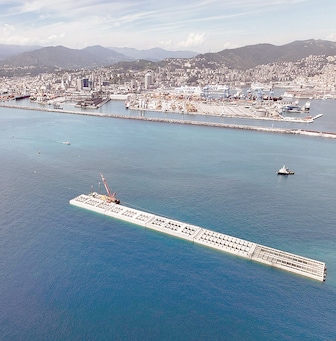
Speaking about the reform, Matteo Paroli, president of the Port Authority of Genoa and Savona, pointed out that it aims to “create, through the company Porti d’Italia, a steering committee – a national coordination centre – to determine the specialisations required by individual ports. ‘The 16 Italian port system authorities are not too many,’ he clarified, ‘if these specialisations are established. The Ligurian ports have already established collaborative relationships: the dredged material from La Spezia will be used to fill the central caissons of Genoa’s new breakwater, which is currently under construction.’


