
Portovesme, a 400 million plan to mine lithium
Glencore's circular economy project in Sardinia. Nickel, copper, water, manganese and cobalt will also be extracted

3' min read
3' min read
From lead to bismuth, and lithium on the horizon. The new course of the Glencore group in Sardinia, through its subsidiary Portovesme srl, is travelling under the banner of the circular economy and looking at critical materials. And to the circular economy. There are two tracks on which this journey is taking place: on the one hand there is the San Gavino smelter and on the other the Portovesme plant.
"In the San Gavino smelter, which, by the way, has restarted at full capacity since October 2024, activity has begun for the second test on the production of pure Bismuth (from lead refining),' says Portovesme srl managing director Davide Garofalo. 'Not least because the results of past experiments (with levels first at 40 and then at 85 per cent) have given more than satisfactory results. We have installed a small-scale plant that will be used for experimentation". The aim is to valorise a product obtained from lead refining, which has, albeit in a niche market, an important value with uses ranging from medicine to aerospace. The other track concerns the Portovesme pole where the zinc line was stopped in December due to high energy costs.
'The energy node for zinc production is one of the dominant factors, excluding the material at historical pre-Covid prices it counted for 32 per cent of operating costs,' Garofalo argues. 'With current energy prices we have risen to 65 per cent of costs. This is a huge impact on costs and something that we are unable to pass on to end customers due to the global nature of the zinc market'. Not only that: 'We then have the handicap of insularity and cannot use compensatory tools such as the virtual interconnector or super interruptibility,' he adds. 'Companies operating in the peninsula can access the virtual interconnector, which gives them the possibility of purchasing part of their energy needs in Germany at a cost reduced by 40 per cent compared to Italian prices. Here, the price hike has led to an extra expenditure of EUR 60 million in 2022. In normal situations, compared to other parts of Italy, we spend, for the same amount of energy consumed, about 15 to 20 million euros more. Since we have no gas, we are forced to use other fuels with a higher price.
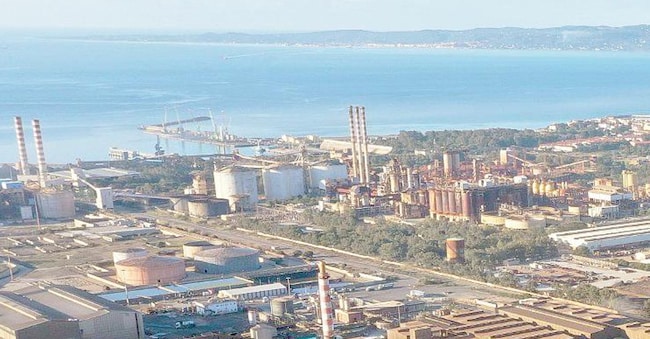
The opportunity for Portovesme, where in any case 'the zinc line has not been stopped in order to relocate', comes from lithium, and the project, which is worth around 400 million euro and does not have to deal with energy costs. The project involves extracting lithium, nickel, copper, water, manganese and cobalt from the black mass (obtained by shredding and processing spent batteries). The company is currently preparing the project update (already submitted to the European Commission) to start the authorisation process.
The feasibility study, if approved, should be concluded by 2027 and eventually kick off the implementation phase. As for the target market, 'it will be the automotive market, which in Europe is currently the prerogative of China, which supplies the batteries and receives back the black mass. "The project, once fully operational,' Garofalo concludes, 'would be able to process between 50 and 70 thousand tonnes of black mass per year. With the plant at full capacity, production envisages refining strategic critical metals for electric vehicle batteries equivalent to about 600 thousand vehicles per year. If we think that Italy registered about 60 thousand electric vehicles in 2024, the plant will be able to play an important role in guaranteeing European needs'.

