
Positive signals for Lombard manufacturing
Economic growth in production, turnover and employment in the first quarter of the year

5' min read
5' min read
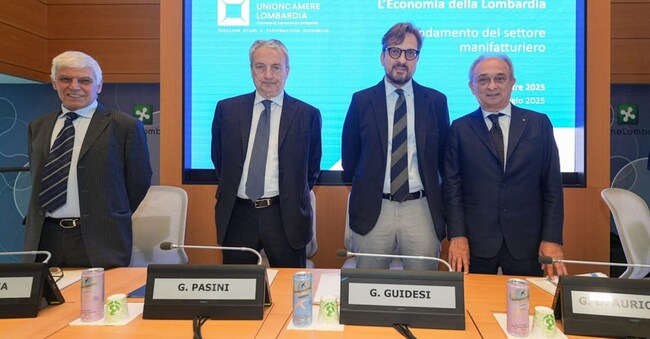
(Il Sole 24 Ore Radiocor) - Positive signs for Lombard manufacturing in the first three months of 2025. In a difficult international context, characterised by great geopolitical uncertainties, industrial production in Lombardy grew in the first quarter of the year compared to the previous quarter (+0.4%). There was also an increase in turnover (+0.1%) and a rise in employment (+0.5%), as well as a positive trend in orders from abroad (+0.4%) against a slight drop in domestic orders (-0.3%). Lombardy accounts for more than one third of the total in value of foreign investments on national soil and develops about one fifth of Italian net investments outside its borders; more than 60% of foreign investors in Italy, and 92 of the 100 most significant investors, are in Lombardy, which confirms its position as the leading manufacturing region in Europe. A supremacy that 'is important to remain so in the coming years,' commented the Lombardy Region's Councillor for Economic Development, Guido Guidesi. In fact, for this reason, the Region has decided to adopt new instruments and initiatives in favour of the production and economic fabric.
Data from Unioncamere Lombardia
Looking at the data in detail, employment returned to growth for both industry and the craft sector, with a positive balance between entries and exits (+0.5%). There is also a reduction in the use of the redundancy fund, which is still mainly used by the sectors most in difficulty (steel, textiles, clothing). The economic data for the craft sector confirm the resilience of the Lombardy manufacturing sector, recording minimal changes in levels compared to the previous quarter (-0.3% for both production and turnover), while orders are positive both from within the country and from abroad (+0.2%).
The trend figure also confirms the stability of production levels just below their peak values, recording slight negative year-on-year changes of -0.4% for industry and -0.3% for the craft sector. Industry orders did better, particularly from abroad (+3.0% from abroad and +0.3% from within). The trend figure for turnover was positive for both industry and handicrafts (both +0.7%). Among the best sectors: food (+3.7%), chemicals (+2.8%), paper-pressing (+2.3%) and clothing (+1.5%). The production of non-metallic minerals and wood furniture (+0.2%) and iron and steel (0%) stagnated. There was a moderate contraction in the production of mechanics (-1.2%), rubber-plastics (-1.4%) and miscellaneous manufacturing (-1.6%). More intense was the contraction in production levels in textiles (-3.7%), leather-footwear (-4.7%) and transport equipment (-5.6%). In the handicraft sector, there were two significant growth sectors: foodstuffs (+3.4%) and textiles (+1.9%). The wood-furniture (+0.4%), paper-pressing (-0.3%) and non-metallic minerals (-0.5%) sectors stagnated with minimal positive and negative changes.
Uncertainties related to the international context remain
.As far as expectations are concerned, according to the Unioncamere survey, for entrepreneurs, uncertainties linked to the international economic context, energy costs and still weak demand, mainly on the domestic market, remain: however, new opportunities linked to the possible reduction in the cost of raw materials and a recovery in consumption are glimpsed. The survey also revealed a strong focus on the issue of sustainability by Lombard entrepreneurs. The issue is considered important for their business by 80% of industrialists, a share that drops to 66% among manufacturing artisans. Large enterprises show high levels of attention (over 90%), while among micro enterprises this share is below 60%, highlighting a structural gap.
Guidesi: 'Lombardy's companies remain competitive


