
Management, the (positive) value of a mistake
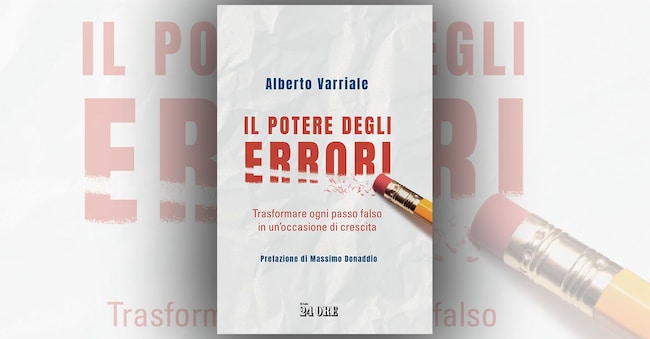
The preface to the book 'The Power of Mistakes. Transforming every misstep into an opportunity for growth', by Alberto Varriale, published by Il Sole 24 Ore. The book stems from the experience gained in the "Sbagliando si impara" (Making mistakes you learn) column and brings together reflections, strategies and insights that have emerged in the daily work of accompanying companies and managers in their growth

5' min read
5' min read
What you have in your hands and what you are about to read is a book that stems from a small, precious and perhaps somewhat hidden gem (but which is emerging in all its value with time) born within the section dedicated to Management of the 'Sole 24 Ore' website. I am referring to the section entitled Sbagliando si impara, where the experts referring to the management consulting and training company Newton have been distilling for over six years, on a weekly basis, knowledge, strategies, insights, and experiences accumulated over a very long period of time in the accompaniment of companies and management training. Many of those voices have been brought together, harmonised and edited by Alberto Varriale, Partner at Newton, who has extensive experience as a lecturer in management topics.
It was he who took upon himself the burden (and the honour) of re-elaborating, re-actualising and presenting to the readers of this book the material partly already published on the web, with the ambitious aim of making it a unified narrative without suppressing the different points of observation and skills, following the red thread of error, understood as a formative moment and not as failure and defeat, since, the editor of these pages argues, 'every error contains within itself a seed of improvement, a lesson that not only invites us to reflect on our behaviour, but also guides us towards more conscious practices and decisions'. Therefore, he adds, 'the manager of the future must be able to embrace error as an opportunity for growth, both for himself and his team. This approach helps to build a corporate culture that does not fear failure, but sees it as an essential step on the path to success, improvement and innovation'.
It is a perspective that seems to me as valuable as it is not taken for granted, indeed, it even goes against the mainstream culture that theoretically does not admit and does not seem to tolerate human error in the corporate context, except then, in the concrete of offices and companies, having to touch with one's own hands every day the fallibility of those processes that are constituted and managed inescapably (at least until today!) by the human element.
Mistake, an opportunity for growth
Starting from this factual datum, then, and far from magnifying the error as such, one can look at a 'hiccup', a negative situation, a misstep and discover that it can be a fundamental building block in a path of growth and learning new skills that may prove particularly valuable. A mistake, in those who really want to put themselves on the line with pride and dignity, in those who have the character and personality to face their task head-on and do their best - in business as in life - is not a simple deadlock, but can be a reset, an opportunity to see the problem from a new perspective, a stimulus to get back on the road with new vigour. Provided we accept it, understand it in its possibility and exploit it in its 'pedagogical' value.
I would like to emphasise a concept that Varriale highlights in the introduction that you will read after these lines: 'The ability to accept mistakes, analyse them and transform them into lessons distinguishes authentic and future-oriented leadership. Those who face error with awareness do not see it as a defeat, but as a precious opportunity to explore unexplored paths, discover creative solutions and deepen their knowledge of themselves and their context'.


