
Postcards from Italy, sales drop but some people still buy and give them as gifts
Between souvenirs, nostalgia and slow communication, postcards resist the digital decline in Italy and Europe, transforming themselves from travel messages to cultural and memory objects
by Davide Madeddu (Il Sole 24 Ore) and Hedvig Arató (HVG, Hungary)
 Aggiungi Il Sole 24 Ore
ai preferiti su Google
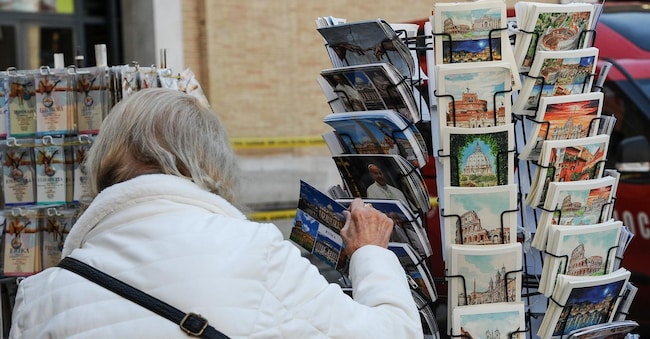
The use is not quite the same as in the 1990s, but postcards, in the age of social and selfie, endure. And they continue to occupy the displays of shops or newsstands. They may no longer be sent to friends and relatives to certify the 'holiday', but there are still those who buy them, especially as souvenirs. In Cagliari, in the newsstands in front of the port, which are mainly run by foreigners and sell newspapers, but also objects and other items for tourists, there is no shortage of postcards of the Sardinian capital. Photos with views of the city by the sea, the beaches or the port. There are also a few shops that sell the new, limited edition postcards, made by photographers who offer sceneries not always accessible to tourists who immortalise the city with smartphones.
The picture does not change if you move elsewhere. In Rome, from Termini station to the Vatican, passing through the streets of the centre, postcards are always on display. Naturally, the subjects change. One finds postcards of the Colosseum, the Spanish Steps and many other views. The same applies if one moves to Florence or Bologna. Postcards resist even though fewer stamps are sold and fewer are sent. "The market is in sharp decline and has shrunk a lot in over ten years," comments Andrea Cossu, professor of Sociology of Culture and Social Research at the University of Trento. Before the advent of social networks and smartphones, those who went on holiday had a list of people, friends, relatives and parents' friends to send postcards to. Today this is a contracted phenomenon'.
The sociologist adds: 'Why do these establishments continue to keep postcards, knowing that sales are falling sharply, and the other, why do those that have started continue to sell postcards'. Then an example: 'I always tell a story: in St Peter's there is a lot of competition and a strong focus on cheap souvenirs. The postcard attracts attention and allows the sellers to have more time in the shops'. There is also another aspect: 'With social media, but before that with the first digital cameras, holidays are documented in an invasive way,' he continues. Now we can take hundreds of them and they are impersonal. For some people, to find themselves with a postcard and a nice photo that meets aesthetic criteria, perhaps taken from positions that are difficult to reach normally, is something more than a selfie'.
And if the number of pieces sold drops, the quality changes. "There are different sizes, bigger or smaller," he says, "and instead of sending them, they are delivered by hand. As happened to me for Christmas'. Souvenirs that are no longer sent to others but are used as bookmarks or small pictures. Without forgetting then that, as the sociologist points out, in a world that digitalises everything to the max, 'and where systems quickly become obsolete, the paper medium is still valid'.
A look across the border: the case of Hungary
While in Italy the postcard endures mainly as a souvenir, in other European countries its role is also linked to a strong historical legacy. This is the case in Hungary, which holds a special place in the history of postal communication: the world's first official postcard was issued on 1 October 1869 within the Austro-Hungarian Empire, making the country one of the absolute pioneers of this format.

