Use

Trump's attack on the Fed: accusations over management and 2.5bn restructuring

The Trump administration accuses Powell of mismanagement and violation of regulations, triggering an unprecedented institutional crisis

by Silvia Martelli

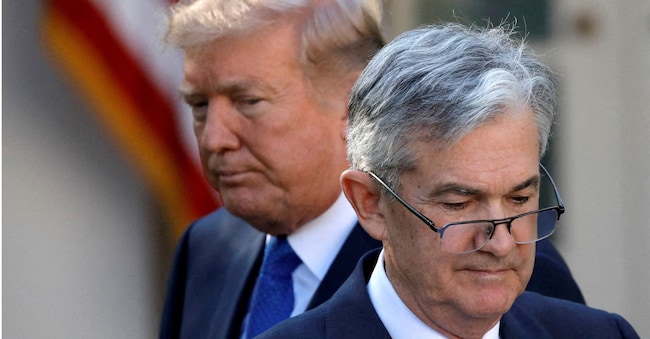
Donald Trump e s Jerome Powell. REUTERS/Carlos Barria/File Photo

4' min read

4' min read

The Trump administration launched its most frontal attack on the Federal Reserve on Thursday, accusing Chairman Jerome Powell of mismanaging funds and violating federal regulations. At the centre of the storm is a multibillion-dollar renovation of the central bank's headquarters and the Fed's inertia in cutting interest rates despite the president's requests.

The director of the Office of Management and Budget (OMB), Russell Vought, sent a public letter to Powell, calling his administration 'seriously troubling' and pointing the finger at a $2.5 billion renovation project that he deemed 'lavish and ostentatious'. According to the administration, the Fed chairman also lied before Congress about the details of the building plan. "Instead of correcting the Fed's fiscal course, you went ahead with a lavish renovation of your Washington headquarters," Vought wrote in a message made public on social media.

Loading...

Behind the architecture, a political attack

This new attack comes just two weeks after a handwritten letter from Donald Trump, in which the president explicitly asked Powell to lower interest rates. But the pressure was not limited to words. Indeed, the administration torpedoed three members of the National Capital Planning Commission, which oversees federal planning projects in the Washington area, replacing them with officials loyal to the White House, including Secretary Will Scharf and Deputy Chief of Staff James Blair.

Blair, interviewed by CNN, expressed 'grave concerns' that the restructuring was not in accordance with the plans approved in 2021 and called for inspections, updated documentation, and clarification. Specifically, he said, "Either the work is not in accordance with the originally approved plans, or Powell lied to Congress. One of the two must be true."

The restructuring of discord

.

The renovation concerns the Marriner S. Eccles complex, home of the Federal Reserve. The costs, initially estimated at 1.9 billion, have risen to 2.5 billion in 2025. Powell explained that the increases are due to rising commodity prices, labour costs and the need to extend the use of rented space during the work.

In a Senate hearing last June, Powell denied the existence of luxury elements, stating: "There are no VIP lounges, no new marbles, no reserved lifts. Just existing old lifts."

Despite this, Vought accused him of lying and violating federal transparency regulations. It is important to note, however, that the Fed has its own autonomous budget and is not directly answerable to the executive control of the federal government.

Pressures to resign?

.

According to analysts such as Ed Mills (Raymond James), the political objective could be to create a climate that would push Powell to resign. Mills warned: 'The Supreme Court has made it clear that the president cannot fire Powell arbitrarily. But one can build a case for 'just cause' or make the climate so toxic that he will voluntarily resign."

Powell was nominated by Trump in 2018 and confirmed by Biden in 2022 for a second term, expiring in 2026. The president has already hinted that he intends to announce the name of the successor soon. Such an advance, however, according to former Fed Vice Chairman Alan Blinder, could undermine market confidence: 'If the Fed's independence is challenged, the markets will react negatively. Rates will not go down, but they will go up." Blinder added: "They are trying to pressure in every way for Powell to step down. But I don't think he will. Nor do I think he should."

Interest rates and the issue of tariffs

.

One of the main reasons for the clash is the Fed's monetary line. Unlike the European Central Bank or the Bank of Mexico, which have already cut rates several times in 2025, the Fed has kept rates unchanged since December. Trump and his advisers have accused Powell of holding back the recovery, claiming that the failure to cut is politically motivated.

But Powell responded cautiously, pointing out that the economy is affected by the changes introduced by the new administration, in particular tariffs. Trump's protectionist policy has increased inflationary risks, dampening the Fed's action.

"If there were no significant changes in the administration's economic policies, the Fed would probably have already cut rates," Powell said in early July.

However, the majority of the Fed board members still expect to make a cut by the end of the year.

A risky precedent

.

The Powell case could mark a turning point in the relationship between politics and independent institutions. The central bank's autonomy is one of the pillars of US monetary credibility, so much so that any perceived interference can have consequences for global financial markets, the dollar exchange rate and inflation expectations.

The Fed, with a balance sheet close to USD 7 trillion, is a major player in stabilising the economic cycle. Undermining its authority, even if only symbolically, could prove to be a boomerang for the White House itself.

The clash between Powell and Trump goes far beyond the housing plan or the level of rates: it represents a direct challenge to the independence of the Federal Reserve at a very delicate moment for the global economy. The next moves - from the announcement of Powell's possible successor to the reaction of the markets - will tell whether we are facing an institutional crisis, or a tactical manoeuvre that will end up strengthening the role of the central bank. Either way, the outcome will not be indifferent for investors, businesses and households.

Copyright reserved ©
Loading...

Brand connect

Loading...

Newsletter

Notizie e approfondimenti sugli avvenimenti politici, economici e finanziari.

Iscriviti