
Powerful comparison between Italy yesterday and today

3' min read
3' min read
Alice Rohrwacher's latest film, La chimera (The Chimera), in theatres from 23 November, confirms the talents of one of the few directors - male or female - who deserves attention because she always knows how to put current and positive tensions at the centre of stories. Her most beautiful film, Lazzaro felice, admirably combined an almost mythical past, peasant and mountainous and provincial, which was ultimately the past common to the country of Italy, with a present, seen in equally and more fabulous ways, which was that of our country as it is today, lived through the sharp and demanding gaze of a young man in urban Milan, accentuating with skilful simplicity tones of fable or apologue perfectly amalgamated, consequential even when apparently overlapping.
In La chimera, his latest work, no less ambitious than its predecessor and no less immediate and simple in its directorial manner, is still divided between two environments that tend towards confrontation, towards the clarity of a message that we can well say is humanistic. In a context such as the current one, which puts the human to the test, and leaves room for chatter that does not say, does not dig, does not propose. Once again, Rohrwacher runs the risk of wanting to say too much, but in a context of directors (and artists in general, and intellectuals in general) who are either too cautious, too pretentious or too astute - without the right mediation between analysis and song - how can we reproach her for not always managing to control her sacrosanct ambitions?
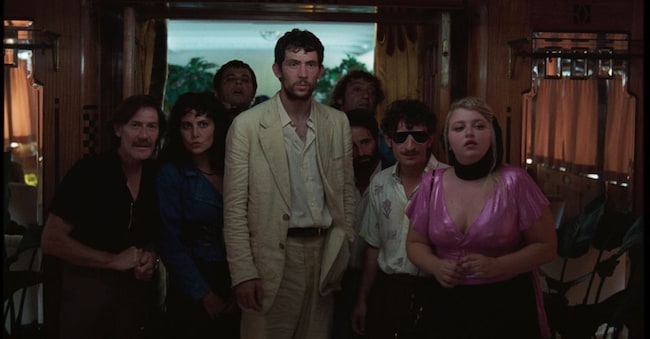
Yes, the two environments, the two stories he weaves in La chimera, do not always merge harmoniously into a clear and exemplary discourse. The first concerns the world of the 'tombaroli', who in central Italy search for and find archaeological finds to place more or less clandestinely on the market of the antiquarians of the rich world; perfectly described and analysed, that of the antiquarians, with due criticism of the methods of some. The second, linked to the first by the character of a 'psychic' who senses the emptiness of the underground, the places where artefacts may be found, concerns a community of women, freely assorted but with similar ideals in the ways they want to choose and lead their lives, in the present context. A 'defect' that is also a merit of the director, that of wanting to say the most and not the least about our confused time, of the passage of civilisation or the last civilisation. Even in La chimera - a film that has powerful passages and a perfect adherence to a landscape, a perfect confrontation between an even distant yesterday and a today that who knows what tomorrow may have and if it will have any - Rohrwacher lacks harmony, due to her anxiety to address the dilemmas she sees as central to our uncertain present. But, again, is it a flaw to want to say the most and not the least about a present like ours, mixing chronicle and history, narrative and metaphor, past and present? With regard to Alice Rohrwacher, I believe one must have the utmost admiration, also and precisely for her calm maximalism, which allows her passages and moments of extraordinary narrative and metaphorical vigour. What appears, and what lies behind ...
I see in Italy only one other director who can stand on a par with it, Pietro Marcello, also inside our present trying to see the beautiful and the ugly, the old and the new, the just and the unjust... Their few faults derive from their great, their very great merits...


