
Precise cubed: the new face of the jumping hour complication
A very special design, with small three-dimensional dice that spin and change colour: the six variants of Tambour Taiko Spin Time are all limited editions.

3' min read
3' min read
Innovation in tradition also means revisiting its icons. Tambour Spin Time is a complicated variant of Louis Vuitton's iconic Tambour collection, relaunched in 2023 with a contemporary, sporty-chic design. Spin Time is the name of the complication that represented a very important step in the history of the House's signature watchmaking: in 2009, the year it appeared on the Tambour, it was the flagship of the first mechanical movement developed by the Fabrique du Temps manufacture, specialised in haute horlogerie, which was acquired by the French brand in 2011 and became the Fabrique du Temps Louis Vuitton.
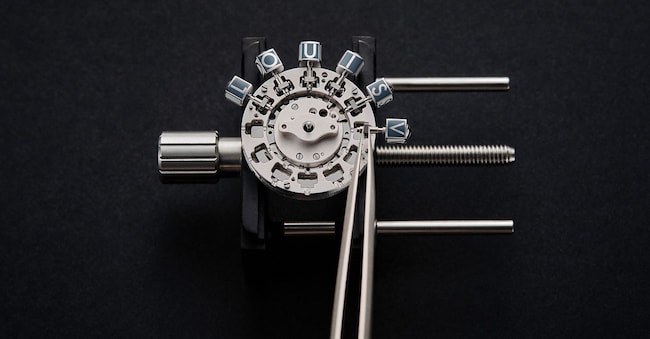
With the six variants of the Tambour Taiko Spin Time, all limited editions and all developed completely from scratch, the characteristic Spin Time display with its three-dimensional jumping cubes marking the hours, invented back in the day by Michel Navas and Enrico Barbasini (the founders of Fabrique du Temps) who reinterpreted the classic jumping hours complication, is back. How does it work? When, for example, it is 10:10, the cube at 10 o'clock turns, showing its side in a different colour than the other 11 cubes. The minutes are marked by a classic hand. Of the six variants, two Taiko Spin Time models have a 39.5 mm diameter case in white gold (one is set with 68 baguette-cut diamonds totalling 3.39 carats) and the mechanical self-winding LFT ST13.01 movement with a pink gold oscillating weight, capable of 45 hours of power reserve.
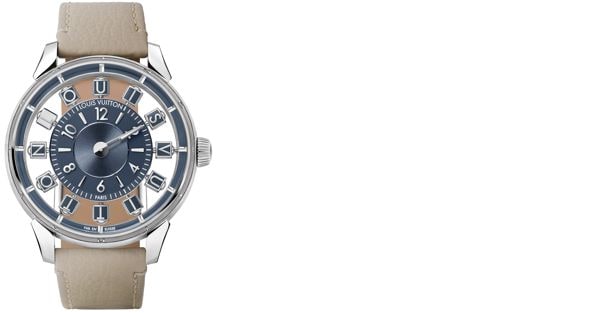
The same movement also animates the Tambour Taiko Spin Time Air, made in two versions, both with a 42.5 mm diameter white gold case. Here, the cubes marking the hours appear as if suspended in the air (Air) due to the dial and back that are transparent. The suspended cubes in one of the two versions have, instead of numbers, the letters that make up the Louis Vuitton name, 12, like the hour circle (the L is at 10 o'clock, the O at 11 o'clock and so on), while the other is decorated with 909 diamonds (2.92 carats) on the case, 118 diamonds (0.26 carats) in the central part of the dial and 192 diamonds (96 white for 0.48 carats, 96 black for 0.56 carats) on the hour cubes.
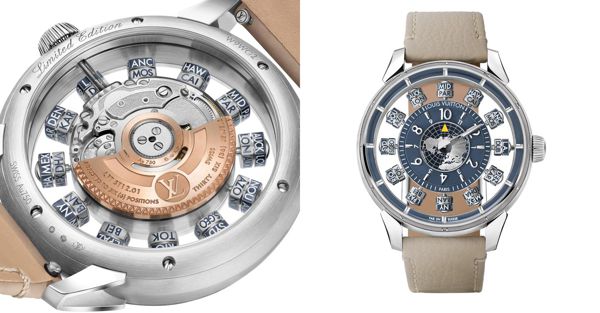
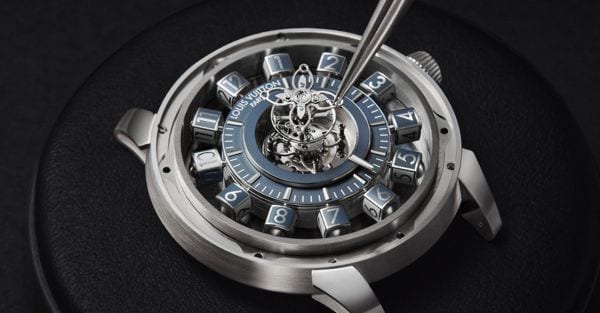
The last two interpretations, also in the Air version, add a further complication in both cases. The Tambour Taiko Spin Time Air Flying Tourbillon, in fact, features, as the name itself declares, a flying tourbillon positioned at the centre of the watch and is animated by another IWC-manufactured calibre, the LFT ST05.01, also with its oscillating weight in pink gold, and with a power reserve of up to 45 hours.The Tambour Taiko Spin Time Air Antipode, on the other hand, equipped with the LFT ST12.01 manufacture automatic calibre (also with a pink gold oscillating weight and 45-hour power reserve) with a new patented mechanism, called the Antipode, is capable of marking the hours of the world and day/night in a completely new and intuitive way. Here, the Spin Time display features 24 cubes, paired and superimposed: each one bears the name of a city, representing the time zone of reference.
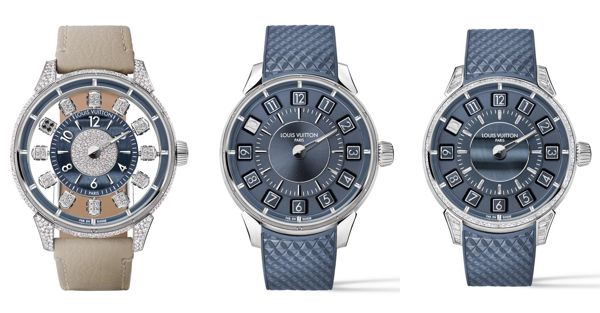
The pairings are made by considering the cities that are at the antipodes (Antipodes), i.e. those where the time difference is 12 hours. In the innermost part of the dial, the numbers corresponding to the hours are placed on a rotating disc reproducing the world: a yellow triangle marks the local one. But let us return to reading the hours of the world. To do so, one has to look at the time adjacent to the cubes bearing the names of the two cities: if, for example, the 12th is adjacent to the two cubes with the inscription Tok and Rio, their time will be noon or midnight. And to indicate which city is daytime and which is nighttime, it is the colour of the cube that will have rotated on itself showing the light side in the first case, and the dark side in the second.

