Commercial pressure

Pressure on banks; distribution networks under strain and forced to sell more and more policies

Strong statements from trade unions at BPER and UniCredit regarding the sale of insurance policies. At Intesa Sanpaolo, there is discontent in Romagna and southern Italia


 Sportello bancario (Imagoeconomica)

4' min read

Translated by AI
Versione italiana

4' min read

Translated by AI
Versione italiana

Unrealistic budget targets, stress for staff, staff cuts and pressure to sell ever more policies. These are the issues that recur, with varying degrees of emphasis, in trade union statements from banks such as BPER, UniCredit and Intesa Sanpaolo. It is primarily local trade union representatives who are often sounding the alarm.

Bper and customer needs

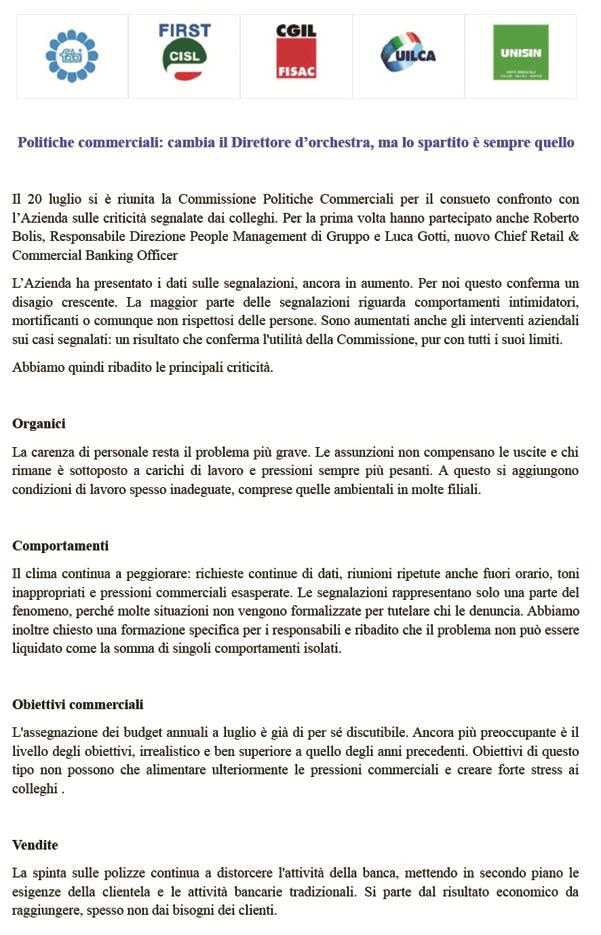
In addition to the reduced workforce and the working environment that ‘continues to deteriorate’, there are two key points in the joint statement issued by the five trade unions represented at BPER on 22 July. The first concerns the budgets: ‘Even more worrying is the level of the targets, which are unrealistic and far higher than in previous years. Targets of this kind can only further fuel commercial pressures and create significant stress for colleagues’.

Loading...

The second critical point relates to sales: ‘The push for insurance policies continues to distort the bank’s operations, pushing customers’ needs and traditional banking activities into the background. The starting point is the financial target to be achieved, rather than the customers’ needs.” Yet it is the customers’ needs that should always be the most important consideration.

“Reports to BPER’s internal trade policy committee are on the rise,” says Nicola Cavallini, national coordinator of FISAC CGIL at BPER. The company’s responses are often delayed and vague. In cases of repeated misconduct, feedback should instead be immediate. Frequently, however, trade union representatives are not informed of the measures taken.” On the subject of sales pressure, Cavallini adds that “there are also too many product campaigns throughout the year. Branches are completely swamped by these initiatives: what about everything else? When you call a customer, you have to explain the product properly; you can’t just brush the person off in a few minutes.”

When contacted, BPER declined to comment.
Unicredit and insurance

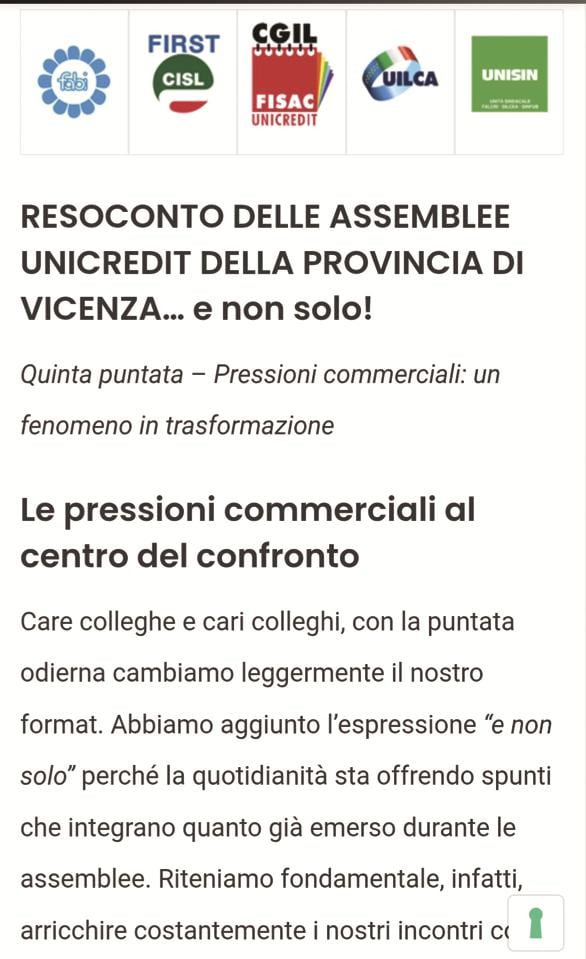
The harshest criticism of Unicredit, however, is coming from the north-east and north-west. A joint trade union press release dated 14 July reports on the Unicredit staff meetings held in the province of Vicenza. At the heart of the leaflet is the issue of commercial pressure, described as ‘the scourge par excellence of our sector’. It then moves on to specific examples of products, with insurance policies recurring time and again: ‘Another very recent event – though one that follows the same old pattern – concerns the launch of a new insurance product linked to the onset of cancer. We do not question its validity, but we emphasise the extreme sensitivity required when dealing with such matters. Is it really possible that every campaign must strictly be accompanied by the demand for ‘at least one policy per adviser’?”

Equally strongly worded was the statement issued by employees in Turin and the surrounding area, entitled: ‘Commercial pressure regarding policies, targeted summonses’. Here is the opening paragraph of the leaflet published on 8 July: “In recent days, some advisers in Turin and the surrounding area have received a ‘special’ summons, reserved exclusively for those who had not yet ‘placed’ a specific policy (temporary life insurance). The invitation was formally issued during a sales meeting, and the recipients were singled out because they were ‘guilty’ of still having the product’s ‘box’ marked as zero.”

So what is going on at Unicredit? “On 10 July, we had an important meeting with the company,” recalls Stefano Cefaloni, Fabi coordinator at Unicredit, “during which the deputy head for Italia, Remo Taricani, described the instances of commercial pressure reported by the trade unions as improper conduct and said he was ready to issue a statement to the network to reiterate the provisions of the agreements on commercial policies.” He adds: “The real issue we are now focusing on, however, is workforce balancing and employability. Once the meetings with all the regions into which the group is divided have been concluded, we will take stock of the problems to be resolved, including commercial pressure.”

We asked Unicredit for a comment, but the bank chose not to comment.

Intesa, from Romagna to the South

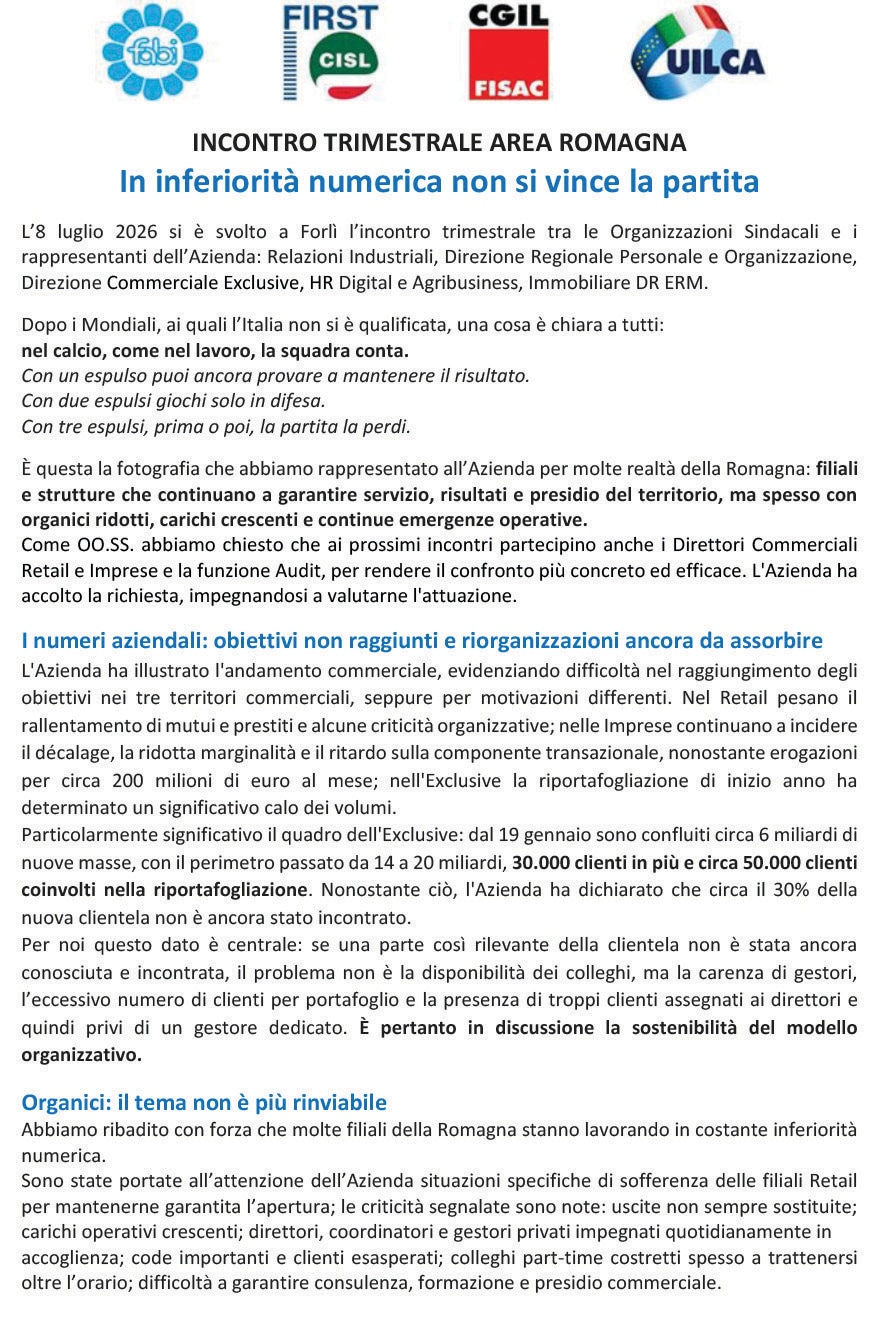
Intesa Sanpaolo is also facing commercial pressure. In particular, the critical branches are those in Romagna and Puglia-Molise-Basilicata.

Loading...

In southern Italia, as in central Italia, the problems relate to staff cuts, heavy workloads and commercial pressure. ‘The statements from Puglia, Molise and Basilicata, and then the one from Romagna, are not signs of a local problem. Far from it,’ points out Fabrizio Michelacci, a trade unionist with Uilca and a member of Intesa Sanpaolo’s commercial policy committee. “I know Romagna well, incidentally, as I am the Uilca provincial secretary for Forlì and Cesena. What emerges from the leaflets is a problem that is surfacing at national level. It all stems from the January reorganisation of the Retail and Exclusive sectors, involving the transfer of clients and assets. At middle management level, there is increased anxiety about reporting figures; there is greater day-to-day pressure with requests for forecast data on product placement. Managers in the Exclusive sector are being asked to increase the frequency of daily meetings, but these colleagues also have to close outstanding cases. Their work doesn’t end with the meeting.” However, he adds: “Regarding reports of commercial pressure, I must say that the company has changed its attitude and has become much more responsive to our requests to intervene in the cases highlighted.” When contacted, Intesa Sanpaolo declined to comment.

PROFILE

COMMERCIAL PRESS RELEASES. The press releases

Sales and customer needs
Trade unions at BPER have taken a firm stance against budget targets deemed unrealistic and the push to sell insurance policies, which they claim ‘puts customers’ needs second’.

The protests in Vicenza
UniCredit staff in Vicenza have levelled heavy criticism at the demands to sell insurance policies. “Numbers, nothing but numbers,” reads the statement in relation to households and businesses.

Criticism from Romagna
Intesa Sanpaolo staff in Romagna are protesting against sales pressure: “We will therefore continue to report any situation in which monitoring turns into undue pressure.”

THE FIGURES

5

The trade unions
Press releases are almost always signed by all five banking trade unions (Fabi, First Cisl, Fisac Cgil, Uilca, Unisin)

2017

Year of the agreement
The agreement between ABI, the Italian Banking Association, and the trade unions to protect workers from commercial pressures dates back to 8 February 2017.

518

Bank employees’ new demands
The total financial demand put forward by bank employees for the new collective agreement is 518 euros gross per month

Copyright reserved ©
Loading...

Brand connect

Loading...

Newsletter

Notizie e approfondimenti sugli avvenimenti politici, economici e finanziari.

Iscriviti