
In the Catania area, the European capital of prickly pears
In San Cono and the other four towns straddling the provinces of Catania, Caltanissetta and Enna that are part of the PDO area, a cultivation of two thousand hectares and a fabric of almost 400 companies
by Nino Amadore
Key points
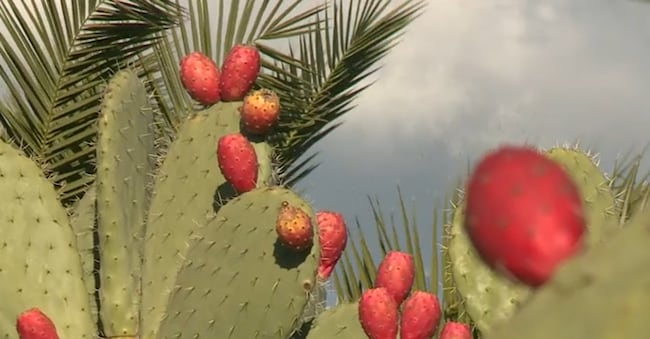
Until a few decades ago, it was considered a residual fruit, even repulsive because of the thorns that cover its skin. But not by everyone, since Sicilian farmers have always appreciated it. Thus the prickly pear was somewhat of a symbol of Sicily but without any success among consumers, despite its goodness and, as we shall see, its great qualities to the extent that it was called 'a wellness centre with roots'. It is said, for example, that the prickly pear shovel has great healing power and can be used on wounds. But there is more to it than that, of course.
And it is precisely by focusing on this fruit and the plant (which has its own great value) that the small town of San Cono, just over 2,400 inhabitants in the province of Catania, has built an agricultural chain. The first step for the valorisation of this product was the recognition of the Protected Designation of Origin: 'We started the process in 2003 and finally the recognition arrived in 2012,' says agronomist Cataldo Firrarello, 'and it was certainly a big step forward. Even if it is complicated to find PDO-certified products: the way out, they explain in these parts, is the certification of companies qualified to do so.
Three provinces involved
.With its 2,000 hectares of specialised cultivated area and an annual production of between 150,000 and 200,000 quintals, San Cono holds a record that projects it into first place in Europe in the production of prickly pears: in the peak harvest periods, this sector employs an estimated one thousand people, not counting allied industries (transport, etc.). The PDO area, which also includes the territories of San Michele di Ganzaria (in the province of Catania), Piazza Armerina (Enna) and Mazzarino (Caltanissetta), Mirabella Imbaccari (in the province of Catania) alone accounts for about 60% of the specialised cultivated area of the whole of Sicily, confirming it as the largest and most important European pole in the sector. There are almost 400 producers involved in the chain, which today benefits from an average price of EUR 1.20 per kilogram, with the prospect of reaching EUR 1.60-1.80 per kilogram. With an annual turnover that, according to some estimates, currently stands at a little over 24 million and that in perspective can grow to 35 million assuming a price of 1.80 euro per kilogram. Considering only the marketing of the fruit. Although others estimate that currently, the fruit at the plant does not generate more than 20 million in total: 0.50 euro per kilo. The mayor of San Cono Nuccio Calaciura, who is also an accountant, is among the optimists: 'The product is growing,' he says, 'and the marketing of the shovels is also growing. We must work in this direction'.
The Region: we aim for new commercial spaces
"The San Cono prickly pear is a true excellence of Made in Sicily,' says the Regional Councillor for Agriculture Luca Sammartino. 'A fruit with incredible nutraceutical properties, a symbol of our territory that is enjoying great success in foreign markets, a trend that we intend to strengthen with investments aimed at conquering new commercial spaces.
In San Cono an innovation workshop
.A reasoning of perspective that was once again addressed during the festival dedicated to the prickly pear that is currently underway in San Cono. It is called a sagra, as tradition has it, dating back 39 years, but it is now something more and different: in these parts, intensive prickly pear production began immediately after the Second World War and has become the leading economic activity, and what was once a sagra is now also a significant commercial event, as well as a planning and programming event. An event that has grown over time, as Emilio Grassenio, Councillor for Agriculture and Entertainment of the Municipality of San Cono, emphasises: 'In the last three years we have made the Prickly Pear Festival a laboratory of innovation: San Cono now hosts the best Italian agri-food realities, projecting itself into a future of growth that combines tradition, research and valorisation of the territory.


