Pulse

Pride: a decline in sponsors – the Trump effect reaches Italia too

Multinational companies are scaling back their DE&I policies, and sponsorship of Pride events is slowing down

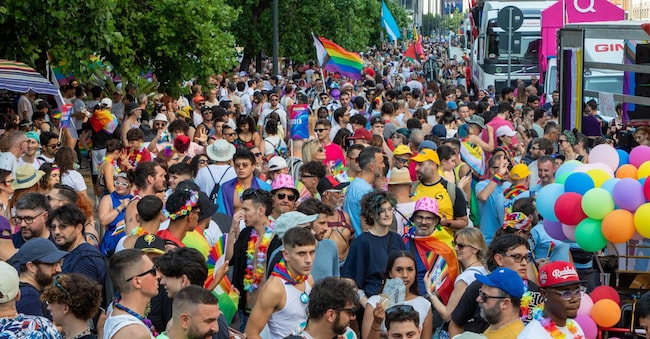
Manifestazione Pride Milano in Partenza da Via Vittor Pisani - Milano (foto Massimo Alberico / LaPresse)  LAPRESSE

6' min read

Translated by AI
Versione italiana

6' min read

Translated by AI
Versione italiana

Pride Month has just come to an end, but behind the images of packed squares and colourful floats lies a less visible change: the way in which LGBTQ+ rights events are funded. The Trump administration’s crackdown on Diversity, Equity & Inclusion (DE&I) policies, the scaling back of federal programmes and the growing climate of polarisation in the United States are having an impact on the other side of the Atlantic too. Not so much in terms of participation in demonstrations, but rather in the strategies of the companies that support them.

In Europe, the picture is more varied: Vienna has lost its long-standing sponsors and seen its municipal funding cut by almost 50 per cent; Sofia has seen its budget halved, whilst in Athens, reduced funding has forced organisers to scale back the number of fringe events. In Spain, however, strong institutional support has so far mitigated the effects of the withdrawal of certain companies.

Loading...

In Italia, the phenomenon is less pronounced, but the organisers of the country’s two main Pride events confirm that something has changed.

“The campaign against the Diversity & Inclusion promoted by Donald Trump and, more generally, by the current US administration, has had a global impact on private-sector funding for non-profit organisations,” explains Roberto Muzzetta, vice-president of CIG Arcigay Milano. “Within the LGBTQIA+ community, the effects have been felt most keenly at the larger Pride events, particularly in the United States, where many events had multi-million budgets supported by major corporations.”

For Milan Pride, however, the impact has remained limited. “In Italia, corporate sponsorship – including from multinationals – is a relatively recent phenomenon and, overall, less significant than in other countries. For this reason, the decline has been more limited: we estimate a reduction in contributions of around 20 per cent.”

Rome, too, has seen a slowdown. “There has been an impact,” says Mario Colamarino, president of the Mario Mieli Homosexual Cultural Circle and spokesperson for Roma Pride. “Some multinational companies, particularly those based in or with significant interests in the United States, have reduced, suspended or made less visible their investments in diversity and inclusion programmes. This has also had an impact on the financial support for Roma Pride.”

According to Colamarino, the decline in sponsorship stands at ‘between 10 and 15 per cent’. This figure, he adds, ‘shows just how much the political and cultural choices of a major market can have an impact even in Europe’. But the picture is not entirely negative. “We have seen Italian and European companies reaffirm their commitment, whilst others have come on board for the first time, demonstrating that support for rights cannot depend on fluctuations in the political climate.”

A different funding model from the United States

The greater resilience of Italian Pride events also depends on how they are funded.

“Milan Pride is supported through three main channels,” explains Muzzetta. “The first is the work of dozens of volunteers, which is of fundamental importance and enables us to keep organisational costs significantly lower than those of other international Pride events of a similar scale.”

The second pillar is sponsorship, “both financial and technical, which not only enables the event to be supported directly, but also helps to reduce the costs of numerous services”. A significant proportion of the funding also comes “from donations by private individuals”.

Rome, too, adopts a mixed model. “The main sources of funding come from sponsorship by private companies that share the values of inclusion, from fundraising, from institutional support and from self-funding events, such as concerts and parties,” explains Colamarino. “For us, it is essential to maintain a balance that guarantees autonomy and political independence: Pride is not a commercial event, but a demonstration for rights.”

Companies are becoming more cautious

Whilst the balance sheets, at least in Italia, remain sound, it is the behaviour of businesses that has changed.

In several European countries, organisers report that sponsors are being more cautious and are less inclined to publicly associate their brand with LGBTQIA+ initiatives, even though they continue to support them.

In Rome, this phenomenon is already a reality. “Some companies,” says Colamarino, “choose to support Pride discreetly because they fear reputational fallout, political pressure or reactions from certain international markets, particularly in a climate where there has been a growing backlash against inclusion policies.”

For the Roma Pride spokesperson, this is a sign of the new international climate. “Of course, we appreciate any practical support, but we also believe that visibility has value: taking a public stand helps to normalise inclusion and sends a clear message to employees, customers and society.”

In Milan, however, the situation is different. “We have not received any requests from companies wishing to support Milan Pride whilst remaining anonymous or avoiding being listed among the official partners,” Muzzetta points out. On the contrary, the companies that have decided to take part have wanted to reaffirm their commitment. “The companies that have supported Milan Pride this year are organisations that have demonstrated a concrete and consistent commitment to rights and inclusion. They have chosen to reaffirm their support even in a less favourable international climate, in which, for some brands, associating their name with inclusion policies may seem less advantageous from an image perspective. This is precisely why their contribution takes on even greater significance.”

A two-speed Europe

However, the picture across Europe reveals profound differences, driven not only by the political climate but also by the structure of funding.

In Vienna, in addition to the withdrawal of international sponsors such as Durex and Absolut, the City Council has almost halved its financial contribution, forcing the organisers to scale back the traditional ‘Pride village’. The event was saved largely thanks to the efforts of over 200 volunteers, who ensured that most of the programme could go ahead despite the cuts.

In Athens, however, the reduction in funding has had a direct impact on the cultural programme. The number of fringe events has fallen from around 60–70 to just over twenty. The organisers attribute this decline both to reduced support from certain companies and to a decision to select sponsors more carefully, prioritising partners whose values align with those of the association and avoiding instances of pinkwashing.

The situation in Bulgaria is even more difficult. Following the withdrawal of support from the US embassy — which had funded Sofia Pride for 17 consecutive years — and the withdrawal of several US sponsors, the budget has been almost halved. The organisers have scaled back the stage, sound systems and investment in promotion, and warn that, should this trend continue, it may be necessary in future to rethink the very format of the event, reverting to a simple protest march.

The situation is different in Spain, where public funding continues to be a stabilising factor. The organisers report that some companies are adopting a more cautious approach, preferring less high-profile Pride communication campaigns, but they emphasise that support from local authorities has so far offset the slowdown in the private sector.

A European comparison thus shows that the impact of the austerity measures on DE&I policies does not depend solely on the scale of the cuts, but also on the composition of Pride organisations’ budgets: where multinationals account for a larger share, the backlash has been more severe; where volunteering, donations and public funding play a part, as in Italia and, to some extent, in Spain, the capacity to absorb the shock has proved greater.

Less marketing, more advocacy

This shift in the landscape is not limited to sponsorship. In many European countries, Pride is once again emphasising its political dimension. In Vienna, this year’s slogan is ‘Visible since 1996’ and the organisers describe the event as ‘a cry of solidarity’; in Athens, the chosen message is a direct response to anti-woke rhetoric; in Spain, the twentieth anniversary of same-sex marriage has provided an opportunity to reiterate that hard-won rights cannot be taken for granted.

Even in Italia, where the decline in sponsorship remains manageable, the message is clear. Funding continues to flow in, but corporate support is no longer a neutral choice from a reputational point of view. And for this very reason, the organisers note, those who decide to publicly reaffirm their commitment today are sending a message that goes beyond marketing.

*This article is part of the European collaborative journalism project “Pulse” and was produced with contributions from Dimitris Angelidis (EfSyn, Greece), Ana Somavilla (El Confidencial, Spain), Desislava Koleva (Mediapool, Bulgaria), Muzayen Al-Youssef (Der Standard, Austria), Francesca Barca (Voxeurop, France) and Petr Jedlička (Deník Referendum, Czech Republic).

Brand connect

Loading...

Newsletter

Notizie e approfondimenti sugli avvenimenti politici, economici e finanziari.

Iscriviti