Anniversary

"Factories first': the Friuli model 50 years after the earthquake

The 1976 earthquake affected 279 industrial companies, stopping 40% of Udine's production system - Paolo Fantoni's memory

by Barbara Ganz

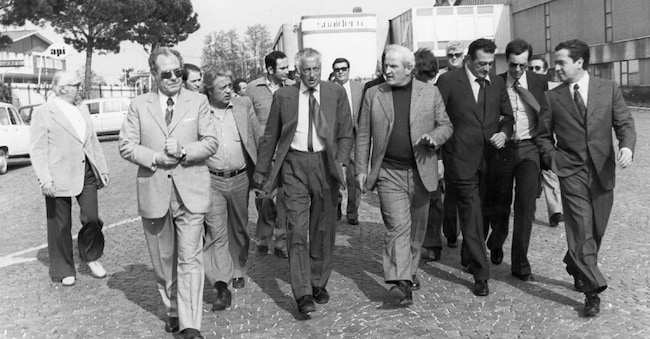
Nella foto scattata l’11 maggio 1976: al centro Gianni Agnelli, all’epoca presidente di Confindustria, in vista allo stabilimento Snaidero a Majano. Alla sua destra Rino Snaidero, fondatore dell’azienda e Rinaldo Bertoli allora presidente dell’Associazione degli Industriali di Udine, oggi Confindustria Udine

4' min read

Translated by AI
Versione italiana

4' min read

Translated by AI
Versione italiana

Paolo Fantoni was 18 years old: he remembers well the night of the earthquake, the sounds of collapsed houses, the destruction of the factory in Gemona: 'Only later did we learn that the factory in Osoppo, where 350 people worked, had also collapsed. The next day, my father and some workers were already at the company, rebuilding. On 8 May we gave notice that the month's salaries were available, as a sign of trust. Two caravans stood in for management and the personnel office respectively'.

The reconstruction

The Osoppo factory was replaced by a new one, already under construction at the time of the earthquake: the destroyed site completed its reconversion in the mid-1980s and today houses the production of panels for the group, which has grown to 1,100 employees, 700 of whom work in Osoppo. The fundamental choice "was to settle the population in tent camps to avoid mass emigration and keep people close to the factories," the entrepreneurs who symbolised the companies that recovered from the rubble remember today.

Loading...

Fifty years later, Friuli remembers the earthquake, which struck the region on 6 May 1976, devastating an area of 5,700 square kilometres, affecting 137 municipalities and around 600 thousand inhabitants. In the epicentre area, some 17,000 homes collapsed or were irreparably damaged, causing 989 deaths, over 3,000 injured and 100,000 homeless. 279 industrial companies were affected, of which 166 were members of the Friuli Industrialists' Association, with over 10 thousand employees. Approximately 40 per cent of Udine's production system came to a halt.

6 maggio 1976, il terremoto in Friuli

Photogallery8 foto

First the factories

Large companies such as Snaidero in Majano and Pittini in Osoppo were among those affected. "Friuli demonstrated that, by putting economic and productive recovery first, one rebuilds not only the material fabric, but also the social one," emphasises Luigino Pozzo, president of Confindustria Udine. In the front row then was the Association of Industrialists of the Province of Udine - today Confindustria Udine - with a central role played by the entrepreneurial system in the rebirth of the territory, which "lost everything that night, but not its determination. The entrepreneurs did not give up: they reopened factories even in makeshift premises, kept jobs and laid the foundations for a reconstruction that became a national model. A reconstruction 'beyond the existing' borrowing a phrase from Andrea Pittini,' Pozzo recalls.

"It is around the factories that we have to rebuild, but first we have to make them survive by providing them with men and means,' was the guiding principle expressed at the time by association president Rinaldo Bertoli and which became the pillar of the 'Friuli Model'. With the successive presidencies of Rinaldo Bertoli, Gianni Cogolo and Andrea Pittini, the association played a strong role in supporting local businesses: three days after the quake, it opened a subscription that raised over 3.5 billion lire, earmarked for prefabricated buildings, housing for workers and emergency structures. He promoted concrete solutions such as temporary employment, contract work and agreements with banks and trade unions. Thanks to the commitment of the national Confindustria (Confederation of Italian Industry), with the visit of the then president, Gianni Agnelli, interest-free loans and rapid intervention were requested and obtained. The associated construction companies formed the Corif Consortium, which became the sole interlocutor for the construction of infrastructure.

In little more than a year, the reactivation of production was practically complete. By the end of 1978, industrial jobs in the earthquake-affected areas had not only recovered but increased by about 2,000 (+10%). Between 1971 and 1981, the industrial units in the province of Udine grew by 44.7% and the number of employees by 26.7%, with a decisive boost from the hardest hit areas. In the aftermath of the earthquake, the technicians of Autovie Venete were also mobilised, immediately at the disposal of the emergency machine: in particular, it was thanks to the subscription of the motorway concessionaire's employees that a medical post was built in Magnano in Riviera to provide first aid to the community affected by the earthquake.

The birth of the university

"The earthquake could have been the end of everything and, instead, it was a beginning," is the reflection of the Rector of the University of Udine, Angelo Montanari: "This is where the history of our university fits in. The earthquake could have buried the efforts of those who had been forcefully claiming a university in Friuli for some years, but that did not happen". On the contrary, the population and institutions immediately mobilised to reach the 50,000 signatures needed to present a popular initiative bill for the birth of the university. The signatures numbered around 125,000, many of which were collected in the post-earthquake tent cities. "Thanks to this collective effort, Friuli obtained the University with a regulation contained in the first organic law for financing reconstruction,' recalls the rector. The regulation established and launched the 'University of Udine', the only one in Italia that was born out of the will of the people, which began its academic activity on 1 November 1978".

The programme

In Gemona del Friuli, in honour of the earthquake victims, the reconstruction of Friuli is being celebrated today at the highest institutional moment of this 50th anniversary.

In the afternoon, the town will welcome the President of the Republic, Sergio Mattarella, and the President of the Council of Ministers, Giorgia Meloni. The Head of State will land at the Rivolto air base at around 4 p.m. The first stop of his visit will be a tribute to the memorial of the earthquake victims at the cemetery. From there Mattarella will move on to the Cinema Teatro Sociale where an extraordinary Regional Council meeting is scheduled at 5 p.m.

More than three hundred people are in the hall: including the mayors of the municipalities affected by the earthquake, representatives from the institutional, military, academic, judicial and economic worlds. A big screen has been set up in Piazza del Ferro, and weather permitting, an overflight of the Frecce Tricolori is planned for the afternoon.

© REPRODUCTION RESERVED

Copyright reserved ©
Loading...

Brand connect

Loading...

Newsletter

Notizie e approfondimenti sugli avvenimenti politici, economici e finanziari.

Iscriviti