
Privacy and rights under threat from surveillance technologies
Ai, cloud and facial recognition drive the adoption of systems that help public safety but increase drifts of control over people

Key points
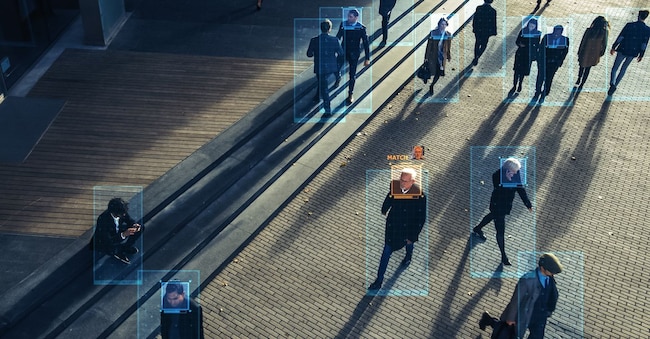
Cities with cameras on every corner, household appliances that listen to us, social networks that collect and sell our data, platforms that exploit artificial intelligence to create pornographic images of famous people: these are not the scenarios of crime TV series but the transposition of the interconnected and digital reality in which we live. The new levels of exposure that artificial intelligence, security equipment and cybercrime are taking us to are matters to be guarded against because the privacy and rights of millions of people are at stake.
The countries most at risk
When it comes to video cameras and facial recognition systems, China is unquestionably one of the countries in the vanguard: its artificial intelligence-enhanced surveillance infrastructure for mass control to maintain 'social stability' is not, however, the only one active in the world with these aims. The United States, Israel, Hungary, Turkey, Russia, Japan and South Korea are equally committed to this front, and US companiesin the first place play a key role in supplying the hardware behind intelligent monitoring systems. However, it is the entire video surveillance industry that is undergoing a transformation, and this is confirmed by a recent global study by Swedish Axis Communications.
Facial recognition and processing capabilities
For more than 60 per cent of industry insiders, Ai and generative Ai will significantly shape the future of the industry in the areas of security, business intelligence (through the use of additional sensory data to video sources) and operational efficiency. What elements will increase the weight and impact of algorithms and Llm models? The report highlights two elements in particular: the accelerating transition to hybrid architectures, which combine the instantaneous in-camera processing capabilities of edge Ai with the long-term scalability of the cloud, and the increasing use of facial recognition systems, supported by regulations that aim to regulate their application in an (at least on paper) ethical manner.
The American and European models
In the USA, intelligent video surveillance is a controversial topic, reflecting a fragmented approach to privacy regulation (left largely to individual states) and a public debate that has long been seeking a balance between the need for security (especially in the prevention of crime and terrorism) and the risk of a potential militarised drift of control. New York City, in this scenario, has become the emblem of the large-scale use of closed-circuit television cameras equipped with 'facial recognition' technology (more than 25 thousand are reportedly installed, most of them active in the Brooklyn and Bronx neighbourhoods) for the protection of public order and the prevention of crime. The consequences on people's rights are well known and the Italian Privacy Guarantor knows something about it, having intervened in recent months to sanction Clearview AI, a company that makes available to law enforcement agencies all over the world an immense database of information sifted on the Net to enable them to match images captured by cameras and search for potential matches between subjects already known to the police and potential repeat offenders.
Can individuals be recognised?
"The risk of abuse," explains Andrea Baldrati, founding partner BSD Legal and founder of Privacy Week, "is in the collection of data without people's knowledge and the aggregation of this data through algorithmic systems to build a profile of the individual. All this can also take place in war contexts: it is well known, for example, that the Israeli army has been using machine learning for years, and recently Llm models, to monitor people and behaviour. This opens the way to an indiscriminate use of technology that leads to undermining one of the principles of democracy, namely the presumption of innocence and protection from the accusation of being found guilty of an act that has not yet been committed" . In Europe, on the other hand, the most striking case is that of Hungary, which last spring passed new laws (in fact in contrast with the AI Act) to expand the use of facial recognition technology and allow surveillance of people present at peaceful demonstrations that are disliked by the central government, such as the Pride events of the LGBT+ community.

