
From Private Research Foundations the extra weapon to conquer the future
Five realities in comparison. Resta (Bruno Kessler): 'We want to bet on young people and their energy'

3' min read
3' min read
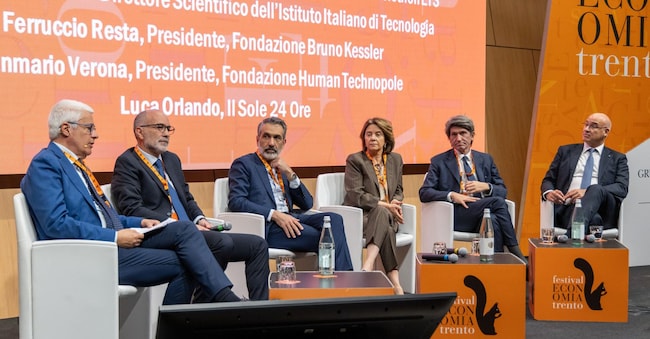
Thousands of patents. And then brains that finally return, start-ups born in the heart of companies and already active on the market, discoveries that can defeat diseases and give hope. In an Italy that is systematically behind in the global rankings for innovation and research, there is actually a virtuous little oasis, the one represented by the private research foundations, not directly governed by the Ministry of Universities and Research, brought together at an ad-hoc event in Trento. Between structures that are by now historic (Airc was established in 1965, Telethon in 1990), others that are already consolidated (Iit in 2003, Bruno Kessler in 2007) and 'new entries' (Human Technopole has been operational since 2019), these are realities capable of representing a powerful engine in terms of innovation and technology transfer, as witnessed for example by the joint laboratories set up by the Italian Institute of Technology, which has already seen the development of numerous start-ups thanks to this scheme. "Our model," explains Iit's CEO and scientific director Giorgio Metta, "has proved effective in combining basic research with technology transfer, one of the cornerstones of our statutory mission. Proof of this is the 38 start-ups that have emerged from IIT and more than 1,300 active patent titles, in addition to more than 900 commercial collaboration contracts'.
Among the nodes of the system, particularly in the medical area, is that of being able to concretely discharge the results of research on the ground, finding a virtuous balance between collective interest and corporate profits. 'If research does not leave the laboratory and become a product,' explains Francesca Pasinelli, a member of the board of the Telethon Foundation, 'the patient does not benefit, whereas for us the goal is to transform innovation into therapy. That is why we have chosen the licensing route, which on the one hand allows manufacturers to count on predictable returns, and on the other leaves us in control of the subsequent development'. Among the objectives of these foundations is also to target young people, both by offering them interesting career paths, so as to reverse the flight of talent to foreign countries, and by supporting their efforts towards new activities.
'In addition to the general demographic problem,' explains Bruno Kessler Foundation president Ferruccio Resta, 'there is also the problem of companies and their demographic decline, which must be combated. And we must do so with new logic, not with the classic bank counter metrics. We are trying to do this, for example with the Proof of Concept programme, we want to bet on young people and their energy. The resources invested here are certainly more productive than those put by our public and private system into decadent enterprises". "Thanks to the opportunities open in our structure," explains Gianmario Verona, president of the Human Technopole Foundation, "40% of our researchers have returned from foreign experiences, thanks to the flexibility of engagement that we have and that allows us to make return an incentive. In addition to patents and publications, I would say that this is also an important element of 'impact' on the country system. Which can also count on our state-of-the-art facilities, made available to other researchers for their projects'. Crucial in the field of cancer research is the role of Airc, which, thanks to the funds it raises each year, is able to finance hundreds of projects by supporting and encouraging the work of young researchers. "Thanks to the concrete help of 4.5 million supporters we develop 70% of independent oncological research in Italy," explains Airc's CEO Daniele Finocchiaro, "and looking at the numbers it is as if the public's sensitivity towards research is greater than that of the institutions: we are the leading charity in Europe, but in a certain sense the primacy is also a failure at system level, which could certainly do more on these".
© REPRODUCTION RESERVED


