
Probes and cosmic rays against landslides and fires
by Valentina Saini
 Aggiungi Il Sole 24 Ore
ai preferiti su Google
3' min read
3' min read
From Padua to Antarctica, cosmic ray probes help predict landslides and fires
Figuring out whether a mountainside is soaked with rain that it is in danger of collapsing or how likely a forest fire is in a given area during a dry spell is no simple matter. Even less so is quantifying the water that will reach the valley floor as the snow that has fallen at high altitudes during the winter melts. But monitoring water and managing it is increasingly important because climate change is altering the quantity and pattern of precipitation. With consequences ranging from droughts to flash floods, like the one that hit the upper Vicenza area last month, with destructive effects.
What can help is an innovative technology developed by a group of researchers from the Department of Nuclear Physics at the University of Padua, which makes it possible to exploit cosmic rays to determine how much water is contained in the soil or snow thanks to compact, inexpensive and highly efficient probes. Just to give an example, six are enough to monitor the fire risk of the entire Veneto Pre-Alps. Hoping for its commercial potential, the three researchers created Finapp, first a university spin-off and then, in 2019, an innovative start-up.
They got it right. As of 2020, they have managed to attract a total investment of EUR 1.4 million and, in 2023, the prestigious EIC Accelerator awarded them a grant of over EUR 2 million. And after the beginnings dedicated to product development, operational testing and the search for the first customers, turnover has risen from 80 thousand euros in 2021 to one million last year. Luca Stevanato, CEO and co-founder, expects to close 2025 with two and a half million, and to grow the team from 28 to 45 people by the end of 2026. Thanks to an aggressive sales team, from its 600 square metre production facility in Montegrotto Terme, Finapp has managed to place its probes on all seven continents, including Antarctica.
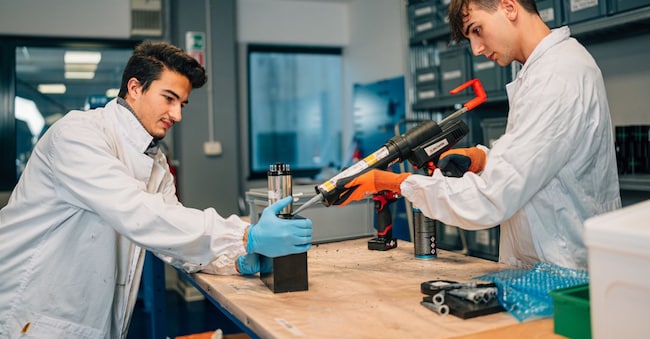
The applications are many and varied, Stevanato explains. "Among the things that make our solution stand out is that it can measure water in the ground without touching the ground. For example, in the city it can measure the water dispersed under the asphalt and, if there is a lot of it concentrated in one spot, it means there is a water leak. So it can be detected and repaired very quickly'. Indeed, municipal companies are among Finapp's main customers in Italy, along with regional environmental protection agencies, civil protection, companies such as Anas and farms. The secret of the effectiveness of their probes lies 'in the chemical recipes we have developed, which have allowed us to reduce the size and weight of the instrument by about ten times compared to what the market was offering'. In Montegrotto Terme, Finapp produces around twelve probes per week and, as sales are going well, there is usually a maximum of one or two weeks' production in stock. The cost varies depending on the application. If the probe is to be used as a warning system, for example in the case of hydrogeological risk, it can cost 11 thousand euros, while when there is less need for counting and speed, and one can be content with receiving one piece of data every three hours, the cost drops to 5 thousand euros.

