

Banga (Banca Mondiale): «Creare lavoro per i giovani è la soluzione migliore contro la povertà»
di Gianluca Di Donfrancesco

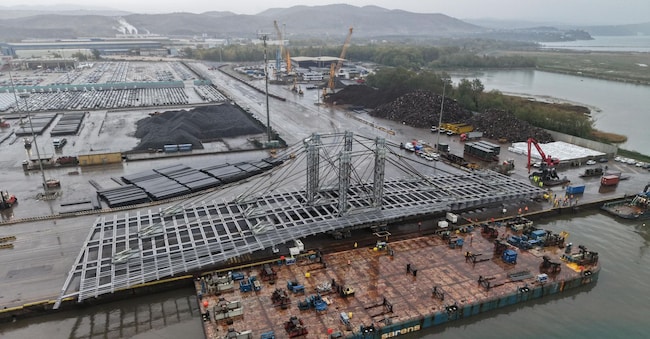
The new Anne de Bretagne bridge, destined for the city of Nantes (Loire Atlantique, France), will soon make its way to France, once the loading operations at the port of Monfalcone have been completed. The work, commissioned by Nantes Métropole, is part of a large urban transformation and sustainable mobility project. The new bridge is designed to triple the width of the current crossing, from 18 to 61 metres. It will accommodate vehicles, two tram lines and a garden-belvedere, taking the form of a true suspended square on the Loire river.
The metal deck, built by Cimolai Spa, reached the quay after a careful approach manoeuvre from the company's factory, to be then loaded onto the barge. The main element weighs approximately 2 thousand tonnes, to which must be added over 1 thousand tonnes of temporary structures, for a total of approximately 3 thousand tonnes loaded, net of the weight of the trolleys used.
The project is the result of an international public-private partnership involving Nantes Métropole as the client, with technical assistance from Systra, Barriquand & Frydlender, Cerema and Cabinet Coudray. It is being implemented by a joint venture consisting of GTM Ouest, Dodin Campenon-Bernard and Cimolai, with the participation of DFA Dietmar Feichtinger Architectes as architect, Paume as town planner, Schlaich Bergermann Partner for design and construction supervision and SCE for technical supervision.
'The work stands out for its structural complexity,' said Marco Sciarra, president of Cimolai Spa. 'The Anne de Bretagne bridge combines engineering, architecture and sustainability, and once again testifies to our country's ability to build internationally recognised infrastructures of excellence. It is a project that expresses the best of Italian expertise in the construction of unique and innovative works, capable of improving mobility and the quality of life in cities.
The deck will be placed on the piers at the beginning of next winter. Only at a later stage will work begin on upgrading the existing bridge, which will remain independent of the new structure: the two crossings will be separated by 30 centimetres, but visually united by a surface joint that will give the impression of a single bridge.

