
Prose and poetry, a sestina and a cinquina in the final of the Premio Strega 2026
From the Turin Book Fair to the Roman Theatre of Benevento, eleven works to understand the ruins and wonders of our society
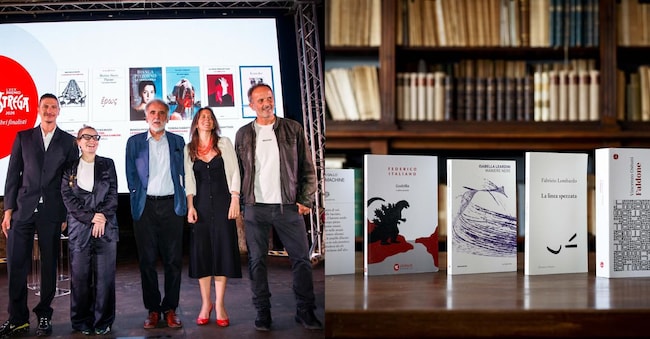
Avoiding predictable schemes and already beaten narrative formulas. The verdict of the eightieth Premio Strega has already produced a heated debate, especially with respect to readers who would not be able to distinguish between fine literary sophistication and authorial strategies of stylistic complacency, alias mere manner. Yesterday evening, at the Roman Theatre in Benevento and with the conduction of Stefano Coletta, the finalist sestina was announced; since, in addition to the first five nominated novels, thanks to Article 7 of the regulations in force, a title published by a medium-small publisher has the right to be included in the second round of voting. Therefore, President Melania G. Mazzucco proclaimed: "I convitati di pietra" (Einaudi) by Michele Mari with two hundred and eighty votes; "Platone. Una storia d'amore" (Feltrinelli) by Matteo Nucci with two hundred and forty-two votes; "La sonnambula" (Bompiani) by Bianca Pitzorno with one hundred and ninety-five votes; "Donnaregina" (Mondadori) by Teresa Ciabatti with one hundred and eighty-four votes; "Lo sbilico" (Einaudi) by Alcide Pierantozzi with one hundred and seventy votes; "Vedove di Camus" (L'orma) by Elena Rui with one hundred and sixty-three votes. The favourite is Mari's work, the most 'bewitching' of them all. The author arrived on the stage after decades of critical awards, but without ever having won the most coveted one, the golden liqueur. On the other hand, in 'The Stone Convitees' he condenses several of his warhorses, including his obsessive relationship with literature itself. If his advocates see between the lines the crowning glory of a career, the naysayers tend to identify him with an intellectual elite, to consider him a 'writer for writers'.
The inevitable Strega Tour
The five finalists will immediately begin the Strega Tour: nineteen stops all over Italia plus one abroad, this year in collaboration with the Italian Cultural Institute of Mexico City, thus strengthening the dialogue between the two countries in view of Italy's participation as guest of honour at the Feria Internacional del Libro of Guadalajara (FIL) next December. The first public appearance was on Thursday 11, in the former Carabinieri barracks in Quartu Sant'Elena, Sardinia, where the straw-coloured tour found a home and returns for the second year. While the evening organised by Argonautilus will be introduced by Eleonora Carta, the conduction will be in the hands of Fabio Canino. The announcement of the overall winner, on the other hand, will take place on 8 July in Piazza del Campidoglio, with Pino Strabioli and Gloria Campaner conducting.
Poetry will not save the world
"Sapessi almeno scriver dei bei versi, / un po' troppo sonori, anche un po' vani, / nulla più che una musica all'orecchio, / come piacciono i versi agli italiani" (I should at least know how to write beautiful verses, / a little too sonorous, even a little vain, / nothing more than music to the ear, / as Italians like verses)," a 30-year-old Saba lashed out lightly. Nevertheless, the Strega jury rewarded a poetry that pushes itself to the threshold of the current crisis, which renounces confessional singing and 'beautiful verses' tout court in order to survive within an altered world; even when myth and the fantastic appear, they serve the poets to emphasise the instability of the present. At the last Turin Book Fair, among the one hundred and thirty-eight works nominated, the five finalists were revealed: "Procne Machine" (Einaudi) by Carmen Gallo, "Godzilla e altre poesie" (Guanda) by Federico Italiano, "Maniere nere" (Mondadori) by Isabella Leardini, "La linea spezzata" (Donzelli) by Fabrizio Lombardo, "Faldone" (Il Saggiatore) by Vincenzo Ostuni.
The Time of Horrors
The motivations of the scientific committee favoured the theoretical dimension of the texts and their architecture, also stylistically. From Chernobyl's radiation to Shakespeare's aquatic ghosts, poetry was treated as an organism as complex as it is necessary to measure reality, which is not afraid to conceptually indicate evil nor to bend to a divisive language; as a system of thought capable of going beyond individual voices, Cortellessa would have said, to apply a coherent rhythm to a feral time to be internalised.

