
Prose and poetry: a sestina and a cinquina reach the final of the 2026 Strega Prize
From the Turin Book Fair to the Roman Theatre in Benevento, eleven works that shed light on the ruins and wonders of our society

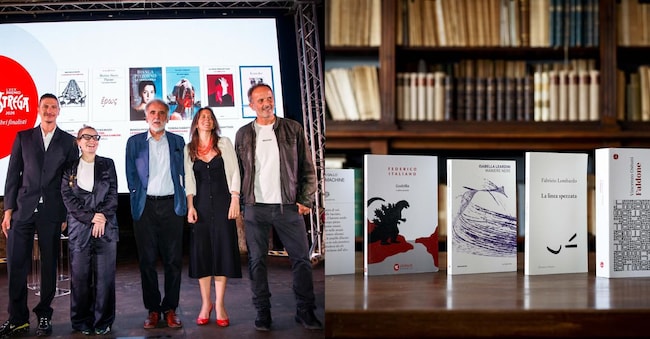
Avoid predictable plots and hackneyed narrative formulas. The verdict of the 80th Strega Prize has, almost immediately, sparked a heated debate, particularly amongst readers who are unable to distinguish between refined literary sophistication and authors’ strategies of stylistic self-indulgence – in other words, mere affectation. Last night, at the Teatro Romano in Benevento and hosted by Stefano Coletta, the shortlist of six finalists was announced; for, in addition to the first five nominated novels, thanks to Article 7 of the current regulations, a title published by a small-to-medium-sized publisher is entitled to be included in the second round of voting. Consequently, the chair, Melania G. Mazzucco, announced: ‘I convitati di pietra’ (Einaudi) by Michele Mari with 280 votes; ‘Platone. Una storia d’amore’ (Feltrinelli) by Matteo Nucci with 242 votes; “La sonnambula” (Bompiani) by Bianca Pitzorno with 195 votes; “Donnaregina” (Mondadori) by Teresa Ciabatti with 184 votes; “Lo sbilico” (Einaudi) by Alcide Pierantozzi with 170 votes; “Vedove di Camus” (L’orma) by Elena Rui with 163 votes. Mari’s work is the favourite, the most “enchanting” of them all. The author has reached this stage after decades of critical acclaim, yet without ever having won the most coveted prize, the golden statuette. Indeed, in “I convitati di pietra” he brings together several of his signature themes, including his obsessive relationship with literature itself. While his supporters see between the lines the crowning glory of a career, his detractors tend to identify him with an intellectual elite, regarding him as a ‘writer for writers’.
The unmissable Strega Tour
The five finalists will set off on the Strega Tour straight away: nineteen stops across Italy plus one abroad, this year in collaboration with the Italian Cultural Institute in Mexico City, thereby strengthening the dialogue between the two countries ahead of Italia’s participation as guest of honour at the Guadalajara International Book Fair (FIL) this coming December. The first stop to be publicly announced is on Thursday 11th, at the former Carabinieri barracks in Quartu Sant’Elena, Sardinia, where the Strega Tour has found a home and returns for the second year running. While Eleonora Carta will introduce the evening organised by Argonautilus, Fabio Canino will host the event. The announcement of the overall winner, however, will take place on 8 July in Piazza del Campidoglio, hosted by Pino Strabioli and Gloria Campaner.
Poetry won't save the world
“If only I could write fine verses, / a little too melodious, even a little vain, / nothing more than music to the ear, / just as Italians like their verses,” quipped the thirty-year-old Saba. Nevertheless, the Strega jury has awarded a prize to a poem that ventures to the very edge of the current crisis, one that renounces confessional verse and “beautiful verses” tout court in order to survive within an altered world; even when myth and the fantastical appear, they serve the poets to highlight the instability of the present. At the last Turin Book Fair, from among the 138 nominated works, the five finalists were revealed: “Procne Machine” (Einaudi) by Carmen Gallo, “Godzilla e altre poesie” (Guanda) by Federico Italiano, “Maniere nere” (Mondadori) by Isabella Leardini, “La linea spezzata” (Donzelli) by Fabrizio Lombardo, “Faldone” (Il Saggiatore) by Vincenzo Ostuni.
The Age of Horrors
The scientific committee’s criteria prioritised the theoretical dimension of the texts and their structure, including their stylistic aspects. From the radiation of Chernobyl to Shakespeare’s water-ghosts, poetry was treated as an organism as complex as it is necessary for gauging reality, one that is not afraid to conceptually point to evil nor to yield to a divisive language; as a system of thought capable of going beyond individual voices, as Cortellessa might have said, to apply a coherent rhythm to a savage time to be internalised.

