
Protecting meadows and pollinators: this is how Unifarco plays ahead
With the defence of biodiversity active ingredients for products on the list

2' min read
2' min read
Unifarco's headquarters are located in Santa Giustina, in the centre of the Belluno Dolomites, a Unesco heritage site. On the other hand, when it was founded in 1982, the name of this Spa dedicated to the production and distribution of dermatological, cosmetic and nutraceutical products to pharmacies was precisely Dolomiti Cosmesi. Natural, then, to find in the sustainability report actions that insist on the territory that - as Marco Melchiori, sustainability manager & Dpo of Unifarco, observes - has always managed to naturally absorb man-made altering gases. "But, with the Vaia storm of 2018, for which Belluno lost 13,844 hectares of forest, things have changed, and this is also why we sat down at a working table made up of public and private entities, to monitor the situation". In the future, it may be that natural based solutions will no longer be sufficient to neutralise the gases. And this is precisely why the work of the Belluno Carbon Neutral Alliance is even more important.
Meanwhile, the path taken by Unifarco is clearly that of the regenerative economy. Typical of companies that have included benefit objectives in their statutes. This can be seen in the actions taken to protect the narcissus meadows on Col Artent and Moscher: here, by supporting Gruppo Natura Lentiai and Cai Unifarco aims to restore simple actions "such as traditional mowing," explains Melchiori, "or the manual uprooting of veratro (a plant toxic to both humans and animals) to obtain flowering meadows like those of the past.
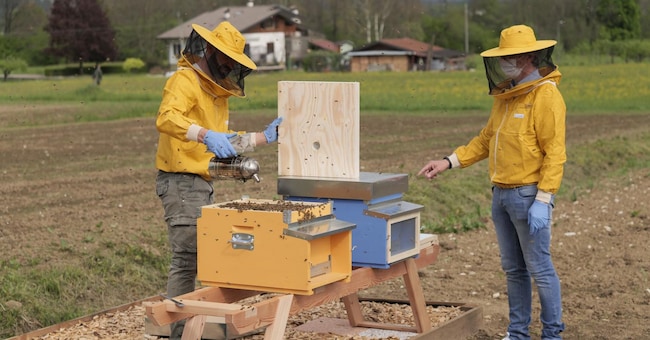
Or again, in the construction of an ecological belt to protect pollinators housed in ten farm beehives, next to which a bug hotel has also popped up to host ladybirds, chrysops, hoverflies, various diptera and lepidoptera. And, again with a view to protection, mention must also be made of the support given to the Ethnographic Museum in Seravella (Belluno), where more than 300 rose plants from farmhouses, villas and parsonages in the province of Belluno have been replanted and catalogued. The well-blooming and biodiversity essences are an active part of the Unifarco products, also known to the general public for the Dolomia phytocosmetics brand and the Ceramol brand (products for skin diseases). Investing in the defence of biodiversity (150,000 euro in 2023) also bears good fruit: roses, marigold, but also wild strawberries and saffron (the 'waste' of the native variety is used here, i.e. the flowers and not the pistils) are used to extract active ingredients for various references in the list. Because at the heart of Unifarco's strategies are also circular economy actions: this is also seen in the use of larch bark, whose patented extract is the basis of Larixicin to soothe coughs and sore throats. Here, the agreement came about through collaboration with a sawmill in the Zoldo Valley. 100 per cent natural industrial symbiosis.

