
Public safety, alert level at its highest: fears of cyber attacks, 30,000 sites under surveillance
Yesterday the Committee met at the Viminale with Piantedosi and the intelligence chiefs. Sabotage and the hybrid threat are of concern, but also rising anti-Semitism

3' min read
Key points
3' min read
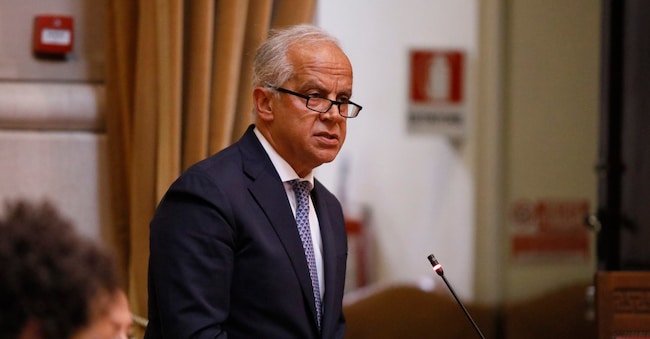
In Italy, the alert level for public security is already at its highest since the beginning of the crisis in the Middle East. And since the attacks in Iran last June, the number of targets considered sensitive and under surveillance has risen to over 29,000, including diplomatic premises, cultural centres and over 10,000 critical infrastructures. The alert around US bases in Italy, from Sigonella to Aviano, had already been reinforced. But the violation of Polish airspace by Russian drones prompted the Committee for Public Order and Safety, chaired yesterday by Interior Minister Matteo Piantedosi, to a further 'update on priorities' for safeguarding public safety.
The point made at the Viminale, attended by Interior Undersecretary Nicola Molteni and intelligence representatives, showed the potential effects of the scenario of new international tensions on domestic security.
Cybersecurity priorities, risk of increased attacks
At the top of the concerns, as confirmed by various sources, is the risk of an intensification of cyber attacks and hybrid warfare, particularly of Russian origin. In its report to Parliament on 2024 activity, the National Cybersecurity Agency headed by Bruno Frattasi had confirmed the exponential increase in digital threats with 1,979 cyber events handled (+40% compared to 2023), with a monthly average of 165. Strictly speaking, real-impact incidents numbered 573, 48 on average per month, up 89% from 2023. Explicit was the report by the Department of Security Intelligence, according to which Russia, the leader of hybrid campaigns, 'is expanding the scope and pace of its asymmetric operations against Western states', with an 'increase in sabotage actions and acts of violence'. Objective: to delegitimise the governments siding with Ukraine.
Fears of sabotage and misinformation
It is precisely sabotage actions that are considered among the main dangers. Last year, Russia was already the first country, followed by Iran and China, by origin of networks engaged in "coordinated inauthentic behaviour" detected by Meta from 2017 to 2024; 1,135 disinformation contents published by pro-Kremlin outlets and 37 suspicious incidents and sabotage reported in Europe. Unparalleled, in the view of the 007s, is Moscow's firepower in the hybrid threat, i.e. its ability to make use of intelligence, press, economic, cyber and diplomatic means, and even military forces. Resorting to organised disinformation as a privileged vehicle.
The episode of the Russian drone intercepted in Varese in March
For some time now, the Defence Minister, Guido Crosetto, has been repeating that a hybrid war is already underway and yesterday he reminded us that 'Russia is also at war with us'. He had also said this last March, when a Russian-made drone allegedly flew over the European Commission's Joint research centre in Ispra, on Lake Maggiore, in the province of Varese, five times. The Milan public prosecutor's office is investigating the case for political-military espionage aggravated by the purpose of terrorism. Evidence of destabilisation, against which the government is raising its shields and may decide to raise the alert level of our armed forces.


