
Want to speak in public effectively and persuasively? It’s all down to practice
Julian Treasure, one of the world’s best-known voice experts, explains how to train one’s voice, posture and memory, but above all how to develop the technique of ‘reflective listening’ to the audience.

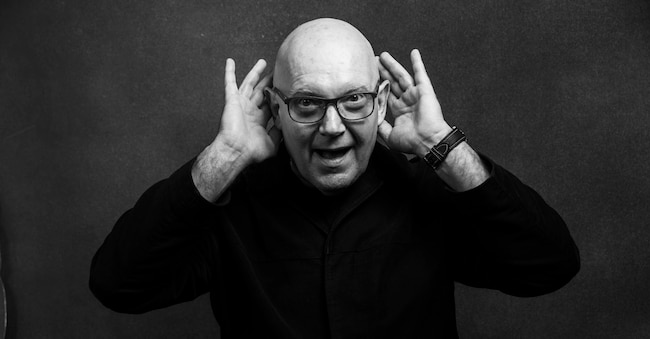
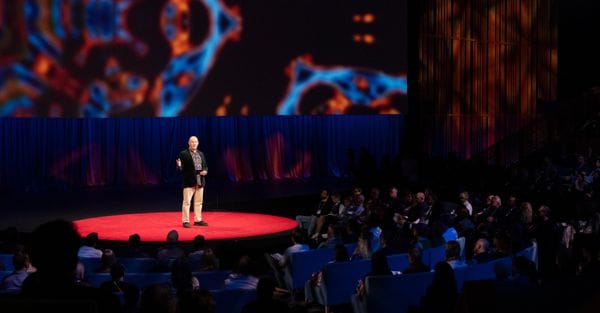
He takes to the stage with the measured composure of someone who has spent years speaking in public, with just a touch of British eccentricity emphasised by a forest-green velvet jacket and a green and gold patterned shirt. The first question is direct: ‘For how many of you is speaking – giving speeches, talks or presentations – an important part of your daily work?’ From the audience – hundreds of professionals and consultants attending the Public Speaking and Storytelling Forum organised in Milan by the Roi Group – almost every hand goes up. “How many of you have received specific training in this?” he adds. There is an awkward murmur and a moment’s hesitation. This time, very few hands go up. Julian Treasure is one of the world’s leading experts on mindful communication, listening and the impact of sound on human life. His TED Talks – including the hugely popular How to speak so that people want to listen – have surpassed 160 million views, making him one of the platform’s most-watched speakers. For twenty years, alongside his coaching and consultancy work, he led The Sound Agency, a company specialising in audio branding and soundscapes for businesses. His passion for sound goes back a long way: as a boy he was a musician, playing the drums in a band, and it was there, he says, that he learnt a kind of multi-track listening: ‘When you play, you have to hear all the other instruments at the same time whilst doing something complex. The neurologist Oliver Sacks described the peculiarities of musicians’ brains very well,’ he explains, before returning to the need to practise before giving public speeches: ‘The voice is the instrument we all play. No one would perform at Carnegie Hall without ever having learnt the piano. Yet, a great many people take to even the most prestigious stages without any training at all,” he emphasises. In his model of powerful speaking, Treasure provides many practical tips for connecting with the audience and identifies the seven deadly sins of communication: gossip, judgement, negativity, complaining, making excuses, exaggeration and dogmatism. ‘Take exaggeration, for instance – typical of digital communication – used to grab attention. We spend our time labelling everything awesome (exceptional), only to risk running out of adjectives when something truly is out of the ordinary. I also suggest avoiding both overly prescriptive and judgemental words, such as the verb ‘must’, and downplaying expressions: in a sentence like ‘I just wanted to talk to you’, that ‘just’ immediately diminishes both the person and the content,’ she emphasises. She then moves on to a proper technical voice workshop, discussing breathing, vocal register, rhythm, pauses, volume and prosody, and getting the audience warmed up with the very same exercises that professional singers do before going on stage: vocal exercises, breathing exercises and lip vibrations. But the aspect on which he places the greatest emphasis is pitch, the height and modulation of the sound. ‘Learning to speak in a low voice, making the ribcage vibrate, conveys calm and authority, and variety of tone is also crucial: monotony lulls the audience to sleep. ‘You Italians have an advantage; like Mediterranean cultures in general, you have a much richer prosody than Nordic countries – more tonal variations, more musicality,’ he observes. And what about gesturing, which is often criticised? ‘It depends on who is listening. An Italian speaking to an audience of fellow Italians makes use of the shared language of gestures. They can be used, provided they are understood by everyone and if they add weight to what is being said, without becoming a source of distraction. Let us always remember that we are speaking to someone else who is listening, and with whom we must connect every single time.’
It is precisely the concepts of audience and active listening that provide the key to the second part of his talk, whilst also illustrating Treasure’s new field of research and the subject of his latest book, *i*: *Listening to the World*. How sound influences our lives and our wellbeing. From the stage, he makes dozens of people jump in their seats with the din of a jackhammer. Immediately afterwards, there is the incessant buzz of an open-plan office, almost physically irritating. Then, the tone changes: the sound of ocean waves, wind in the trees, birdsong – defined by the acronym WWB: Wind, Water, Birds – sounds that the brain immediately recognises as reassuring. The tension eases. This is his way of explaining that sound is never neutral. ‘It influences us even when we’re not aware of it. It can increase cortisol and adrenaline, speed up the heart rate, and disrupt sleep. Or it can calm, regenerate and enhance well-being,’ he says. It is no coincidence that Treasure has always maintained that architects and designers should design with their ears in mind, creating spaces that are healthier and more productive from an acoustic perspective as well.
“Unfortunately, at school we learn to read, write and, to some extent, express ourselves better. Nobody teaches us how to listen. And that would be a real paradigm shift,” he observes. Later, he will explain to me how this lack of a listening culture causes enormous economic damage, citing data and research. According to Gallup’s report State of the Global Workplace, employee disengagement costs the global economy 8.8 trillion dollars a year, around 9 per cent of global GDP. Added to this is the cost of poor communication: a study carried out by Grammarly in collaboration with The Harris Poll estimates that American companies lose up to 1.2 trillion dollars a year due to misunderstandings, errors, repeated information and communication inefficiencies. In the United States, each employee is said to waste almost one working day a week due to internal communication issues. ‘If people aren’t listened to, they stop participating. They don’t put forward ideas. They don’t feel valued. They disengage.’ The problem particularly affects leaders: ‘There is an inverse relationship between seniority and listening. The higher you climb the hierarchy, the less attentive you are to others, because you think your role is simply to speak. Listening, on the other hand, is a profoundly humble act. When I pay attention to someone, I am saying: right now, you are more important than me.’ It is therefore no surprise that one of the central themes of his work has become the crisis of listening in the modern world. A crisis that has been exacerbated by the advent of artificial intelligence and the attention economy. “We live in a world where millions of people suffer from dopamine addiction. They are constantly scrolling through reels, shorts and fast-paced content (Treasure describes it as slop, digital rubbish, ed.) in search of instant gratification, immersed in a noise that is not just acoustic, but above all mental.”
He does not, however, take an apocalyptic view of artificial intelligence. Just a few weeks earlier, he had been at the Ted Conference in Vancouver, where he witnessed the first talk delivered by an artificial intelligence: text generated from a prompt, artificially created images – all produced by an AI. ‘It was impressive, technically flawless. But I believe it will take a very long time before a machine can truly forge an authentic human connection – one that arises from a live conversation, not from emails or messages.’ This is where speaking and listening become even more important. “Organisations that fear technology should focus on developing relationships based on trust, empathy and genuine listening. Customers stay when they feel understood. A machine still can’t do that.” Ultimately, all of Julian Treasure’s work seems to revolve around this idea: listening is not a passive act. It is a way of being in the world and perhaps today, in this age of constant noise, it is also a form of resistance.

