
Puglia: the Taranto-Grottaglie cargo airline makes its debut, serving the agri-food sector in the South
The service, in partnership with Turkish Airlines, delivers cargo to Istanbul and then distributes it worldwide

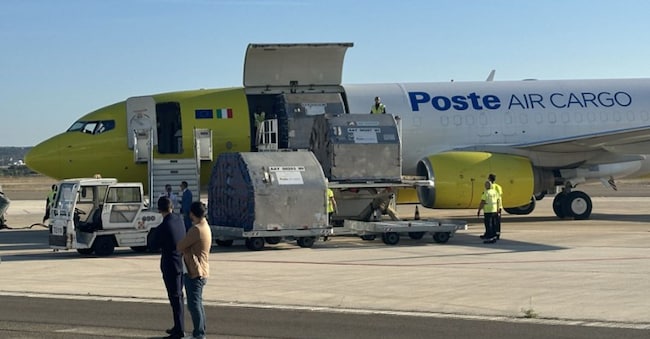
The doors to European markets – and beyond – are opening even wider for Apulia’s agri-food sector and, looking ahead, for the whole of Southern Italy. Whilst until recently Apulian fruit and vegetables had to be transported to the airports in Milan or even Frankfurt to be loaded onto flights, from 3 October they can be shipped directly from home via the cargo service launched by Taranto Airport – Grottaglie. Indeed, the first cargo flight organised by the Puglia Region, Aeroporti di Puglia, Poste Air Cargo, Turkish Airlines and Gesfa, a logistics company, bound for Istanbul Airport in Turkey and then on to 350 possible destinations. On board the aircraft, bearing the white and yellow livery of Poste Italiane, were several pallets of table grapes and plums from Puglia, salad – the latter from Campania – and also mechanical components. The flight – which arrived shortly before 8.30 am on 3 October and departed again after about an hour – reached Istanbul in one hour and 50 minutes. The next departure from Taranto-Grottaglie is on 17 October. Pasticciotti, a traditional sweet from the Salento region, are also expected to be shipped.
Decaro: flights from Istanbul to more than 300 destinations
“I believe this is an important moment for our region and also for Southern Italia,” says the President of the Puglia Region, Antonio Decaro. “We are launching this cargo flight as part of a partnership between Poste Cargo and Turkish Airlines, Turkey’s national carrier. This aircraft will transport goods to Istanbul and from there on to over 300 destinations. We’re talking about the Middle East, Asia, Africa, Northern Europe and North America – so this presents an opportunity for all businesses in Southern Italia, from Sicily to Abruzzo, and in particular for businesses in Puglia. The distance travelled is reduced. It offers cost savings compared to the current hubs in use – which are essentially Milan and Frankfurt – and also reduces export times. This is also to the benefit of product quality, particularly in the agri-food sector. ‘We believe this could be Southern Italia,’ adds Decaro regarding the potential catchment area for cargo flights from Taranto-Grottaglie, “as it will be more cost-effective for businesses from Sicily to Abruzzo to come here than to the Milan hub, which is much further away and involves longer transit times and higher costs for road freight transport compared to using the Grottaglie terminal. Apulian agri-food products currently face higher costs and longer lead times just to reach Milan, including for loading. Here, however, it will be much simpler. We’ll be able to transport fresh produce without necessarily having to freeze it. I’m thinking of what I described a few days ago as the international star of the food world: Apulian burrata. ‘This,’ says Decaro, ‘will no longer need to be frozen, but can be shipped fresh to hundreds of destinations around the world.’ Regarding growth forecasts for the cargo service, Decaro notes: ‘We are taking it one step at a time with the industry operators who have decided to invest. One step at a time because these are companies that normally also have multi-year contracts with air transport hubs, precisely because there are so few of them across Europe. So, as those contracts come to an end, we are confident that, little by little, they will turn to the Grottaglie terminal, which we hope will eventually become a hub.’
Other regions in the South want to make use of the Apulian airport
According to Francesco Paolicelli, Councillor for Agriculture for the Puglia Region, ‘an important opportunity is opening up for Southern Italia. We will also be organising meetings in other regions. Meetings are already scheduled with my fellow Councillors for Agriculture. They are very keen to bring this scheme into contact with businesses in their areas. For them, too, increasing competitiveness means having fresh produce that arrives sooner – such as table grapes, plums and lettuce, which set off today.” Goods, adds Paolicelli, that “reach the point of sale sooner and are therefore more competitive than others. They arrive fresher, at more affordable prices and more quickly. This is precisely what we are doing: enhancing services for farmers and the agri-food industry. This is the peak harvesting season for table grapes, plums and lettuce – the latter coming from a farm in Campania. So we’re already establishing links with other regions through freight forwarders who specialise in this field and are starting to invest. Agreements are already in place with other cargo carriers. The better we are at responding to requests from outside the region, the more this airport will become a hub for southern Italia.”
Aeroporti di Puglia: strong growth for the company and passenger numbers
The chairman of Aeroporti di Puglia, Antonio Maria Vasile, also speaks of an ‘important moment’. He announces that 50 million has been invested in the Salento (Brindisi) airport, 30 million at Taranto-Grottaglie airport, and “the management of Aeroporti di Puglia is truly driving this company towards targets and figures that, even this month, show growth of over 20 per cent”. Furthermore, says Vasile, “traffic in Brindisi continues to grow and this year will reach 4.5 million passengers, a figure we were only due to reach in 2029”. For Vasile, “this is a catastrophic time for air transport. It is a catastrophic time because the price of fuel has a direct impact on ticket prices, on aircraft operations and on the financial stability of airlines. At this moment, as a regional airport system, we must press ahead with completing the infrastructure, because the difficulties we face today will sooner or later be overcome – or things will get worse. Consequently, we must prioritise infrastructure development and the quality of what we do. Artificial intelligence, too – a topic with a significant impact on our airports – will have repercussions in the future,’ explains Vasile, ‘particularly in terms of efficiency and, consequently, shorter waiting times and greater safety. And this is what we are doing, with the support of the Region.’

