The summit

Modi-Xi summit, Trump's tariffs bring India and China closer together

New Delhi and Beijing announced that they would increase economic cooperation and aim to resolve the long-standing territorial dispute that divides them

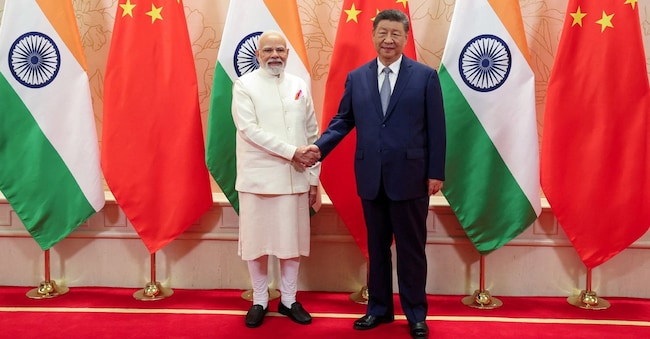
Il primo ministro indiano Narendra Modi accolto a Tianjin dal presidente cinese Xi Jinping in vista del vertice della Shanghai Cooperation Organisation (SCO)

4' min read

4' min read

From our correspondent

NEW DELHI - After years marked by high tensions, Indian Prime Minister Narendra Modi and Chinese President Xi Jinping announced on Sunday that they would resolve the decades-long territorial dispute between the two most populous countries on Earth and increase their economic cooperation at a time when both Asian giants are being targeted by US trade policies.

Loading...

The announcement came during the Indian premier's first official visit to China since a series of clashes on the disputed Himalayan border between the two nuclear powers cost the lives of dozens of soldiers in 2020, leading to an abrupt deterioration of the (almost never cordial) relations between New Delhi and Beijing. Modi's last visit to China was more than seven years ago. The occasion for the trip these days came from the summit of the Shanghai Cooperation Organisation (SCO), a Central Asian, Russian-Chinese-driven political-military forum underway in Tianjin.

"Mutual respect" and "stable relationships"

.

The Indian Prime Minister said that relations between the two countries have moved "in a significant direction" under the banner of "mutual respect and trust", adding that after the de-escalation of the past few months, "there is a peaceful climate" on the border. Xi expressed hope that the meeting between the two leaders would "further elevate" bilateral relations, making them "healthy, robust and stable".

The Chinese president also emphasised that "territorial disputes should not be allowed to define relations with India", stressing that the primary concern of both countries should be economic development. "To the extent that we remain true to the goal of being partners and not rivals, and of creating opportunities for development and not threats, China-India relations will prosper," Xi said.

China and India fought a high-stakes war in 1962 that left, in addition to 3,488 kilometres of disputed borders, a strong mutual distrust. The two countries,' explains Manoj Kewalramani, an expert on Indo-Chinese relations at the Takshashila Institution in Bangalore, 'are engaged in what promises to be a long and complex process of establishing a new balance in their mutual relations'.

The sting of US tariffs

The determination of two distinctly nationalist leaders like Modi and Xi to resolve, in the name of growth, the territorial issues that divide their respective countries is significant of the climate in Asia after the Trump administration targeted the region's major exporters, giving New Delhi and Beijing particularly harsh treatment, with tariffs of 50 and 30 per cent respectively. Definitely higher than those of 19-20% applied to other countries in the region such as Vietnam, Indonesia, Pakistan and Bangladesh, to mention only those with the most overlapping industrial fabrics with the two populous Asian economic superpowers.

Faced with the prospect of a major downsizing of their exports to the United States, the trade diplomacies of India and China have been working for months on expanding their respective spheres of influence - in Asia, but not only there - and overcoming the mutual mistrust that has held back their economic cooperation in recent years.

One of the factors, but not the only one, that is contributing to making the ongoing SCO summit in China a meeting of powers in many cases united by conflictual relations with the West and the United States in particular (Iran is also attending the summit). Proof of this is the presence in Tianjin of Russian President Vladimir Putin, who, not by chance, will meet with both Xi and Modi, two of the few world leaders not suspected of vassalage to Russia who have not condemned the invasion of Ukraine and have financed Moscow with the purchase of huge quantities of gas and oil.

An anti-Western summit

.

In this sense, some of the choices made by the Trump administration in recent months have contributed - and not a little - to Chinese ambitions to present the Tianjin summit to the world as the sign of the coagulation around Beijing of a new world order alternative to the American one. It was not only the US bombings aimed at slowing down the Iranian nuclear programme that weighed heavily, but also the 50% anti-India tariffs, justified by the purchases of Russian energy by Indian oil companies, state-owned and otherwise. A close Trump aide even went so far as to call the conflict in Ukraine 'Modi's war'.

Loading...

Beyond the visual effects generated by the photo opportunities of the summit, the SCO remains an organisation shot through with tensions. Not only because, despite the goodwill of these days, relations between India and China remain complex for a myriad of reasons, including India's growing trade deficit, Chinese hydroelectric projects and the hospitality extended by New Delhi to the Dalai Lama. But also because among the member countries is Pakistan, which, in addition to having an adversarial relationship with India to say the least, has cunningly gotten into Donald Trump's good graces with a promise to nominate it for the Nobel Peace Prize.

Copyright reserved ©
Loading...

Brand connect

Loading...

Newsletter

Notizie e approfondimenti sugli avvenimenti politici, economici e finanziari.

Iscriviti