
Putin against the West: ‘Ready to use any weapon to defend Kaliningrad’
Moscow did not wait for winter and the onset of cold weather to cripple Ukraine’s electricity grid: the first attacks have begun, this time using ballistic missiles

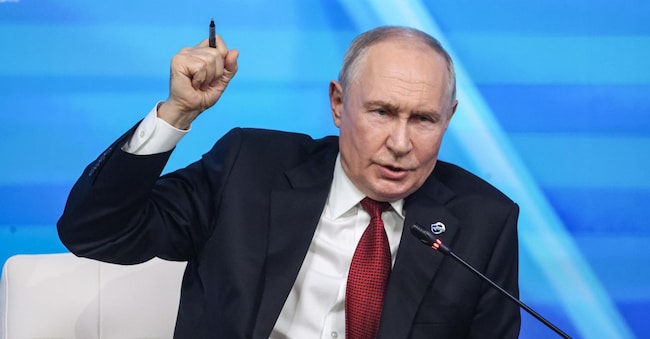
Russian President Vladimir Putin has warned the West against an escalation of the war in Ukraine, stating that Moscow is prepared to use ‘all the weapons’ in its arsenal, including nuclear ones, should its Baltic exclave of Kaliningrad come under attack. Speaking at the Valdai Discussion Club in Moscow, the Russian leader said he had no intention of attacking any European country, but that he was prepared, if necessary, to respond to Western aggression, referring to the Russian territory nestled between Poland and Lithuania, both NATO members. His warning follows recent NATO military exercises near Kaliningrad, which the alliance described as defensive manoeuvres aimed at strengthening deterrence. These exercises have raised serious concerns in Moscow, which warned at the end of September that it would react if NATO attempted to blockade the exclave by air or sea.
“The military exercises in the Baltic Sea, one after the other. Then the attempts to seize our ships and vessels. All of this amounts to an escalation. And then we began to hear statements concerning the Kaliningrad region,” said Putin. “If it were to come to a direct attack against the Russian Federation – in this case against Kaliningrad and possibly against other territories – the question of using all the weapons in our country’s arsenal would inevitably come to the fore. It is inevitable,” he warned.
Meanwhile, warnings from Ukrainian officials about increasingly powerful Russian attacks on Kyiv’s energy infrastructure have already become a reality. Moscow, in fact, did not wait for winter and the onset of cold weather to cripple Ukraine’s electricity grid. The first major attack had been expected in late autumn, but as early as Wednesday, missiles and drones struck a large thermal power station and other energy facilities, shaking the Ukrainian capital, Kyiv, with explosions. In the morning – as reported by The New York Times – several neighbourhoods were without electricity and water. According to Ukrainian authorities, the attack marked the start of a new campaign aimed at plunging Ukrainian cities into cold and darkness, with the ultimate goal of breaking the morale of the population and paralysing the war effort.
Russia has carried out similar campaigns every year, with mixed results, but this winter it is armed with stocks of ballistic missiles and jet-powered drones that Ukraine has struggled to intercept. The scale of Russia’s ambition to subdue the Ukrainians is evident in a document that the Ukrainian energy minister, Denys Shmyhal, showed to European partners in Paris two weeks ago, according to two people familiar with the presentation. Shmyhal reportedly described the document as an intercepted Russian plan to bring about the collapse of the energy system through methodical attacks. The plan, a copy of which was obtained by The New York Times, outlines a campaign of attacks involving the use of up to 1,000 missiles, drones and bombs. The targets are said to include a wide range of infrastructure, such as electrical substations, hydroelectric and thermal power stations, and thermal power plants.
In an interview with the Financial Times , Ukrainian President Volodymyr Zelensky has once again complained about the lack of commitment from allies: Ukraine’s partners are doing “not enough, obviously not enough” to help Kyiv. Zelensky criticised the US and European governments, the business newspaper reports, for what he described as a lack of political will to force Putin to end the war, arguing that Ukraine’s partners possessed the economic and diplomatic leverage needed to exert greater pressure on Moscow. Ukraine is working flat out to produce a high-speed interceptor drone capable of shooting down Russian jet-powered missiles, he further explained. Zelensky stated that five interceptors are currently undergoing testing. By the end of October, he added, Ukraine will be able to produce around 400 units of one of these models. The other four remain in the testing phase.

