Digital Economy

Qualcomm launches Snapdragon 8 Elite: 'Smartphones faster than PCs', but there is threat of lawsuit with Arm

The chip manufacturer unveiled its new smartphone platform that promises to be a huge step forward in performance and functionality

by Giancarlo Calzetta

4' min read

4' min read

Qualcomm has unveiled its new smartphone platform, Snapdragon 8 Elite, which promises to be a huge step forward in performance and functionality. Five focal points of the platform (the Oryon CPU, the Adreno GPU, the Exagon NPU, memory management and power consumption) have undergone such marked improvements that this product designed for smartphones will rival the computer microprocessors of AMD and Intel. Strangely enough, in these days of announcements, a confidential document relating to the ongoing lawsuit between Qualcomm and ARM was leaked, bringing back the diatribe by which ARM would like to prevent Qualcomm from producing Oryon processors.

An all-muscle platform

During his annual Snapdragon Summit event, the company's CEO Cristiano Amon stated in his keynote speech that the newly released second version of the Oryon CPU is the fastest processor ever when looking at the world of smartphones, but in the slide where he compares the performance with competitor products the names of AMD and Intel appear with the AMD Ryzen AI9 HX370 (ah, AMD's taste for easy-to-remember names of its products...) and Intel Core Ultra 7 Series 2 256V (and maybe they know from whom AMD learned ...).

Loading...

The appeal, therefore, to a wider world than that of microprocessors for smartphones is obvious, and Amon reiterates the point by pointing out that the Oryon processor is around 30 per cent faster than the competition for the same power consumption.

Actually, these results should be taken with a grain of salt, as the platforms are very different, but it will be interesting to see in the coming months whether Intel and AMD will really have to worry about smartphone processors as well, in addition to those that make up the Snapdragon X platform aimed precisely at laptops and announced a few months ago.

In the meantime, we can only appreciate how Qualcomm is pushing the accelerator when it comes to the evolution of its platforms. For potential, the Oryon CPU introduced two high-powered units (in jargon 'cores') called Core Prime and six units called Core Performance that supplanted the 'efficiency cores'. By also modifying the memory architecture and some cache functions, it achieved a 45% leap in performance compared to the first version.
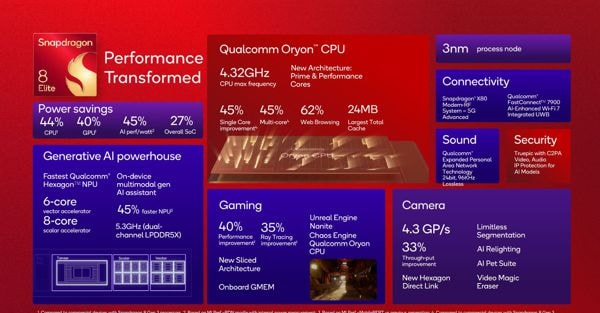

The GPU, an essential node in a world where Videogames are becoming more and more important and gaining space over Cinema and Music, shows impressive improvements with 44% improved power efficiency, 40% performance increase and 35% improvement in ray tracing capabilities.

But the real star of the Snapdragon 8 Elite platform is the Exagon NPU, the chip dedicated to handling Artificial Intelligence tasks. Thanks to a 45 per cent speed increase, 8 scalar accelerator cores and 6 vector accelerator cores, smartphones will now be able to run multi-mode artificial intelligence engines locally. In other words, smartphones will be able to converse with humans ChatGPT-style, examine audio, video and photos, and interact with sensors and creative stuff to respond to our requests. All without the need to connect to the cloud. The new version of Exagon is so powerful that it can delete subjects on the fly in the background of the video footage we are taking: be it people, objects or graphic elements. How long will it be before these devices are also able to replace faces and voices in real time in our videos, allowing anyone to create dangerous tools for misinformation or fraud? We don't know, but it doesn't look like much longer.

A tangible impact on the mobile sector

.

Snapdragon 8 Elite promises to transform not only the way we use smartphones, but also the very role of these devices, which could approach the performance of a desktop PC. The introduction of the new Oryon core could mark a momentous change for the mobile industry, putting Qualcomm at the centre of technological innovation.

With this new generation of processors, Qualcomm is no longer just looking at mobile competitors such as Mediatek or Apple, but is claiming a place in the high-end computing landscape, offering desktop performance in an uncompromising mobile format.

The lawsuit will start in December

All this in the hope that Qualcomm and ARM will come to an agreement to avoid clashing in court. At the heart of the dispute are the miraculous Oryon CPUs that Qualcomm developed from the acquisition of the company Nuvia (which had a licensing agreement with ARM). The latter, sensing that one of its best customers was planning to start producing chips by detaching itself from its technologies, thus limiting the amount of royalties it would pay to it, never wanted to transfer the agreement from Nuvia to Qualcomm and is now threatening to terminate the licence agreements that allow Qualcomm to produce its processors.

Qualcomm issued only a note for comment saying, "This is a further threat from Arm, increasingly unfounded, aimed at intimidating a long-time partner, interfering with our performance-leading CPUs, and increasing royalty rates without regard to the broad rights under our architecture licence." He continues; "With a trial fast approaching in December, Arm's desperate manoeuvre appears to be an attempt to disrupt the legal process, and its request for termination is completely without merit. We are confident that Qualcomm's rights under the agreement with Arm will be upheld. Arm's anti-competitive conduct will not be tolerated'.

Copyright reserved ©
Loading...

Brand connect

Loading...

Newsletter

Notizie e approfondimenti sugli avvenimenti politici, economici e finanziari.

Iscriviti