Letter to the saver

Quantum computers: Rigetti & Co's challenges to technology giants

Focus. Boom on the stock market, also on the speculative wave, of many companies in the sector. The technology is not mature and the quotations are high but the big techs are betting on it

by Vittorio Carlini

(Alamy Stock Photo / via Reuters)

6' min read

Translated by AI
Versione italiana

6' min read

Translated by AI
Versione italiana

The quantum computer. A topic which - unlike Artificial intelligence (Ai) - does not fill the headlines. And which, however, has attracted the attention of investors on the stock exchange. Especially recently. To realise this, one only has to look at some of the performances of companies in the sector. Dynamics which, on the one hand, have been supported by speculation; and which, on the other, must be approached - also because intraday volatility is high - with great, great caution.

Titles and market

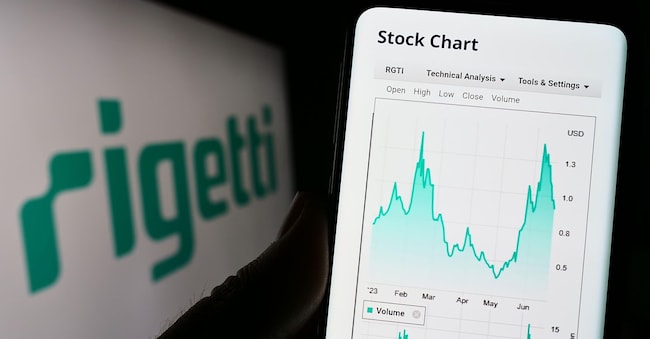
That said, the market numbers describe upward trends. Any examples? IonQ. The company, headquartered in Maryland, has gained 244.3% over the past year. That's quite a leap forward, which, on closer inspection, has mainly taken off since the beginning of last September. At that time, the stock of the company - which offers quantum computing solutions through cloud platforms from Amazon, Microsoft and Google - was hovering around $6.6. Now it dances around the $45 mark. A similar argument can be made in two other cases. The first is that of Rigetti Computing. Only at the end of November 2024, the shares of the latter - active in the sector since 2013 - were 'languishing' at around $3. Then, in little more than a month, the stock rose to $17. The second, however, concerns D-Wave Quantum. Here, the small Canadian company jumped from the two-dollar area to rise - after touching $10 - to the current $9.91. All this with an increase - in the last month - of 258.4%. Faced with such a scenario, the saver - inevitably - asks: what has awakened the interest of traders?

Loading...

RIGETTI E I NOVE MESI

Loading...

The Profit and Loss Account

First of all, it must be emphasised that this is not a reaction to the trend in profitability or, more generally, to the fundamentals. Sure: some improvements in the balance sheet items - as in the case of IonQ - can help. And, however, the companies in question are frontier hi-tech companies which, operating with a technology that is not yet commercially mature, on the one hand invest a lot of money in research and development; and, on the other, so far do not cover their production costs. Thus, IonQ itself - in the fourth quarter of 2024 - reported revenues rising to USD 12.4 million, but - having, among other things, spent USD 33.2 million on R&D - posted an operating loss of USD 65.5 million. Rigetti, on the other hand, posted an operating red of 17.3 million last quarter. D-Wave, finally, posted a net loss of EUR 22.7 million. In short: the market movers are not to be found in the quarterly figures, although these should always be x-rayed.

The race for quantum computing

In reality, other situations or events played an important role. Some of these are related to the individual history of the companies described. Others, on the other hand, are more sectoral in nature, involving several technological giants. In the race for the quantum computer, in fact, several big tech companies are also involved: from Alphabet to Microsoft to Ibm. Is this surprising? "Absolutely not,' replies Roberto Siagri, former founder of Eurotech and current CEO of Rotonium. Quantum computing represents a paradigm leap'. It is a technology that, instead of relying on traditional bits (which use the binary code 0 and 1), works 'with quantum bits. That is, units of information capable of being 'simultaneously' in the two states 0 and 1. Thanks to it, the quantum computer 'is able, among other things, to achieve much greater capacity and speed of calculation than the traditional one. A combination that, for example in the training of neural systems, is very useful. Among other things, to reduce energy consumption'. It is clear, therefore, why 'big companies, active in Ai, want to be in the game'.

D-WAVE E I NOVE MESI

Loading...

True! The quantum computer - operating on sub-atomic scales, i.e. extremely small systems - is highly unstable. It is affected by the slightest background noise and is therefore very difficult to realise. In other words: it is a technological revolution that, despite rapid scientific progress, is - according to several scientists - still a long way off. 'Nevertheless,' Siagri retorts, 'important steps forward are being taken. So much so that within three or four years we will arrive at its use in industry'.

The Google chip

Well: it is precisely one of these steps forward that has contributed to the recent rise of quantum stocks on the stock exchange. On 9 December, Google unveiled a new quantum computing chip: Willow. In the big 'G's' tests on quantum memory - data storage and retrieval - Willow completed the test in no time at all: less than five minutes. The result is truly remarkable: a current supercomputer would have taken several years. That said, however, limitations remain. One example? The still high error rate. Although Willow has shown progress in this regard, there remain obstacles that all players must overcome before quantum computing becomes a commercial product. In fact, many say that it is unclear how long it will take.

IONQ E I NOVE MESI

Loading...

But it is not just a question of news flows related to big tech that can influence the entire sector. There is also news - concerning individual small companies - that has pushed up the prices. Such is the case of Rigetti. The company, on 25 November, announced the successful sale of its stock for $100 million. This was part of the 'at-the-market' share offering programme announced in March. It is clear how - in this case - investors rode the news of the re-financing both speculatively and - more strategically - with a view to corporate growth.

Yes, corporate growth. International business machine (IBM) is among the world leaders in quantum computing. The group - which is so far on track with its road map on the subject - recently announced several technological breakthroughs. Among others - during the Ibm quantum developer conference - is the fact that its Quantum Heron processor can precisely execute certain quantum circuits with up to 5,000 two-qubit gate operations. In short: beyond the individual small companies in the sector, there are hi-tech giants that are betting on the technological frontier in question. Which - according to various experts - can be a way of exposing themselves to 'quantum computing' without running the risks associated with start-ups or companies that are not yet profitable. Ibm itself - although in the last quarter it reported mixed figures with adjusted EPS above estimates but revenues below consensus - can be an example in this sense.

IL SETTORE DEL QUANTUM COMPUTING

Loading...

Market multiples

So far, some suggestions on technology, market movers and players. What, however, are the multiples on the stock market? First, one can look at the small mid caps already described. According to Seeking Alpha, IonQ boasts - as of 29/12/2024 - a Price to Sales over the past 12 months "rolling" of 254.7. While the same indicator on 2024 is 236.3. Needless to say, the multiples are very high. Identical is the film projected on Rigetti's screens. Here, on the one hand, the price to sales ratio (over the past 12 months) is - as of 24/12/2024 of 155.6; and, on the other hand, the prospective Ev to Sales multiple is higher at 282. Finally: D-Wave. Compared to the Canadian company, the rolling and prospective Ev/sales is - as of 29/12/2024 - 238 and 256 times respectively. In conclusion: beyond the individual numbers, these are very high valuations, typical of companies that burn cash and bet on reaching the moment when their solutions/products can translate into real sales and profits.

Different, however, is the narrative - for example - at Alphabet. This has a non-GAAP forward P/e above the median benchmark. But, of course, its solidity - and business prospects in the wake also of artificial intelligence - make it less prone to the volatility that characterises the small mid caps described. In the end, as always in such situations, diversification is an essential approach to mitigate the dangers. In this sense, it may be useful to analyse the portfolio composition of ETFs invested in the quantum computer.

In doing so, one becomes better acquainted with the competitors and prospects of an industry that - however - the do-it-yourselfer must handle with extreme caution, taking into account his or her risk appetite.

To go deeper:

The stock trend

Copyright reserved ©
Loading...

Brand connect

Loading...

Newsletter

Notizie e approfondimenti sugli avvenimenti politici, economici e finanziari.

Iscriviti