
Quantum computing: European digital sovereignty is decided outside the laboratories
Europe excels in research but struggles to fund the growth of its businesses. The Quantum Act will be presented tomorrow. The European strategy for quantum computing is taking shape

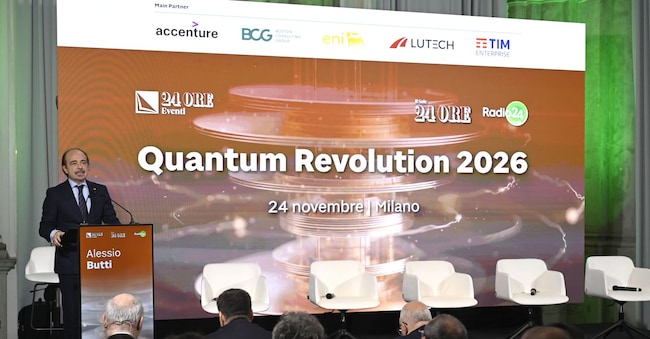
In quantum physics, a system can exist in a superposition of states. European industrial policy has, until now, faced a different problem: research is a priority, but too many companies are struggling to grow here. The figure illustrating this gap comes from the European Commission: in quantum computing, EU companies attract just 5 per cent of global private funding, compared with 50 per cent for US companies. The risk is that we will train researchers and build prototypes in Europe, only to end up buying the resulting technologies from elsewhere.
This is where the debate on digital sovereignty begins. It does not mean producing every component within European borders. It means having the expertise, businesses, infrastructure and freedom of choice in a technology that could have an impact on materials, medicines, security and industrial computing. The market is not yet mature, and the promises of quantum computers have not yet translated into applications that are widely available on a large scale. This is precisely why today’s decisions — who funds the start-ups, who buys the first systems, who controls the supply chains — could have far-reaching consequences for years to come. The first announcement, however, comes from Tommaso Calarco, MUR Expert Coordinator for the Italian Strategy for Quantum Technologies: ‘Tomorrow, the Quantum Act will be presented – the European Union regulation designed to transform the continent’s scientific excellence in quantum technologies into industrial capacity, commercial competitiveness and technological sovereignty. The funding is substantial and will see us climb the rankings for public investment’, implying that we will overtake an absolute leader such as China. But the problem – he emphasised – is the weakness of our production ecosystem. Because we have the same number of start-ups as the United States but only one-twentieth of the private investment. ‘We need private capital to support our businesses,’ and to prevent a ‘talent hunt’ by China and the United States. As Gianfranco Cuscito, Managing Director and Partner at BCG Platinion in Europe, pointed out, ‘we’re good at exploring, but not quite as good at scaling up, and that’s where we need to focus our efforts’. “Quantum computing,” noted Giacomo Cappellini, Technology Officer at Eniquantic, “offers the prospect of a paradigm shift in tackling complex problems, harnessing the potential of quantum mechanics.”
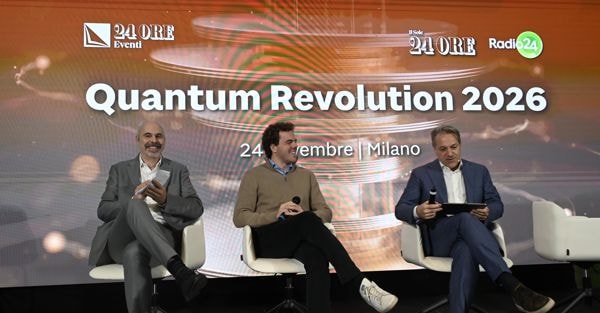
It was precisely on security that the speakers at the conference focused their discussion. A theft has been taking place for years, and almost no one has noticed. It is called ‘harvest now, decrypt later’: encrypted data that no one can read is stolen today, and the wait is on for a quantum computer capable of doing so. It’s like breaking into a safe and keeping it in the cellar until the right lock-picking tool comes along. “There is objective evidence and concrete proof that hostile actors are already intercepting and archiving confidential information (both data in transit via sniffing and data at rest via dumping). Although this data is currently encrypted and unintelligible,” explained Marco Molinaro, Cybersecurity Lead for Italia and Greece at Accenture, “it is being stored to be decrypted in the future as soon as the necessary quantum computing power becomes available.”
“Quantum risk,” added Alessandro Zavatta, CEO of Qti, a Telsy (Tim) company, “already affects today’s data.”
There are two defences, which are very different from one another. Post-quantum cryptography changes the maths: it is software, it scales anywhere, but its security is a gamble. Quantum key distribution changes the physics: if someone eavesdrops, the key breaks and we know it. But it requires fibre-optic cables, dedicated equipment and limited distances. And there is a deadline: the European Union is asking Member States to begin the transition to post-quantum cryptography by the end of this year. That is, in five weeks’ time.Quantum key distribution, or QKD, changes the way two parties exchange a secret key. These are the two answers to the same question: how can we protect communications when quantum computers powerful enough to break some of the encryption used today come into existence?


