
Quantum finance, University of Naples and Intesa successfully test a new algorithm
A team formed by researchers from the Federico II University, Intesa Sanpaolo and the start-up G2Q announced that they have achieved important results in Gaussian quantum sampling, a type of quantum algorithm with potential applications in frontier fields such as quantum machine learning, cryptography and quantum finance

3' min read
Key points
3' min read
Use quantum computing to address and solve more rapidly and accurately complex financial problems, from the development of advanced models for credit risk analysis (credit risk modelling) to the implementation of algorithms capable of predicting the price dynamics of derivative financial instruments (derivative pricing).
The joint Federico II-Intesa Sanpaolo study
A group of researchers from the University Federico II, Intesa Sanpaolo and the start-up G2Q Computing announced that they have achieved important results in this direction, taking a decisive step towards the road to quantum finance. The researchers claimed to have achieved unprecedented performance in performing Quantum Gaussian sampling (Qgs). Quantum Gaussian sampling' is a type of quantum algorithm used to simulate probability distributions with potential applications in a wide range of frontier fields, such as Quantum machine learning, cryptography and, last but not least, quantum finance.
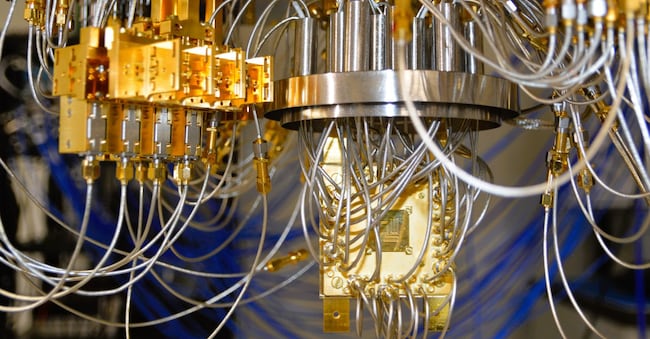
The use of the 25-qubit quantum computer Partenope
.The results were obtained thanks to the use of Partenope, the 25-qubit superconducting quantum computer hosted at the Federico II University and funded by the ICSC (National Research Centre in High Performance Computing, Big Data and Quantum Computing), a platform financed by the NRP that aims to promote the development of hardware and software solutions for quantum computing and the creation of an Italian supply chain dedicated to these technologies.
Corbelletto (Intesa): "Important step towards quantum finance"
"The project," specifies Davide Corbelletto, team leader of the Quantum competence centre of Intesa Sanpaolo, "arose from a need at Intesa Sanpaolo, which had already attempted to run algorithms similar to Qgs on other types of quantum computers, but had run up against a number of machine-level constraints on which it had not been possible to intervene directly until now. This problem,' continues Corbelletto, 'has been solved thanks to the in-depth understanding of the operating mechanisms of the Partenope quantum computer's processor and the algorithmic optimisation skills of the Federico II and G2Q Computing researchers, which have made it possible not only to generate the expected normal distributions, but above all to control their characteristic parameters. This result,' Corbelletto adds, 'assumes particular relevance for quantum finance, which aims to tackle potentially highly complex problems such as credit risk modelling or derivative pricing more quickly and accurately. It also shows how collaboration between the public and private sectors represents an added value for innovation and the development of concrete solutions in the quantum field'.
Tafuri (Unina): 'Our knowledge at the service of business and research'
Thanks to this new milestone, the Centre for Superconducting Quantum Computation at the University of Naples Federico II University is confirmed as a strategic hub of the Italian quantum ecosystem and a successful example of an innovation model that relies on public-private collaboration.


