Advanced Grant Announcement

Pasquale Calabrese, record-breaking quantum physicist receives third Erc grant

The professor from Sissa in Trieste is among the 0.2% of the world's most influential scientists. With the latest EU funding of 2.4 million euros he will study fundamental quantum phenomena and their implications in various fields: from black holes to the computers of the future

by Antonio Larizza

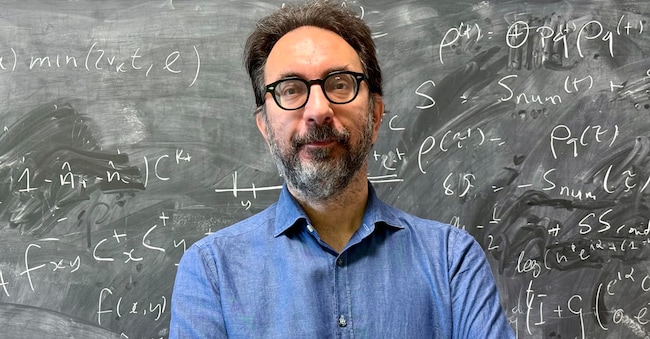
Pasquale Calabrese, professore di fisica alla Sissa di Trieste

3' min read

3' min read

Pasquale Calabrese, a scientist from the International School for Advanced Studies (SISSA), has received the third grant from the European Research Council (Erc), the EU body that funds frontier research.

Professor Calabrese's group will receive EUR 2.4 million for studies that will explore fundamental quantum phenomena - such as quantum entanglement - and their potential implications in different areas: from black holes to the computers of the future. Calabrese will continue his research around the deepest mysteries of matter and quantum physics with his new project 'MOSE-Monitoring symmetries with Entanglement'.

Loading...

Third Erc in 15 years

.

The one just received is the third Erc grant won by Professor Calabrese in less than 15 years, a rather rare achievement given the very high level of competition. The Erc is in fact the most important and selective European research grant. In total, the contributions received by Professor Calabrese with his three Ercs amount to over 5 million euros, again a significant achievement in the field of theoretical physics and beyond.

What is quantum entanglement

Quantum entanglement is the physical phenomenon in which two or more particles that have been interacting with each other for some time remain inextricably linked. Thus, what happens to one of them instantaneously affects the other regardless of the distance between them.

Symmetries and entanglement are two fundamental concepts in modern quantum physics and have revolutionised the way we understand quantum systems composed of many particles. Their relationship is becoming a central theme of current research, with implications in many different fields, such as quantum computing, condensed matter physics and high energy physics.

The MOSE project and the multidisciplinary approach

.

The aim of the MOSE project will be precisely to understand the relationship between symmetry and entanglement in quantum mechanical and statistical systems. The project will use highly advanced theoretical approaches, for example to study entanglement in black hole phenomena. The project will also explore the so-called 'Mpemba effect': a counterintuitive phenomenon in which a hot system can cool faster than a cold one, looking for links between quantum and classical dynamics through symmetries.

While Professor Calabrese's group will handle the theoretical part, an experimental part will be conducted by other groups of researchers to test whether the predictions made can be observed in the laboratory. This interdisciplinary approach will help to better understand fundamental quantum phenomena and their potential applications in quantum devices of the future, such as quantum computers.

Who is Pasquale Calabrese

Pasquale Calabrese, 49, after a degree in physics from the University of Pisa and a doctorate from the Scuola Normale Superiore di Pisa, worked at the University of Oxford and Amsterdam. Returning to Pisa, he then moved to Trieste in 2014, bringing with him his first Erc, entitled Edesqs. His second Erc came with a 2018 Consolidator Grant for the NEMO (New states of Entangled Matter Out of equilibrium) project. "The new funding," Calabrese explains, "will allow me to continue doing research at the highest level and to contribute to making our School even more international and competitive.

Calabrese also appears in the top 0.2 per cent of the world's best-performing scientists according to the 'Career Long' ranking. In the most recent edition of this ranking, published in September 2024 and referring to data updated to 31 December 2023, Pasquale Calabrese occupies position 19,096 out of the 217,097 total scientists taken into consideration and representing, precisely, 2% of the active scientists globally.

Sissa first in Italy for Erc-teacher ratio

Looking at the ratio between the number of male and female scientists and the number of ERC grants received, Sissa Trieste ranks first among research institutions in Italy. In fact, the number of ERCs achieved to date in relation to the number of lecturers is by far the highest in Italian universities with approximately one ERC for every three lecturers, a success rate 25 times higher than the average for the Italian academy.

'That a university institution with fewer than 90 lecturers manages to obtain such a high number of European grants,' comments Sissa Director Andrea Romanino, 'is a sign of the quality and international profile of its teaching staff, of which Professor Calabrese is a particularly prominent exponent. It is a figure that goes hand in hand with that of the percentage of so-called 'top-scientists', also the highest in Italy'.

The Advanced Grant Announcement

The funding received by Calabrese is part of the Erc's Advanced Grant call, which has reached 281 European researchers for a total of EUR 721 million. One of the European Union's most prestigious and competitive calls, it offers senior researchers the chance to pursue ambitious projects that could lead to important discoveries. The new funding is part of the Horizon Europe programme.

Copyright reserved ©
Loading...

Brand connect

Loading...

Newsletter

Notizie e approfondimenti sugli avvenimenti politici, economici e finanziari.

Iscriviti