
Those cosmic neutrinos that help us understand the mechanisms of black holes
Francis Halzen is a scientist who has devoted his career to studying the most abundant, yet also the most elusive, particles in the universe

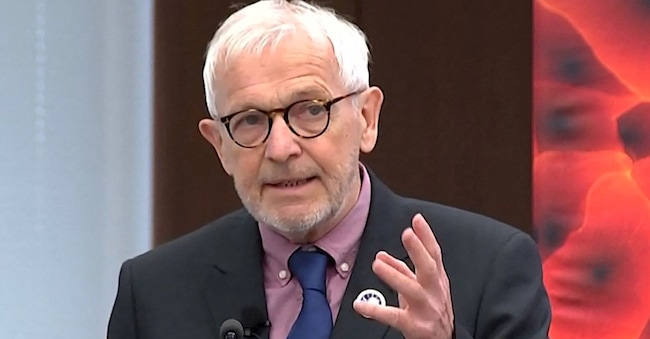
The 2026 Nobel Prize in Physics has been awarded to Francis Halzen, a scientist who has dedicated his career to the study of cosmic neutrinos – the most abundant, yet also the most elusive, particles in the universe. Thanks to the IceCube detector, built at the South Pole using a cubic kilometre of ice at a depth of over two kilometres, Halzen and his numerous collaborators have pioneered neutrino astronomy, which enables us to understand how supermassive black holes at the centres of active galaxies accelerate the high-energy particles that constantly bombard us – particles we call cosmic rays.
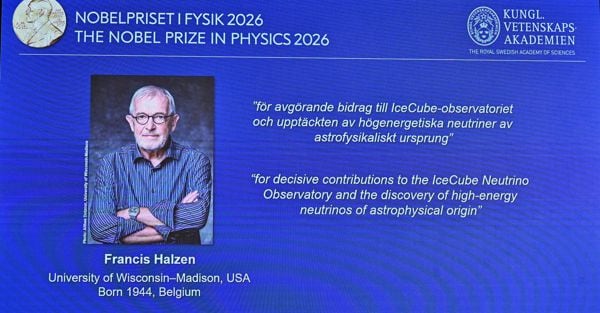
In fact, the citation for the prize reads: “for decisive contributions to the IceCube Neutrino Observatory and to the discovery of high-energy neutrinos of astrophysical origin”.
Born and brought up in Belgium, Francis Halzen graduated from the University of Louvain in 1966. After spending a couple of years at CERN, he visited the University of Wisconsin in 1971 and decided to stay there to build his career. Despite having spent over half a century in the United States, he has retained a strong Flemish accent. It was impossible not to notice it during the telephone call in which Halzen answered journalists’ questions. He made no secret of the fact that he was in Italia, where, after attending the Bergamo Festival on Sunday, he stayed on to work on a future project which, perhaps, thanks to the Nobel Prize, will have a better chance of being approved.
Mark Pearce, chair of the Nobel Committee at the Stockholm Academy, said, “Francis Halzen led an international team of researchers and engineers who have provided us with an extraordinary tool”, adding that “His tenacity and scientific vision have paved the way for a new kind of astronomy.”
In fact, looking back at the key milestones in the history of the IceCube Neutrino Observatory, we find that Halzen first presented the plans for this observatory in 1988, envisaging a huge structure buried deep within the Antarctic ice, capable of detecting the passage of elusive neutrinos.

