
Quincy Jones in the Olympus of Producers
Farewell to the 91-year-old author, conductor, arranger and multi-instrumentalist with an indelible omnivorous spirit
by Enzo Gentile
4' min read
4' min read
When one speaks of a giant and that very definition seems to be narrow, to be even a diminutive: to define a figure like Quincy Jones, who passed away earlier this week, at the age of ninety-one, much of which was devoted to music, for music, would seem a gamble, given the many professions that, like a matryoshka doll, the Chicago artist embodied.
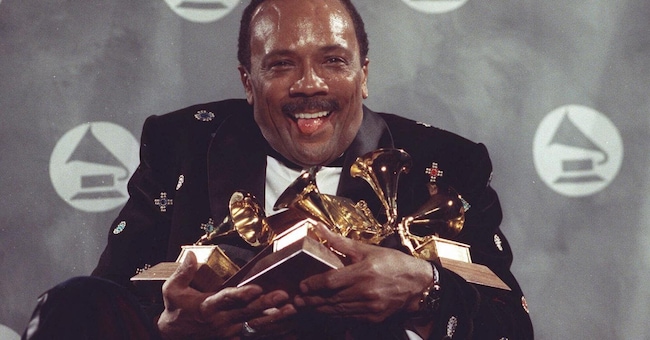
With staggering numbers, a career spanning seven decades, Grammys and honours won in clusters, records made in excellence since the mid-1950s; and then with collaborations made in every field, Quincy Jones has traversed and accompanied great music, starting at the age of fifteen, when he began playing and treading the boards with his friend Ray Charles. It is hard to indicate a ranking of preference among the professions embraced by Quincy: songwriter, conductor, arranger, multi-instrumentalist, between jazz, funky, soul and soundtracks, the imprint left on the terrain of the 20th century remains clearly visible and also linked to the prodigies of so many albums that have gone down in history. But, if one were to emphasise a role that has seen Jones excel, beating out colleagues from different eras, that of producer would put everyone in agreement.
Manufacturer
A delicate, often obscure function, played behind the scenes, when you have to suggest the high road to your clients or protégés, clip the wings of egotism by teaching them how to make the best of themselves: a high-flying coach, a subtle and intuitive strategist, who, in the case of Quincy Jones, not only had to administer taste and a certain feeling for the décor in the sounds, but went directly between the pages of the score, piloted the studio musicians, and then took care of the cuts, the editing, to refine the raw material, to arrive at the sumptuous final product of dozens and dozens of titles. Often the producer operates without being seen, he does not like to be noticed, almost as if the magic potions destined to be distilled for days and nights, months to find the best solution, were an industrial secret to be jealously protected.
The producer, with his name always to be looked for at the bottom of the cover, or in a corner of the booklet inside a CD, which has disappeared more easily now that music has become liquid, with no more collateral information, often has the fate of a creature as fragile as a song, or a record, in his hands.
We are the world (1984)
.Once invested with that responsibility, well positioned on the command deck, he has to interact with the artist or the band, bend their moods along with those of the songwriter, and then choose who actually harnesses the instruments, the sound engineer, through to all the necessary steps to reach the final delivery. A total, painstaking commitment, where the charisma, authority and prestige acquired will be the fundamental tread: that is why, according to common opinion, someone like Quincy Jones will remain at the top of all, in the Olympus.
There is a sequence, in the documentary dedicated to the genesis of We are the world (1984), with the top pop-rock stars summoned in one night in Los Angeles, to edit a song and collect money and aid for Africa, that is particularly instructive: after hours of non-stop sessions, the moment comes for Quincy, producer of the whole operation, to give the reference verse to Bob Dylan, whose notoriously shy and grumpy character we know.
He's holding a piece of paper with his part, while behind him Stevie Wonder is playing the melody on the keyboards: amidst the blizzard of superstars, stars and prima donnas, Jones, in white overalls, approaches Dylan and encourages him, even to the point of teaching him how and what to sing. The expression between incredulity and gratitude of Mr. Zimmermann, an alien monument, is worth director Bao Nguyen's docufilm alone.
With his spirit as an omnivorous musician, capable of producing all kinds of superstars, Jones would indirectly explain to the world, even how to make Michael Jackson the pinnacle, even commercial at the end of the last century. Behind an epoch-making and symbolic album such as Thriller (1982), the best-selling album of all time, at all latitudes - over one hundred million copies estimated -, there is the genius and intuition of a master who, not at all intimidated by Jackson's temperamental tantrums, knew what to say, fixing in the collective memory what unanimously belongs by right to the ranks of masterpieces. The producer, in the popular imagination, is the lider maximo of a record project, the plenipotentiary, but, in the worst case scenario, also a dissipator of energies and finances, in charge of balancing the books, selecting machines and men on which to have the last word.
The (dis)adventures of Jones's emblazoned colleagues have been made the subject of films, as in the case of Phil Spector (on Netflix), obsessions and paranoia in pursuit of success and glory: quite the opposite of Quincy, who spent his life also defending civil rights and freedoms at the highest level.

