Architecture & Design

Rabat, Morocco inaugurates the Mohammed VI Tower. Green, extra-luxurious and disaster-proof With its 55 floors, 250 metres high and 102,800 square metres of floor space, it is among the tallest on the African continent. Inside 36 lifts, offices, residences, a hotel and 4,000 square metres of photovoltaic panels

by Laura Cavestri

3' min read

Translated by AI
Versione italiana

3' min read

Translated by AI
Versione italiana

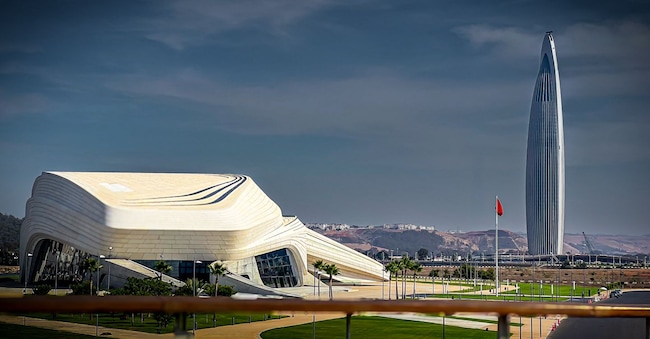
Inaugurated in Rabat on the banks of the Bouregreg River is the Mohammed VI Tower, Morocco's new architectural icon and one of the tallest buildings on the entire African continent. With its 55 floors, 250 metres high and 102,800 square metres of floor space, the Tower stands out as a symbol of the country's urban and cultural rise.

The project

The project bears the signature of Madrid-based Rafael de La Hoz Arquitectos, in collaboration with Moroccan architect Hakim Benjelloun, and combines iconic architecture, sustainability and a high-profile functional mix. Its realisation was initiated by Moroccan entrepreneur Othman Benjelloun, president and founder of O Capital Group, a major player in the Moroccan economy, while project management was entrusted to his subsidiary O Tower.

Loading...


Conceived as a prestigious multifunctional complex, the Tower houses offices, luxury residences, cultural spaces and a Waldorf Astoria hotel suspended between heaven and earth, with interiors designed by Pierre Yves Rochon and a restaurant by Alain Ducasse.

Located in the heart of the oued Bouregreg valley, it is the result of almost eight years of work. The design was inspired by a journey made by Othman Benjelloun in 1969, when he was invited by NASA to attend a flight simulation in preparation for the launch of Apollo 12 to the Moon. From this particularly significant experience was born a dream destined to take shape half a century later: that of a tower whose lines evoked the silhouette of a rocket on its launch pad.

The basement houses a reception hall, several restaurants - including the Brasserie Magnolia signed by chef Lahcen Hafid - a large reception hall, an exhibition gallery and a bank branch. From the 29th floor, suspended between heaven and earth, is a 55-room luxury hotel, under the Waldorf Astoria brand, destined to become the most exclusive address in the Moroccan capital.
On the 50th floor, the Heritage Observatory offers an immersive and interactive experience: thanks to the division of the glass surfaces, visitors can explore the main monuments and sites of interest in Rabat and Salé in augmented reality. Finally, on the 51st floor, the 22-metre high 'cockpit' of the Tower invites visitors to discover the fundamental contribution of the Arab-Andalusian civilisation to the history of astronomy through the exhibition 'The sky speaks Arabic'.

Objective, resist disasters


The realisation, in a 'Design & Build' formula, was entrusted to a consortium consisting of Besix, a Belgian group specialised in the realisation of complex works and already protagonist in the construction of the Burj Khalifa, and Tgcc, a Moroccan leader in the public works and construction sector.

The tower project is part of the desire to create an impressive building, yes in terms of design, but above all green. It was a winning bet because by following the highest environmental standards it obtained the international Leed certification. Technological innovations such as the façade made entirely out of photovoltaic panels together with rainwater harvesting and energy recovery systems helped Mohammed Tower IV win this title.

Furthermore, the presence of 36 lifts allows connections between various levels, not to mention the foundations that are 60 metres deep. This will allow the Moroccan 'colossus' to withstand earthquakes or river floods, not to mention the sophisticated damping system that makes oscillations caused by the wind null or barely perceptible to humans. The south façade and basement are clad with a double skin consisting of 3,900 square metres of high-performance photovoltaic panels, capable of capturing and harnessing solar energy. This solution effectively combines thermal protection and green energy production, in a harmonious balance between aesthetic appeal and technological performance.

French interior architect Pierre Yves Rochon has been entrusted with the design and decoration of elegant, refined and luminous spaces. Spaces that are both contemporary and timeless, in which noble materials such as white marble, engraved bronze, brushed brass, Cordova leather, ceramic zelliges and refined wood panelling find full expression.
Almost 7,000 works signed by some 143 Moroccan and international artists are thus presented to art enthusiasts, creating a veritable artistic itinerary that is fully in line with the vision of Rabat, 'City of Lights, Moroccan Capital of Culture'. This extraordinary artistic selection also includes rare pieces, created in keeping with the Tower's imposing dimensions: monumental chiselled wrought-iron doors, giant sculptures, wall frescoes, painted ceilings, stucco walls and traditional plaster calligraphies, including quotations from the Andalusian Golden Age poets Al Idrissi and Ibn Al Khatib.

Copyright reserved ©
Loading...

Brand connect

Loading...

Newsletter RealEstate+

La newsletter premium dedicata al mondo del mercato immobiliare con inchieste esclusive, notizie, analisi ed approfondimenti

Abbonati