
Racing Bulls on clean energy: Cefla's fuell cell plant in the F1 pole
Inauguration at the Faenza site of the project that provides energy and heat from biomethane produced from the agricultural waste of the Caviro wine cooperative

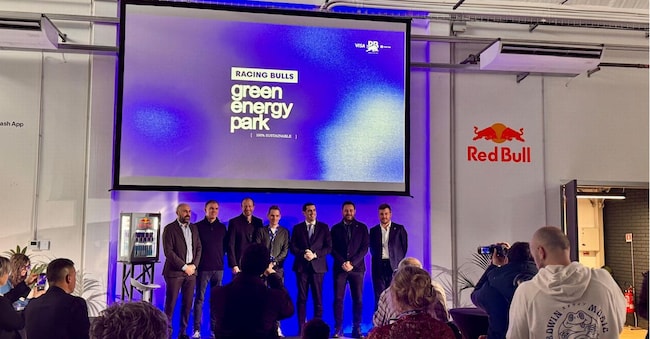
In Faenza, the energy transition takes the form of an already operational industrial plant. Visa Cash App Racing Bulls, the second Formula 1 team of the Red Bull group, presented on 25 February at its production site based in Romagna the Nova project, developed together with Cefla and powered in a circular way thanks to the involvement of Caviro, a wine cooperative from Romagna. Not an announcement of principle, but an infrastructure that produces energy, with numbers and technology that aim to redefine the perimeter of sustainability in motorsport and, more generally, in industry.
Fuel cell technology
The heart of the project is the Nova Solution by Cefla fuel cell plant, integrated in the new Racing Bulls Green Energy Park, an area of 14,500 square metres adjacent to the company's headquarters in Faenza. The technology, which originated in California in the space sector and is now used for industrial applications, allows an average annual production of 4.6 gigawatt hours of carbon-neutral electricity, with an installed power of 550 kilowatts. The system also recovers the heat generated, fully covering the site's heating needs, and starts up without the use of water, further reducing the environmental impact.
Cefla and Caviro
Cefla, an Imola-based group founded in 1932 and now active on an international scale in plant engineering and energy, holds the authorisation to use the Nova patent in Italia. "We are inaugurating a fully operational plant that guarantees energy self-sufficiency to such a prestigious partner," emphasised Gianmaria Balducci, President of Cefla, claiming continuity between the company's engineering tradition and the new frontier of sustainability. The model, however, is not limited to technology. The energy that powers the fuel cells comes from certified biomethane produced locally. This is where Caviro, one of Italy's leading wine cooperatives, comes in, supplying the biomass needed to produce the renewable fuel. The result is a closed cycle: agricultural waste transformed into biomethane, biomethane that fuels the plant, electricity and thermal energy that makes the production site self-sufficient. An entirely local supply chain that combines industry, agriculture and energy.
Replicable example
For Red Bull this is a strategic step in the ESG path shared with Formula 1 and Fia. "We are committed to minimising the environmental impact of our operations and achieving true energy autonomy," highlighted Enrico Fastelli, facility management at Visa Cash App Racing Bulls. "Through strong partnerships with local suppliers we not only reduce emissions, but also promote innovation and growth in the community." The Faenza plant thus becomes a replicable industrial laboratory. If today it fully covers the thermal needs of the Red Bull site and a significant share of the electrical needs, Cefla's declared ambition is to extend the model to other production realities, transforming a technology born for space into a platform for sustainable business competitiveness.

