
Rackets and tea, elegant English tennis in Alassio
3' min read
3' min read
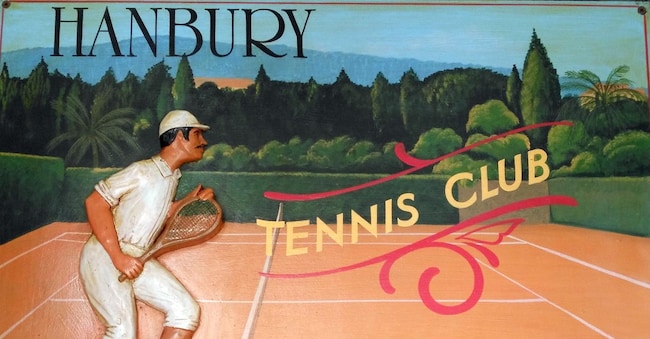
What are the four Australian Davis musketeers - multiple tennis champions Gerald Patterson, Jack Crawford, Harry Hopman and John Hawkes - doing in Alassio in 1928, looking as elegant as they do today? They train, what a question... And they do it in a jewel of a club where English is at home simply because the English founded it over 100 years ago and then relaunched it after the Second World War: it is the Hanbury Tennis Club, which right from its name reveals its identity, with its clay courts, the club house, the black and white photos, and then posters and memorabilia of all sorts. An authentic and unmistakable atmosphere.
Having come to the western Ligurian Riviera between the end of the 19th and the beginning of the 20th century (but passing through even earlier), attracted by the climate, the sea and the landscape, several English families settled permanently in Alassio, creating the English Library (the largest in Italy, after Florence, with a collection of over 15,000 volumes, not including pocket books), the Anglican Church, the club where they met to play bridge and have tea, the cemetery... and of course a tennis club. Initially it was small and unpretentious. But Daniel Hanbury - son of Thomas and nephew of his namesake, the two brothers to whom we owe the splendid Mortola garden - thought big and gave life to the Hanbury Tennis Club, as well as buying Villa della Pergola (now owned by Antonio and Silvia Ricci, who have turned it into a magnificent resort, lovingly tending its gardens, as Stefano Salis recounted in Sole 24 Ore).
It was the year 1923 when the yellow colonial-style building was inaugurated, with a terrace overlooking the seven courts, a wooden staircase leading to the changing rooms, a hall for ceremonies and a guesthouse, Villa Philippa (this was the name of one of Daniel's daughters) for those who wanted to stay and feel at one with rackets and balls. Extraordinary talents passed through there (one for all, the American champion Bill Tilden, considered among the strongest of all time), Open tournaments and prize-giving took place, the leading Italians of that season played there (such as Placido Gaslini, Giovanni Palmieri, Gianni Cucelli) and among the women Lucia Valerio, the 'lady of tennis', the first Italian player to win the Internazionali di Roma in 1931.
A fascinating world - made up of long trousers and graceful dresses, cups of tea and fierce challenges - well reconstructed in the special issue of "Alassio magazine" edited by Magda Rosso and Bruno Schivo (with texts in Italian and English) for the centenary that fell last December. The editors recall the arrival of the darkest hour, described by Gianni Clerici in Alassio '39, the chapter of his famous The White Gestures in which the protagonist Giovannino, 9 years old and a pupil of the gruff tennis teacher Sweet (who really existed) at Hanbury, understands that suddenly everything is tragically coming to an end: with fascism and war looming, the British will leave Alassio, shortly afterwards there will be the German occupation, it will seem like a point of no return.
The damage was severe, the Nazi command used the camps as corrals for horses. In fact, after the conflict, the British gradually returned, including Daniel Hanbury and his second wife Ruth Hardinge, who tried to animate the English community by, among other things, spending time on the reopening of the library (to which the publication edited by Alessandro Bartoli, La English Library di Alassio 1875-2022, Marco Sabatelli editore, 2022, is dedicated). The club came back to life after restoration work, even surviving the founder's sudden death in 1948. But Ruth cared as much about that jewel as her husband did, and entrusted it to the care of her lifelong operations manager, Percy Goodchild.


