Aeronautics

'Radia will produce the WindRunner in Grottaglie: first flight planned for 2029'

Giuseppe Giordo, president and CEO of Radia Italia explains the stages and requirements of the project to build the world's largest aircraft in Italy

by Vera Viola
3' min read

3' min read

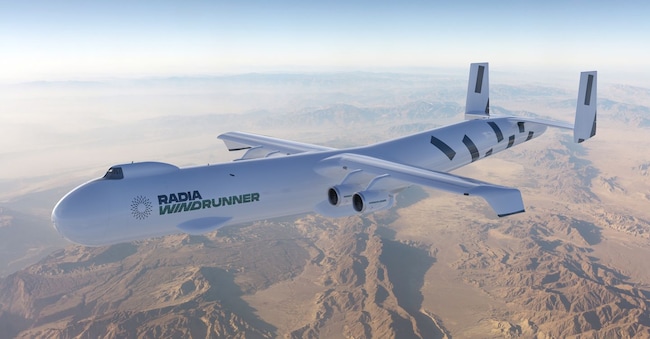
The first flight is scheduled for 2029 and the first aircraft will be delivered in 2030. The WindRunner will be twelve times larger than the Boeing 747, and will be able to land on unpaved runways. To date, the preliminary engineering has been completed, the WindRunner has been analysed, and the main suppliers, including Leonardo and Magnaghi, have been chosen. We must move on to industrialisation and then production as soon as possible.

The speaker is Giuseppe Giordo, former CEO of Alenia and now president and CEO of Radia Italia. A subsidiary of the US parent company that was founded in 2016 on the initiative of MIT aerospace engineer and ceo, Mark Lundstrom. From the outset, his project rested on the idea of putting aerospace technologies at the service of wind energy production. And since this sector requires very large blades, even more than 200 metres long, which are impossible to transport by road, Radia decided to design and build the WindRunner.

Loading...

Will it really be the largest aircraft ever built?

That is how it is. Conceived to transport components for wind power plants, we realised along the way that in other sectors there was a need for an aircraft with these characteristics. For example, in the defence field, because even in the military field there is no such aircraft for strategic transport. Moreover, we have already had feedback that there would be great interest from both Europe and NATO in acquiring one. More generally, the WindRunner will be able to transport large cargo and could be useful to the aerospace sector. In short, we are convinced that there will be a market for it in various industrial sectors.

The choice of location fell on southern Italy: why?

For three fundamental factors. First of all because in Italy, and especially in the Mezzogiorno, there is expertise from large and small companies. Then because there are no conflicts of interest, I mean large construction companies with their own competing programmes. Lastly, we thought of an investment in southern Italy because public funding is available there: this is a business initiative that could relaunch civil aeronautics, which is in crisis in Italy due to the absence of a new industrial project. And for an investment of this type, there is no way around it.

There is talk of a 3 billion investment: correct?

We think that the investment, not defined in total but undoubtedly in the billions, should be private for 40% and public for the remainder. We have already had contacts with private investors, Confindustria is close to us, the Brindisi territorial with the director Angelo Guarini is very active in fostering links, and also with institutional players: from Mimit to the Regions concerned, and the Zes. We decided to use existing manufacturing technologies to speed up production and to contain costs that would otherwise have exploded.

So all made in Italy? .

Almost everything. The design phase was handled in the USA. As for the necessary certifications, we decided to equip the aircraft with both American and Italian ones. So it will be tested by Fia, the Federal Aviation Administration, the American body that regulates and supervises civil aviation, and also by Enac.

Are some regions also involved?

Puglia, Campania and Calabria. The first two because they boast important aerospace industrial poles with research centres and infrastructure. As for Calabria, we plan to set up a training school there to train Radia personnel. We expect to hire 2500 people.

The financial picture remains unclear.

It is now necessary to clarify how it will be possible to access the funds. And this is necessary in order to take further steps: from the last quarter of 2025 we will move to industrialisation and it is necessary to have certainty of funding.

In detail, how will you organise production?

The actual production will be carried out in suppliers' factories, everything will then flow into a final assembly line in a new Radia plant in Grottaglie, Apulia, near the airport.

Copyright reserved ©
Loading...

Brand connect

Loading...

Newsletter

Notizie e approfondimenti sugli avvenimenti politici, economici e finanziari.

Iscriviti