
Radiohead are back. Thankfully
Four dates in Bologna for Thom Yorke's band, back to perform live after seven years of silence

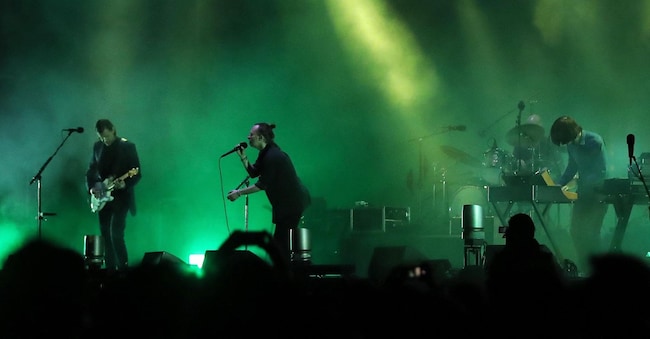
Radiohead are back, after seven years off the stages and almost a decade without new music. In the year of the most talked-about reunion in the history of rock - that of Oasis - Thom Yorke's band also returns to perform live: a European tour in just five cities, which opened in Madrid on 4 November and landed on 14 November at the Unipol Arena in Bologna (the first of four Italian dates, all sold out), before continuing on to London, Copenhagen and Berlin. The parallelism with the Gallagher brothers stops here. Not only because Radiohead had never really disbanded, limiting themselves to a long hiatus that allowed the members to follow other paths and immerse themselves in other sonic forms (Atoms for peace, The Smile, to name but two). The substantial difference, in the Oxford quintet's comeback, was the absence of the most awaited guest of any retrospective exercise: nostalgia. No self-celebratory pilgrimage into the past, no commemorative liturgy, no building of shrines dedicated to the Cool Britannia years: in Bologna, a show was staged that spanned more than thirty years of repertoire with awareness and maturity, as if those songs had never stopped growing and evolving. Fifteen thousand people accompanied the opening of the concert with Planet Telex (first song from The Bends, 1995) dissolving the temporal distance and catapulting the band into the present.
Then, for just over two hours, it was a grandiose, almost hellish up and down between different eras and records, between rock ballads, psychedelic distortions and powerful drum rolls: 2 + 2 = 5, Sit down. Stand op., Bloom, The gloaming, There There. The intimate and sweet peak of No surprises (from OK Computer). Everything in its right place, the opening song from Kid A, the record that in 2000 revealed Radiohead at ease among synthesisers and drum machines. Then came The national anthem, Daydreaming and the rhythmic beats of Idioteque. In the grand finale came Fake plastic trees, Let down, Paranoid android, A wolf at the door, Just and Karma police. The absence of Creep, long since expunged from the repertoire, counts as a statement: there is no place here for forced returns to adolescent traumas, although the song of the 'little monster' with low self-esteem certainly soundtracked the youth of much of the audience present.
A textbook concert, which perhaps would have deserved a more noble context than the palasport in Casalecchio di Reno, but that's another matter. In that neutral, almost anonymous space, the show nevertheless unfolded in its fullness: central stage, democratically surrounded by the audience on all sides. Around the band, twelve vertical screens rise and fall like moving panels, projecting now abstract visuals, now close-up details of instruments and artists' faces: the images deform and recompose, as if the music could be translated into light impulses. On the circular stage, Thom Yorke almost never stops moving: he dances, twists, jumps and has fun, with an energy and physicality that he certainly did not express when he was in his twenties (he is now 57). He does not speak, not this one, except to thank the audience and to ask, as if to verify that the only important thing is that, if the music "feels good?". Many, inside and outside the arena, perhaps expected more words: the issue of the conflict between Israel and Palestine has hovered over Radiohead's perception for several years now. In 2017 they had played in Tel Aviv, and had been overwhelmed by criticism, including from director Ken Loach and Roger Waters (formerly of Pink Floyd), who had asked them not to perform. Jonny Greenwood is married to an Israeli and has collaborated with Israeli artist Dudu Tassa (the duo had to cancel several concerts planned in England in June). Many things have been said and the BDS (Boycott, Divestment, Sanctions movement) has called on fans to boycott this tour. In a recent interview with the Sunday Times, Yorke stated - among many other things - that he will no longer play in Israel as long as Benjamin Netanyahu's government remains in office.
It is hard to say whether the conclusion of the concert was in any way an answer: the band chose to project the Universal Declaration of Human Rights on the big screens. Did they want to say something? Perhaps. Or, more simply, that was not the point of their reunion.
If one regret remains, it is the tortuous procedure of buying tickets with compulsory pre-registration on the website and waiting for a phantom 'code', like a lottery draw, to access the actual online sale: ideally designed to limit scalping and secondary ticketing, it turned into a complicated and frustrating experience. True, times have changed, and at least Radiohead have not inflicted their fans with the additional scourge of dynamic pricing, but the feeling remains that they could have done better. It is the only discordant note in an evening that, above all, revealed the direction in which Radiohead seem to want to go today: a music that no longer belongs to just one generation, but to a transversal audience. Hence the increasingly clear impression of their 'pinkfloydization' (forgive Roger Waters for the juxtaposition and the neologism): let's be clear, for years the British band has been compared to Pink Floyd, in an almost predictable parallelism that emphasises musical and technological experimentation. But in this live reunion - there is no new record on the way, or at least, nothing has been declared to that effect - another aspect has become evident: the same ecumenical vocation, the same ability to create a transversal community around sound, rather than myth. The band rejects nostalgic worship and reaffirms its desire to - in some way - dialogue with everyone, without entrenching itself behind the unforgettable anthems that have consecrated it. And so, one of the most moving aspects of the evening is to see rows of twenty-somethings moved to tears during Let Down: it matters little that the song is back in fashion thanks to TikTok, used as a soundtrack by teenagers for their most emotionally charged videos, because what you are witnessing is not kids listening to those songs as relics of a glorious past, but as music of the present. They get excited at every turn of the chords, scream "I don't believe it" when they realise they are about to hear The gloaming (from 2003's Hail to the thief) live, and deliver a singalong that, in some ways, surprises and comforts.

