
Rai, Mediaset and Sky account for 67 per cent, but streaming platforms are growing and have now become the fourth major player
Netflix, DAZN, Amazon and Disney+ account for 23.3 per cent of the TV market’s resources. Fibre-optic coverage has risen to 77.6 per cent of households, but the take-up rate for 1 Giga remains at 11.8 per cent

Rai, Sky and Mediaset remain in the lead, but their dominance is waning. The three major operators still control 67 per cent of the Italian TV market: Rai with 26.6 per cent, Comcast-Sky with 22 per cent, and Fininvest-Mediaset with 18.5 per cent. This snapshot highlights the strength of the incumbents, but also the pace at which the centre of gravity is shifting. Netflix, DAZN, Timvision, Amazon and Disney+ account for 23.3 per cent of the TV market’s share (+11 points compared with 2021). They are no longer mere participants in the system: they are the fourth major player, capable of attracting audiences and subscriptions.
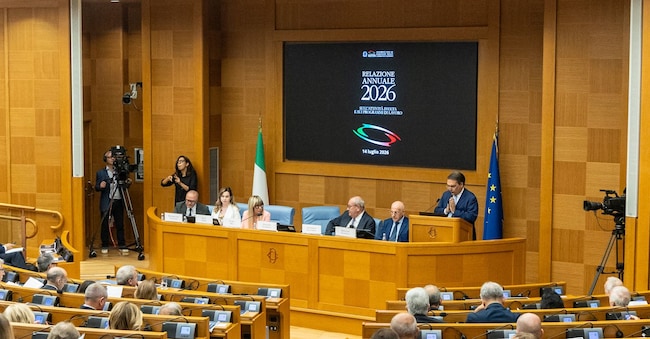
AGCOM’s Annual Report, presented by Giacomo Lasorella to Parliament, paints a picture of a market that is less stable than it appears. Television is holding its own, the internet is thriving, and daily newspapers are in freefall. The most stark figure concerns the latter. By 2025, the circulation of print copies had plummeted to 1.2 million per day – a fall of 9.3 per cent in a single year and almost a tenth of the figure at the start of the century. Revenues for publishing companies fell by 7.9 per cent; those from the sale of newspapers, including digital editions, by 8.7 per cent. Revenue from ancillary products fell by 23.6 per cent, whilst advertising revenue fell by 5.7 per cent. Without public funding – which now accounts for nearly 10 per cent of the sector’s resources – as highlighted by the Agcom chairman, part of the publishing industry would already be beyond the point of sustainability.
As for the television sector, it recorded revenues of 8.9 billion euros, up 0.6 per cent. Pay-TV services, both online and traditional, represent the primary source of funding at 43.6 per cent; followed by advertising, which fell to 34.5 per cent, and public funds – including the Rai licence fee – at 21.9 per cent. This confirms that funding is increasingly shifting towards access to content and away from advertising breaks.
Television remains the giant of traditional media, accounting for 74.1 per cent of resources; newspapers and magazines have slipped below 21 per cent. But the real dividing line no longer runs between TV and the press. It runs between national operators and global platforms. In the Integrated Communications System, Google is already in second place behind Rai with 11.8 per cent; Meta exceeds 8 per cent. Online advertising is worth 7 billion and is growing by 12.2 per cent, whilst advertising in traditional media remains stable at around 5 billion.
Artificial intelligence adds a new dimension to this imbalance. Answer engines are replacing traditional search engines: users no longer click on links, but receive a concise answer. According to Lasorella, ‘providing an answer based on artificial intelligence, rather than a reference to a variety of sources, risks in itself impoverishing the diversity of voices in public debate’. It is an industrial shift even before it is a technological one. If platforms absorb content, summarise it and retain the traffic, publishers bear the costs of journalistic production whilst losing readers, advertising and subscriptions.


