Middle East

Randa Masoud: 'The situation in Gaza has not improved'

The medical coordinator of Médecins Sans Frontières describes a very serious crisis. Tramballi: 'It is a war of revenge. The government's intent is the expulsion of the Palestinians'

Roberto Bongiorni

Gaza e Cisgiordania da non dimenticare

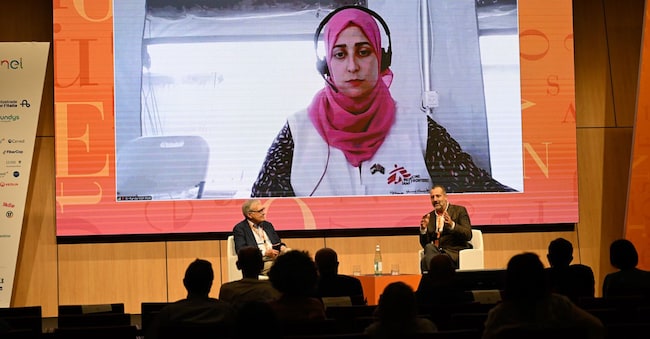
Nella foto: Ugo Tramballi; Roberto Bongiorni; Randa Masoud (in videocollegamento)

3' min read

Translated by AI
Versione italiana

3' min read

Translated by AI
Versione italiana

- "It is embarrassing and painful to have to admit that, seven months after the so-called ceasefire, the situation has not improved at all. The sanitary conditions remain catastrophic'. For a few minutes, Randa's voice croaks, comes in hiccups, but her image remains clear. As if she were only a few kilometres away, and not in a clinic in the Gaza Strip, in the city of Deir el-Balah. Randa Masoud has been the medical coordinator of Médecins Sans Frontières since 2024, but has been working in emergency health planning in the Strip for 14 years. Her speech at the Trento Festival of Economics, in the panel "Gaza and the West Bank not to be forgotten", is a description of a crisis that is still very serious: the ceasefire wanted by US President Trump has not produced concrete improvements. "Before the ceasefire there were more than 72,000 dead and more than 172,000 injured. We thought that at least the killings and injuries would end, but Palestinians continue to be hit every day'.

'On 11 May,' the worker continues, 'a bombing hit a shelter for displaced people full of women and children, 400 metres from a Médecins Sans Frontières facility. A few days later, on 17 May, another attack hit a community kitchen distributing food to displaced people, causing three deaths and numerous injuries'.

Loading...

According to data from the Gaza Ministry of Health and the World Health Organisation, quoted by Randa, 50% of essential medical supplies are exhausted, including basic medicines and chemotherapy. Only 53% of hospitals and 58% of primary care centres are still partially operational.

Masoud (MSF): nonostante il cessate il fuoco continuano attacchi a Gaza

The services, all services, in Gaza are in a catastrophic situation. The committee of Palestinian technicians chosen mainly by the Board of peace, which was supposed to provide emergency management, has never entered the Strip. "Access to drinking water, sanitation and hygiene products remains extremely limited. Rubbish accumulates everywhere. I have been working in Gaza for over 14 years, but I have never seen rodents biting the faces of children and infants".

There is also another major emergency that is little talked about: mental trauma, the wounds of the soul. "The WHO and the Health Cluster," continues Randa Masoud, "have verified that more than one million people in Gaza need psychological and psychosocial support. A 2025 study of adolescents in the Strip found that about 80 per cent have symptoms of post-traumatic stress disorder'.

"If this problem is not addressed quickly, the damage will drag on in the long term, with the risk of hundreds of thousands of people unable to provide for themselves and their families".

A situation that is destined not to improve, at least in the short term. The perception in Israeli society is that coexistence with the Palestinians is no longer possible. This is explained by Ugo Tramballi, columnist for Sole 24 Ore and scientific advisor to Ispi . "The 7 October attack for the Israelis was a trauma from which they have not yet recovered. They do not realise that the war waged by Israel, even after the ceasefire, is not only a war for security, but also one of revenge for what happened in the kibbutzim on the border with Gaza".

The current conjuncture does not appear favourable. The Israeli government led by Netanyahu continues to take a very hard line. "According to an important Israeli think tank," Tramballi points out, "over 67% of Israelis believe that the birth of a Palestinian state represents a danger to national security. This means that even many moderate and left-wing Israelis, including part of the opposition to Netanyahu's extreme right-wing government, do not want a Palestinian state. A position that will make Israel's future extremely complicated'.

And while Gaza is back in the international spotlight, in the West Bank, almost in silence, violence against Palestinians committed by the most extremist fringes of the settlers continues, along with the acquisition of land and the construction of new outposts. Their growth is proceeding at an unprecedented pace, as are the acts of violence. "By now one can no longer even speak of a slow and progressive occupation of the Palestinian Territories. The intent is to provoke the expulsion of the Palestinians. But this is not only the policy of the far-right parties in the government, those of Itamar Ben Gvir and Bezalel Smotrich. It is the position of the entire Netanyahu government'.

The coming months could mark a turning point. It is not yet clear in which direction. 'Paradoxically, the next election, scheduled between September and October, will not have the Palestinian issue at the centre of the debate, despite the fact that it is precisely the one that will define the future of the State of Israel,' Tramballi concludes.

Copyright reserved ©

Brand connect

Loading...

Newsletter

Notizie e approfondimenti sugli avvenimenti politici, economici e finanziari.

Iscriviti