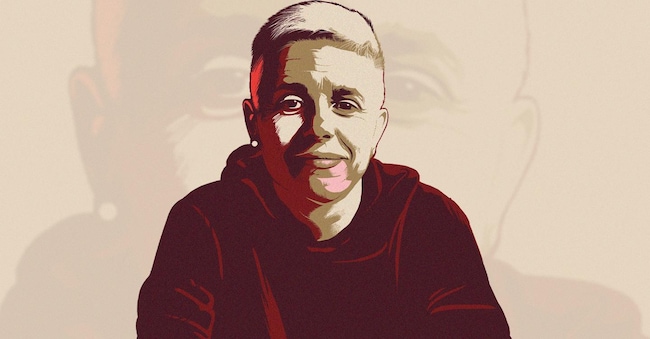
Paola lives in Milan with her 21-year-old daughter Beatrice. She was born in Genoa. She, born in 1968, grew up in Quarto, a petty bourgeoisie of the port and clerical class of the then flourishing public industry: 'I remember six buildings of seven floors each. You saw children everywhere. We were playing in the streets. We were at the height of the birth boom. At the Italo d'Eramo primary school, the first year my class was drawn for the second shift: we went to school in the afternoon. My mother Armanda was from Novi Ligure and worked in the family rotisserie in Corso Buenos Aires, Genoa. My dad Ermanno was an Istrian exile. He and his family had lost everything with the occupation of Zara by Tito's communists, except their love of the sea. At the age of 14, he was a deckhand on ships. Later working with shipping and insurance companies, he specialised in inspecting and assessing ships that were detained in the world's most distant ports. And, from those trips, he would bring home vinyls and cassettes with the most diverse music. In 1978, on his return from Japan, he gave me the first Sony Walkman'.
As a super-healthy starter I get spinach. She, on the other hand, chooses green beans with butter. Her passion for rap music began in 1987: 'I had an American boyfriend, Richard. I went to visit him in Washington. And I came into contact with the four forms of that new popular culture, which we knew nothing about in Europe: rap, dj-set, graffiti and break-dance. In the 1990s, that culture also spread to Italy. In music, groups like Sangue Misto, Articolo 31, Sottotono and Lugi were doing interesting things. In graffiti, I was lucky enough to meet Phase 2 and in breakdancing, monsters like Crash Kid, from Rome, and Next1, from Turin'. Paola, meanwhile, graduated in pedagogy: 'At university I wanted to enrol in psychology, but Genoa lacked it. I am very happy with my degree. I took a variety of exams, from educational subjects to psychology, from history to sociology. This study helped me to build a bottom-up and at the same time profound view of reality and of others. The Magisterium building was in the Brignole area. Today the Buridda social centre stands in its place'. After graduating, Paola moved to the German-speaking Swiss canton to teach Italian. And she writes for 'AL Magazine', a fanzine that closes in 2000.
For the main course we both choose a sea bass in salt, covered with tiny cut vegetables dipped in balsamic vinegar and surrounded by boiled squash blossoms. "The early 2000s," he observes with the precision of someone who understands the intimate connection between processes and people, business and art, "were marked by the spread of the internet and music piracy. Digital had not yet been institutionalised and regularised as it has been in recent years. I started at that time: it was the low point. It was a wild time. All forms of new music were being both exalted in their dissemination and torn down in an attempt to make it, as those who speak well of it say, an industry. One only has to think of Fabri Fibra's Mister Simpatia, self-produced in 2004, which did very well in the underground and was super-exploited by piracy. At the time, however, the discography in Italy did not believe in rap. The heads of the record companies were often very good, but they had an old ear'. This long experience has now come together in the book co-written with Claudio Cabona Explicit Lyrics. Nuovi stili di censura (Mondadori).
The first artist accepted by the multinationals was Fabri Fibra who, with the album Tradimento produced in 2006 by Universal and edited by Fish of Sotto Tono, sold 100,000 copies. 'I owe a lot to Fabri,' says Paola, 'because I sought him out and we worked together when no one wanted to, but when the record company thought of giving the recording budget to others, because I had never done it and because I was a woman, he imposed himself and said: "no, no, let her do it". Our environment is competitive and male. The fact of having the trust of men who are charismatic and impactful in their own way, like Fabri Fibra and like Marracash, whom I trusted at the beginning and continue to trust, has helped me a lot as a person in critical moments. It is friendships and collaborations between strange and non-standard people, as we all are, that in the end produce quality, research, numbers'.
The small artistic, human and professional community that Zukar lovingly describes is made up of a woman from Genoa - so particular and lateral compared to the average Italian anthropology as to be completely out of any self-promotional project hypothesis of female lobby and pink maphia - , by a provincial from Senigallia like Fabri Fibra who has a violent unresolved anger towards respectability and the family institution, by a Milanese from the Barona area, the son of Sicilians from Nicosia, so Saracen in his features that as a child he called himself (with normal contempt from others, to his real sorrow) Moroccan-Marrakech and had such a refined and powerful writing talent that as a boy and as an adult he became Marracash, the 44-year-old author of the album Persona, one of the most beautiful and new things written in the Italian language in recent years. Now, Madame has been added to the small community built around Paola Zukar. "Madame is from Creazzo, a small town in the province of Vicenza. I noticed her when I saw a video of the song Sciccherie on You Tube. I liked her immediately because she has no stereotypical beauty, dances well, and writes even better'.