
Enlargement report: EU supports Ukraine
The European Commission has backed Kiev on its path to EU membership. In an annual report on the future of enlargement, the EU executive also expressed optimism for some countries
From our correspondent Beda Romano
 Aggiungi Il Sole 24 Ore
ai preferiti su Google
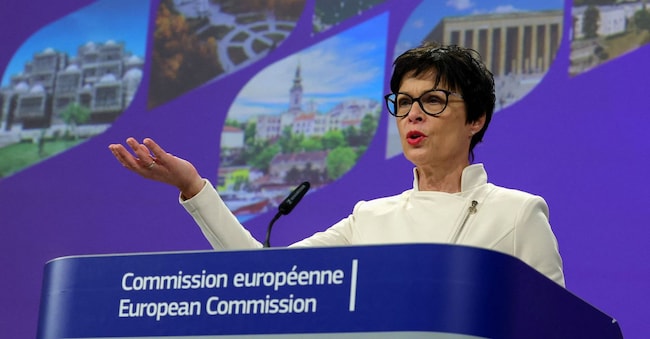
BRUSSELS - The European Commission yesterday gave its support to Kiev on its path to EU membership. In an annual report on the future of enlargement, the EU executive was optimistic about a number of countries. Besides Ukraine, it mentioned Albania, Montenegro and Moldova. While reassuring the member states, he assured that after accession specific safeguards will be indispensable to avoid dangerous backward steps on the rule of law front.
"Considering the pace achieved by some candidate countries, an enlargement is a realistic possibility in the coming years," said the Enlargement Commissioner Marta Kos, without making precise predictions. "Our candidates have ambitious goals: Montenegro wants to conclude negotiations at the end of 2026, Albania at the end of 2027, Moldova and Ukraine in 2028. The subsequent ratification process, the Commissioner reminded a press conference, takes 'one or two years'.
2026 decisive year
The European Commission explained that 2026 will be 'a moment of truth' for future EU enlargement. To tell the truth, Hungary has so far opposed the opening of actual negotiations with Ukraine (see Il Sole/24 Ore of 10 October). More generally, Brussels' optimism clashes with the cautiousness of many member states, worried both by new accessions and by the possible hypothesis of putting their hands on the Treaties to adapt the Union to a new enlargement.
Not least, Commissioner Kos assured: 'We must ensure that the positive dynamics regarding the rule of law, democracy and fundamental rights are maintained after accession (...) We want to respond to the concerns of our citizens in this regard'. He then spoke of the need to introduce 'safeguards' to avoid 'Trojan horses' and ensure 'respect for the rule of law'. He did not rule out possible 'trial or transition periods'.
Node corruption
In a press conference, Ms Kos made it clear that she was referring not so much to the past as to the future, although her gaze runs to the drift of Hungarian democracy. Speaking of Ukraine, she pointed the finger at its pervasive habits of corruption. 'Recent negative trends, in particular the increasing pressure on specialised anti-corruption agencies and civil society, must be decisively reversed'.


