
Ravasi: 'War is the upper hand of the I over the we'
Monsignor Gianfranco Ravasi's speech opened the 20th edition of the Trento Festival of Economics by talking about the tensions that run through humanity: the role of religion is to recompose the bonds
by Lello Naso
3' min read
3' min read
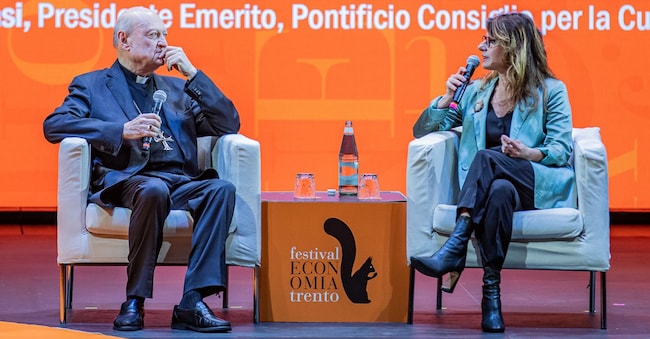
It begins and ends with two stirrings of the spirit, two breaths of lightness in an ocean of depth, the introductory speech of Monsignor Gianfranco Ravasi at the 20th edition of the Trento Festival of Economics. To begin with, the President Emeritus of the Pontifical College of Culture recalls that last year he had taken a final leave of absence from the Festival's prologues, in which he had been a protagonist for years. But, as Oscar Wilde said, much quoted by Ravasi, 'there is no other way to free oneself from a temptation than to succumb to it'. And Trent, the particular atmosphere generated by the reflections on man and the economy, on acting and deciding, as Ravasi reminded us, are a temptation too strong even for a theologian.
To conclude his speech, which went through the torments of today, and perhaps to induce the audience at the Social Theatre to a liberating smile, Monsignor Ravasi, surfing between St Augustine's Confessions and Julien Green, recalled that 'restless is our wandering', but as the English-born French writer said, 'as long as we are restless, we can be calm'.
In the midst of the two whispers, Cardinal Ravasi, stimulated by questions from Sole 24 Ore correspondent Lina Palmerini, reasoned on the spirit of our times, the difficulty of acting and deciding, the need for three 'I's much deeper than those in the programme of the first Berlusconi government (English, enterprise and information technology). Questioning, intelliging and interpreting, said Ravasi, are the keys to go beyond the simplification, banality and the obvious that plague politics and even the ecclesiastical hierarchies.
And yet we are at a time when humanity, as we saw at the triptych of Francis' solemn funeral, conclave and enthronement of Leo XIV, needs strong symbols, a landing place that goes beyond the everyday. Of big decisions, Ravasi suggested with simplicity. But, as Soren Kierkegaard quoted by Ravasi said, 'the ship is now in the hands of the ship's cook who announces over the megaphone what we will eat tomorrow'.
Without a compass and without a rudder. Only a minority convinced of great values can still be a thorn in the side of a society torn by war and the end of relationships. Gaza, said Ravasi, is a huge sacrifice of human flesh. War is the end of relationships, the overpowering of the 'I' over the 'we'. Religion has the task of recomposing.


