
Ray-Ban Meta and others: smart glasses design the future
From Meta's evolutions to the latest 'made in China' innovations, here is what is happening and the products to watch out for.

3' min read
3' min read
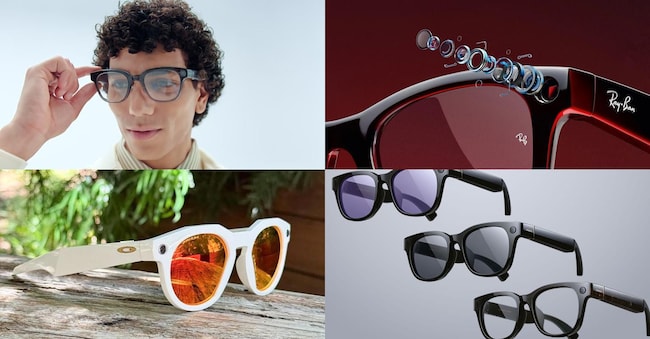
Are smart glasses a digital accessory that is changing our daily lives? Not yet. Or at least, they are for a fairly limited fringe of tech enthusiasts. Since the failure of the first Google Glasses (announced more than ten years ago), the situation has changed today and the demand for this type of wearable gadget seems to have reached a level of maturity that welcomes the new generation of smart glasses. Boosting the 'revolution' are products such as the Ray-Ban Meta, born thanks to the collaboration between Meta and EssilorLuxottica: in 2024, more than a million of them were sold worldwide and many indications suggest that deliveries by the end of the year could more than double. What makes these objects so popular? The combination of several factors: the familiar profile reminiscent of the traditional look of sunglasses and features such as a camera, microphone, transparent lenses with a filter to protect the eyes during video calls and (but here we are at the beginning) even a built-in voice assistant that answers questions or translates sentences spoken in an unknown language during a conversation. And then, as a recent survey by the comparison portal Trovaprezzi.it confirms, the price factor. The list costs of all four main models of the Ray-Ban Meta have recorded significant reductions compared to the launch price (that of the glossy black Wayfarer model, for example, has fallen by around 11% in 18 months, to reach EUR 264 in June), confirming the advantages of dynamic pricing systems. What do these figures tell us? That these 'devices' are no longer only intriguing to technology enthusiasts, but are becoming a candidate for a concrete alternative to ordinary glasses or tech accessories such as earphones and action cams, exploiting their versatility of use and opening up a new front in the battle between American BigTech and Asian tech giants.
Integrated displays and AI to do it all
.Mark Zuckerberg, the CEO of Meta, is convinced that artificial intelligence-enhanced glasses will relatively quickly become our main tool for digital communication and interaction, to the detriment of the smartphone. If, as the Facebook founder says, this transition process will take at least a decade, his company is as busy as ever working on the next evolutions of its own-brand smart glasses. The first 'new entry' is still linked to the partnership with EssilorLuxottica and concerns the Oakley Meta, glasses designed specifically for those who do sports, while the second looks even further ahead. Aria Gen 2 is an experimental intelligent eyewear that promises a breakthrough for AI that teaches machines to interact directly with the context: thanks to video cameras, motion sensors, GPS and microphones, in other words, these devices collect environmental data on what the person wearing them does and perceives in order to facilitate the design of new digital assistants capable of interacting perfectly with humans. More nebulous, on the other hand, are the horizons that currently surround Meta's latest creation, the Hypernova, which should integrate a small screen in the lens, through which to display notifications and directions and operate with real apps. 2027 should instead be the year of the 'Hypernova 2' with dual display and in this future, for the moment only imaginable, Google is also looking for space with the Android XR platform, whose internal codename ('Martha') is now known, and the design of the app for managing the glasses, with its options for notifications and settings, a function to record what the user sees and tools to provide feedback or report problems. And what about, finally, big rivals Samsung and Apple? The former, according to the latest rumours, is expected to announce its first smart glasses with a Qualcomm Snapdragon AR1 Gen 1 chip (the same one found in Meta's Ray-Bans) and Google Gemini by the end of the third quarter; BigG's artificial intelligence will be harnessed for people and gesture recognition, QR code scanning and payments. The Apple company, according to other rumours, is expected to unveil the first Apple Glasses with voice control, camera and AI-based environmental sensors in 2027, while models for Extended Reality with integrated display and based on Liquid Crystal on Silicon technology will be a year later. A new frontier, meanwhile, has already been reached: Alipay+ and Meizu have in fact completed the world's first payment via an electronic wallet directly from smart glasses (the Chinese manufacturer's StarV Snap) in Hong Kong, exploiting voice recognition technologies and QR code scanning. All this, needless to say, without the need for a smartphone.

