
Refounding the pact with young talent with more salary, welfare and trust
At the debate on Who chooses who in the labour market, organised with Aidp at the Trento Festival of Economics, the levers for attracting and retaining people in both the public and private sector

Key points
Greta Farina is 26 years old. She has been living in London for seven years. She chose King's college for her bachelor's degree and then moved to Cambridge for her master's. 'Things have changed a lot today with Brexit, but when I arrived, in 2019, I had public support to study at the best universities, I had the opportunity to do small part-time jobs to support myself and now I do research in a country where there is the analytical approach and support that research needs,' she says. He always thinks of Italia, 'it is my favourite country'.
If you ask her about return, however, no, that is a different story. There are many obstacles, the main ones, especially for a researcher like her, being 'precariousness and salary', as she told the Festival of Economics in Trento in which she wanted to participate by sending her application to the Call for ideas competition, the voices of tomorrow.
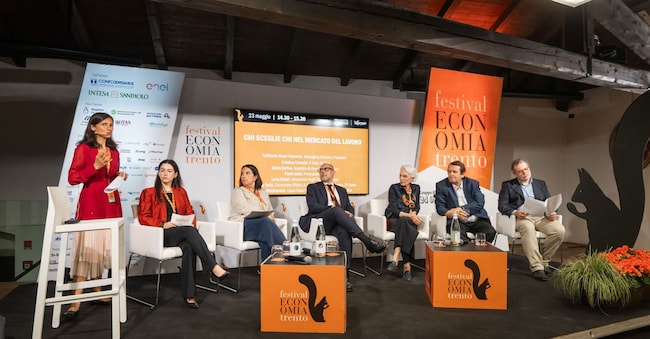
With her ideas, she was one of the winners and flew a week to Trento where she participated in the panel organised in collaboration with Aidp, entitled Chi sceglie chi nel mercato del lavoro (Who chooses who in the labour market), opened by Benedetta Dalbosco, president of the association of Trentino, Alto Adige and Sudtirol, who in the hall of the event at the Castello del Buonconsiglio wanted to explain how much this issue is felt today among personnel managers, in private companies as well as in the public sector with which the association collaborates.
The psychological pact cracked
The issue is very complex and the canonical tools are no longer sufficient to understand it. Paolo Iacci, scientific director of Aidp, president of Eca and lecturer at the State University of Milan, recalls that 'in April 2026, according to Unioncamere, the figures considered difficult to find were 44.6% of the total number of positions sought. However, reducing everything to a simple recruiting difficulty would be a mistake'. The truth, continues Iacci, is that 'the traditional psychological pact between worker and company has broken down. For decades the implicit exchange was clear: stability and belonging in exchange for loyalty and availability. Today, this balance has broken down and people are looking for meaning, quality of life, professional growth, while many companies continue to use cultural models of the past'.
The Value of Relationships
Professor Luca Solari, professor of business organisation at Milan's Università Statale and member of Aidp's scientific committee, considers the narrative of a labour market in which companies cannot find the right people because they lack the skills to be outdated. The numbers tell something more ambiguous: on the one hand there are the hard-to-find figures, on the other there is the phenomenon of over-educated workers that the new generations are no longer willing to accept. The result is that 'those who are better off, if they can, leave the country because it measures the investment they are making not only for the present, but for the future'. The psychological contract between companies and people, according to Solari, is broken on both sides. "More than 1.6 million under-35s have voluntarily resigned by 2024, 55% of young people say they want to leave within 2 years if they do not feel valued, candidate ghosting has increased by 400% in three years and it also affects companies symmetrically. We are facing an emptying of power on both fronts' and the way out 'is not economic, it is relational. The labour market is not a market, it is a relationship and needs time, freedom and trust, three resources that the Italia system struggles to offer'.

