Infrastructure

Metro 4 ready, Milan celebrates (but the spectre of costs is on the horizon)

All 21 stops of the 'blue line' connecting the city to Linate open: the Lombard capital now has five metro lines

by Sara Monaci

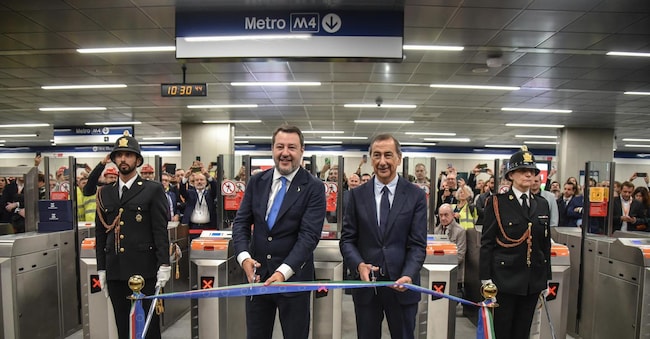
Matteo Salvini e Beppe Sala all’inaugurazione della linea metropolitana M4 alla stazione di San Cristoforo, Milano 12 Ottobre 2024 ANSA/MATTEO CORNER NPK

3' min read

3' min read

After more than eight years of work, various construction site slowdowns and a long debate on costs and benefits, Milan is opening its 'blue line', the fifth metro line: fifth from a chronological point of view, even though it is called Metro 4, because the initial project was older, but also more complex and expensive than the M5, which with Expo 2015 became a priority for event-related travel.

After having benefited from Expo-related funding, the Metro 4 will now be usable in all its 21 stops. For Milan, it really represents a turning point, since it connects the city to Linate airport, covering the southern part of the capital. The line starts at Linate airport, crosses the Cerchia dei Navigli until it reaches the Lorenteggio district, with its terminus at San Cristoforo.

Loading...
Milano, inaugurate le 13 nuove fermate M4: il taglio del nastro di Salvini e Sala

There will be a total of six stations where it will be possible to connect with the rest of Milan's transport system: with Fs it will be possible to interchange at Forlanini, Dateo and San Cristoforo; while with the other metro lines the connection is at San Babila with the red line, at Sforza Policlinico with the yellow line and at Sant'Ambrogio with the green line.

A total of 40 bi-directional, driverless trains with four intercommunicating boxes will run along the line. It is assumed that at full capacity, the line can reach 86 million passengers per year. Milan now has an underground network of 118 km.

Costs

However, this will not help the coffers of the municipality, which has a hefty bill to pay for the operation of Line 4 and the repayment of the infrastructure debt and a difficult annual budget to manage.

Suffice it to say that the share for the Municipality of Milan was worth 42.5 million in 2023; 60 million in 2024 and then rising to 100 million in 2025.

The expenditure grows progressively, according to a financial plan that started in 2015 and expires in 2045. It started at 10.43 million in 2015 and will peak at 174.18 million in 2034, a figure that will then fall again to between 100 and 120 million in the following years.

For some time now, therefore, the City of Milan has been the bearer of a demand felt by all cities but, not surprisingly, above all by Palazzo Marino: local transport must be given more support from the government and national taxation, say city leaders. In Milan, the ticket - the most expensive in Italy, rising to EUR 2.20 per ticket - does not even cover half of the service. The rest is taken care of by the municipality, one third of whose budget is spent on public transport.

The investment value for the new Blue Line, including financial charges, is EUR 3.461 billion, based on what was originally signed by the joint public-private company and the pool of banks that initiated the project.

For the past year, however, the company has changed skin: the municipality has bought the shares from the private developers, going into absolute majority, while the minority share of 31.5% is held by Atm, the municipal transport subsidiary. M4 is therefore back entirely in public hands, a choice that the council has defended as a desire to keep strategic sectors under municipal control. This decision also has a financial significance, because M4 will be able to renegotiate debts more easily and reduce interest by a few million.

History

The planning began during the years of mayor Letizia Moratti and was then inherited by Giuliano Pisapia in 2011, who decided to go ahead despite the opposition of some of his councillors. But the die was cast, Palazzo Marino's top management thought, and it was necessary to go ahead, despite the onerous cost to the City's coffers (3.5 billion spread over thirty years) and a project bordering on a conflict of interest (because the contracting station, the City, was also a shareholder of the company, the M4).

Ten years later, the first six stops open during the second term of Mayor Giuseppe Sala, who makes no secret of his concerns about the cost of public transport in the years to come.

The 'blue' provides for a strong integration with the other existing metro lines, the urban railway system, surface lines and, above all, the city airport. In fact, therefore, it fills a void that the city felt. That is why no one, of any political colour, wanted to question it despite justified concerns. But tomorrow is the day of celebration, nobody thinks about the costs, local and national politicians will come to cut the ribbons.

Copyright reserved ©

Brand connect

Loading...

Newsletter

Notizie e approfondimenti sugli avvenimenti politici, economici e finanziari.

Iscriviti