
Real-time translations: artificial intelligence learned languages
From headphones that whisper translated phrases in one ear to large language models that rewrite entire conversations in another language, machine translation has left the dictionaries and entered everyday life.

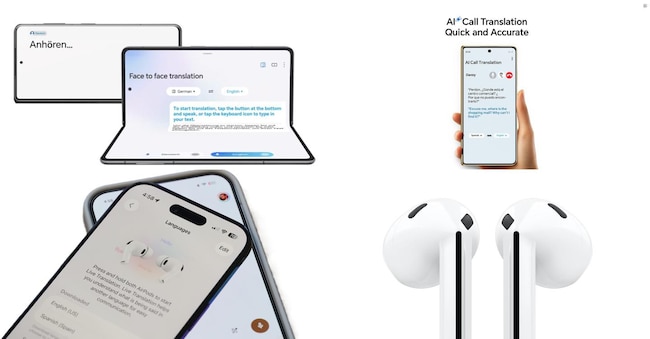
The contexts where this new 'ecosystem' finds application are many: a business call or a video call in a foreign language, but also a trip abroad or any occasion where one has to speak with an interlocutor who expresses himself in an idiom other than our own. Today, real time translations processed by artificial intelligence are accessible through a wide battery of tools, from commonly used devices such as headsets and smartphones to chatbots that we have all become very familiar with. A veritable ecosystem, in fact, that is breaking down language barriers, although to speak of perfection there is still some way to go. We are certainly not in the scenario imagined by Douglas Adams with his 'Babel fish', which makes it possible to understand any language in the galaxy, in short, but it is also true - and this is no small detail - that all the big tech names are playing in this field, from Google to Microsoft, from Meta to Apple, passing through the main Asian manufacturers. Let's take the Apple company: with the latest version of iOs, the Live Translation function has arrived on the AirPods and allows a face-to-face conversation to be translated in real time, listening to the translated voice directly into the earphones. All it takes is a gesture or a command to Siri and the invisible technology that Apple likes so much enters the scene once again by harnessing the capabilities of AI. Meta, for its part, has brought voice translation directly into second-generation Ray-Ban glasses, confirming the vision of an augmented reality that will free us from the canonical screens: the integrated intelligent assistant interprets what the user hears or says, returning the processed text via the device's mini-speakers or transcribing it into the Meta AI app. Another 'hot front' of AI-driven translations is that of messaging platforms, and here the most popular example is WhatsApp, where the transformation of entire conversations or individual messages occurs
on the user's device, respecting end-to-end encryption.
AI translation has thus become a structural feature of smartphones. Samsung paved the way by equipping its Galaxy phones (from the S24 series onwards) with simultaneous interpreters to handle face-to-face conversations and phone calls, Google responded with its Voice Translate integrated into the Pixel 10, which translates calls while preserving the original vocal timbre thanks to on-device processing, and Chinese companies such as Xiaomi, Oppo and especially Honor have taken the same path. With the Magic V5, Honor has integrated a complete large speech model on board the device to activate automatic translation directly from the phone, disconnecting from the cloud.
The BigTech game is also open on the collaboration platforms used by companies and professionals, with Google Meet and Microsoft Teams exploiting proprietary AI agents or third-party software to ensure simultaneous translation with synthetic voice and make these tools increasingly useful and functional in meetings and business contexts. Interesting, in this perspective, is the latest 'gimmick' of the German company DeepL, i.e. DeepL Voice, a technology (already integrated in Teams and Zoom Meetings) that allows one to speak in one's own language during a call by showing translated subtitles in real time to the other participants and translating live dialogues via smartphone. Finally, the latest announcements by Google itself and OpenAI have brought attention back to chatbots and generative artificial intelligence models. With ChatGPT Translate, OpenAI inserts machine translation into its galaxy of services and does so with a distinctive element: the literally translated text is a starting point for reworking the output according to the context, transforming it into 'tailor-made' content. TranslateGemma, on the other hand, is Google's latest offensive: not a consumer service 'tout court' but a family of 'open-weight' models (of which pre-trained weights are released to be downloaded and executed locally in a customised manner) designed for developers and researchers and built on Gemma 3, available in three sizes (4, 12 and 27 billion parameters) and capable of translating up to 55 languages. The two-stage training of these models aims at more natural and contextual translations, but what makes the announcement important, arguably, is BigG's willingness to take the challenge on translation tools to the infrastructure level.

