
Reality and new eyes for 'Zandò' and Degas
The exhibition explains how Zandomeneghi inserted himself into the Parisian avant-garde without distorting himself and contributed to redefining modernity

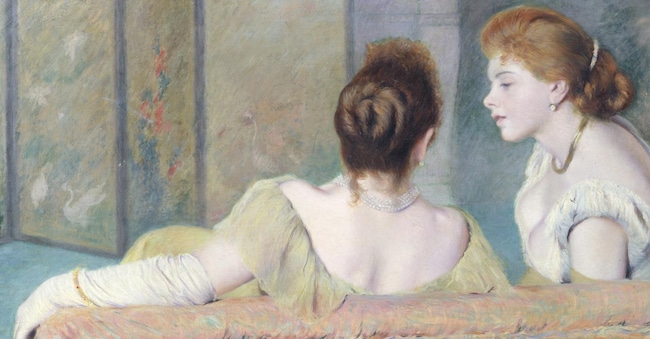
Modern studies on the Venetian Federico Zandomeneghi began one hundred years ago by the Milanese critic Enrico Piceni, and over the decades have rediscovered his role as a bridge between the world of the Macchiaioli and that of the Impressionists, arriving with the 2016 exhibition in Padua curated by Fernando Mazzocca and myself, to refer to Zandò as the only Italian who could properly define himself as an "Impressionist". However, this remarkable critical achievement seems insufficient in relation to the real value of the great painter, considering that one can be considered a worthy but second-rate Impressionist, or an "emulator" of another, much better-known artist.
The antidote can only be dialogue, i.e. to set up opportunities for international comparison and reflection, and this is the intention behind the current exhibition in Rovigo (with the fundamental contribution of the Musée d'Orsay, the Uffizi, Palazzo Te and other important European institutions). The relationship with the "terrible Mentor", Degas, is the chosen key to interpretation, and the exhibition at Palazzo Roverella, "Zandomeneghi and Degas. Impressionism between Florence and Paris', with its unprecedented slant, wants to organically evoke a relationship that was at once artistic, human and strategic. And it wants to focus on a crucial node: how an Italian artist of the 19th century fits into the heart of the Parisian avant-garde without losing his own identity and indeed contributing to redefining the modern outlook. One of the first prejudices debunked by the exhibition concerns Degas himself: it has long been claimed that there was no contact between the young Frenchman and the nascent Macchiaioli movement at the time of his formative trip to Italia (1856-59), which is reasonably impossible when one considers that Degas matured in the path of realism (as opposed to that of his companion from his Italian years, the symbolist Gustave Moreau) precisely in Florence, where he painted the Portrait of the Bellelli family. The picture of Degas' Florentine relations evoked by the exhibition proves decisive in understanding the understanding born many years later in Paris between Degas and Zandomeneghi, who came from the Macchiaiolo milieu. Degas' youthful masterpieces dialogue with those of Puccinelli and Ciseri, exponents of Tuscan purism, devoted to the lesson of the great Ingres. Degas closely observed the 'macchia' the technique pioneered by the young Tuscans. The synthetic, soft drafting, made of wide backgrounds of the pastel Studio per la famiglia Bellelli exhibited for the first time in Italia appears indeed very close to the sensitivity of the nascent Macchiaioli, but the en plein air study of the effects of light and chiaroscuro that is the main aim of the Tuscans did not interest Degas, who loved the interior setting and set himself the goal of achieving a perfect and refined formal language, exemplified by the antique, but capable of proposing contemporary contents. The exhibition reveals how methodological similarities with Degas can be found in the Tuscans' most thoughtful works: in Red Shirts Sewers (1863) Borrani introduces us to an interior where a group of women sew the uniforms of Garibaldi's men; it is not a family portrait, but the portrait of a historical moment observed from the point of view of a social group aware of writing a page of civilisation. The comparison with Borrani, Fattori and Boldini for the first time clarifies a hitherto neglected aspect: Degas was not born an Impressionist. His interest in contemporary life was also formed in Italia, within a figurative culture attentive to truth, structure and psychological tension. By the time Degas ended his stay in Italia in April 1859, Zandomeneghi had already rejected his family's vocation, devoted to sculpture and Canova, by choosing painting and becoming involved in the Risorgimento struggles. Exiled after Villafranca, Federico completed his studies at Brera and joined the Macchiaioli movement in Florence, with whom he shared their artistic ideology for more than a decade. He then moved to Paris in 1874 where Zandò and Degas finally met in 1877: what they had in common was their particular understanding of the term 'Impressionism', a term that Degas disliked, as he felt himself to be a 'realist', i.e. a painter of reality, no more and no less than Zandò. The role of mentor played by Degas in favour of the Venetian was fundamental at the moment of the Italian's conversion to the nouvelle peinture; after that, being with Degas or rather "on Degas' side" was in fact only a choice of field carried out coherently by our Venetian, within the different alignments of which the French movement was composed. From 1879, the Italian took part in the group's exhibitions and in the following decade the dialogue with Degas became even more intense. In Al café and in Al café Nouvelle Athènes Zandò expresses his utmost adherence to Impressionism (as in Mother and Daughter and in Visita in camerino). The venue represented is the famous place Pigalle where Degas' Wormwood is also set, and the unprecedented juxtaposition of these three masterpieces is an added value of the exhibition in Rovigo: the off-centre framing of the canvas is typical of the Degasian approach to reality, a snapshot approach that in the case of the Frenchman is functional in highlighting the brutalisation of the two protagonists and their social marginality; while Zandò approaches the characters with curiosity, finding them serene and participating in their carefree attitude.
In the focuses devoted to the theme of the female nude and dance (the borrowing of the Little Dancer fourteen years old, from the Dresden Albertinum, is exceptional), the divergence between the Frenchman's almost cruel vision and Zandò's affectionate naturalism emerges. During the 1990s, the Italian matured a pacified vision of the themes dear to Impressionism, devoting himself above all to colour research that led him to enhance the Venetian palette of his origins. He thus gave life to a repertoire of great refinement and elegance of which Sul divano and Mattinata musicale are emblematic. They both died in 1917, at the height of the Great War.
THE EXHIBITION AT ROVERELLA PALACE
Until 28 June 2026 Palazzo Roverella in Rovigo hosts the exhibition "Zandomeneghi and Degas. Impressionism between Florence and Paris", curated by Francesca Dini and promoted by the Fondazione Cassa di Risparmio di Padova e Rovigo, in collaboration with the Municipality of Rovigo and the Accademia dei Concordi, with the support of Intesa Sanpaolo, and produced by Silvana Editoriale (catalogue pp. 208, € 32).

