
Recycled plastic drums, so innovation helps the environment
Carlsberg's Draughtmaster system has overtaken a model that has remained unchanged for 50 years

2' min read
2' min read
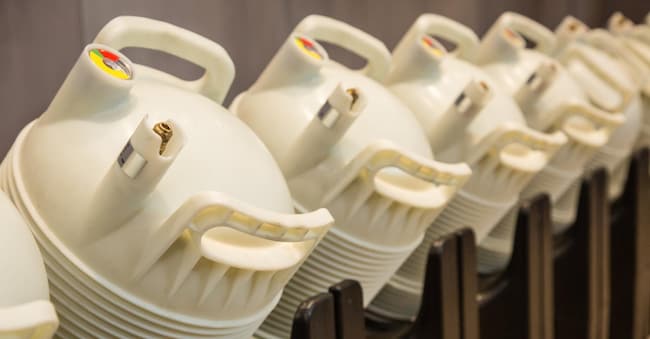
W hen Carlsberg Italy launched DraughtMaster in 2011, Italy was the pilot country of a silent revolution: turning beer tapping into a laboratory of sustainability. "With DraughtMaster we have redefined the standards of draught beer, integrating innovation, sustainability and quality in a virtuous way," explains Serena Savoca, Marketing & Corporate Affairs Director of Carlsberg Italia. Instead of traditional steel kegs, the Danish multinational has in fact introduced Pet containers that do not require CO₂ addition, keeping beer fresh for up to a month. A change that has affected both responsible consumption - less product waste - and environmental impact, thanks to a significant reduction in emissions along the entire logistics chain.
The system has thus overtaken a model that had remained unchanged for over fifty years. Pet kegs, from 2024 half of which will be made of rPet - recycled and recyclable plastic - require no CO₂ addition, are 43% lighter than steel and guarantee freshness for up to 30 days, compared to five days for conventional containers. More compact and easy to replace, they allow efficient tapping down to the last drop, reducing waste and simplifying the work of retailers. The environmental impact, Savoca explains, is measured through life cycle analysis and summarised by the 'Tree Clock': every 60 litres tapped avoids 25 kg of CO₂, equal to the annual absorption of one tree. "Today, 97% of the keg beer distributed by Carlsberg Italy uses this technology.
The path of innovation and sustainability for Carlsberg also continued with EXTRA10, a new 10-litre system introduced in 2024 after more than three years of research and EUR 15 million of investment. Designed for smaller bars and restaurants, it extends the environmental benefits to low-consumption venues.
Attention to the environment, however, Savoca points out, does not only concern industrial processes. Between 2021 and 2023, with the Take Back - Give Back project, Carlsberg involved Milan in a circular economy experiment: spent drums, collected from selected customers, were transformed into street furniture together with students from the Milan Polytechnic in order to donate them to the community in the Bovisa district. The project contributed to recovering 3,657 kg of plastic, reducing CO₂ emissions by 90% in the final stage of furniture production," explains Savoca, emphasising how this result is part of the group's broader ESG strategy, which aims at zero packaging waste and zero emissions. "This project," he concludes, "has supported us in demonstrating that it is possible to transform waste into a resource, generating tangible benefits for the territory and strengthening ties with local communities.

