
Redesigning cities by blending nature and technology
Architect Fusco: “The horizon is a regenerative habitat in which the human species and other forms of life thrive in symbiosis”

Key points
In the beginning, there were caves. Today we live in the cities of the Global Village, inhabiting a world of ‘absent nature’ in the age of AI. We need environmental projects and solutions for urban and human regeneration, writes Alfredo Fusco, architect, biophilic designer and lecturer, in *Abitare la Natura* (Maggioli Editore, €36): ‘Today, the relationship between humankind and the environment is marked by a heart-wrenching paradox: never before has collective ecological awareness been so keen, and yet never before has humankind been so physically cut off from the natural world.’
‘We are the Indoor Generation,’ says Fusco: ‘Nature has been reduced from a primary experience to a mere backdrop, replaced by the illusion of perpetual connection offered by the internet.’ It is a genuine deficit of Nature: ‘which weakens cognitive functions, increases stress and erodes our mental and physical balance. And yet, a reconnection is taking place.”
Human beings are Nature
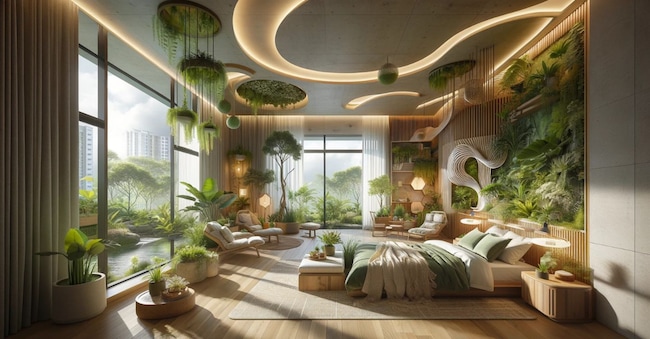
The concepts of biophilic design refer to biophilia, a term coined by the biologist Edward O. Wilson: ‘Human beings are part of Nature. This is why biophilic design, before becoming a technique or a form, is a shift in mindset, a re-evaluation of our place in the world, shifting from a self-referential ‘I’ to an ecological and interdependent ‘we’, extended to the entire biotic community – because, he continues, ‘disconnection from Nature is a recent anomaly’.” Thus, introducing ‘compensatory biophilic elements’ into cities: ‘This is the crucial challenge of our century: by 2050, 7 out of 10 people will live in urban areas. The turning point lies in ceasing to view the city as an inert machine of tarmac and concrete, and reimagining it as a living organism that breathes, absorbs water and regulates its own temperature.
At an individual level, biophilic compensatory measures – vertical gardens, roof gardens, green walls – may seem insignificant, but when multiplied across thousands of homes, they become the capillaries of an urban ecological network. On a collective scale, we need green roofs and walls, ecological corridors and metropolitan reforestation, in accordance with guiding principles such as Konijnendijk’s 3-30-300 rule, that is to say, every city dweller should be able to see three trees from their window, live in a neighbourhood with 30 per cent tree cover, and have access to a park or a forest within 300 metres of their home or workplace.
Turning biophilic patterns into requirements
According to Fusco, it is also necessary to ‘restore permeable ground: I am thinking of the removal of paving, an initiative pioneered by Genoa; breaking up the tarmac so that the earth can breathe again, thereby mitigating heat islands and soil instability’. However, the author warns: “The way forward is through regulation: transforming biophilic patterns into requirements, as demonstrated by Berlin’s Biotope Area Factor or Singapore’s Landscape Replacement Policy, which is based on the principle of ‘no net loss’. The ultimate goal is not to compensate for the deficit in nature, but to go beyond it.”

