
The rediscovered greatness of Giovanni Pisano
The exhibition at the Palazzo dell'Opera reconstructs the history and magnificence of the Pergamon, dated 1310, dispersed and reassembled a hundred years ago in the cathedral

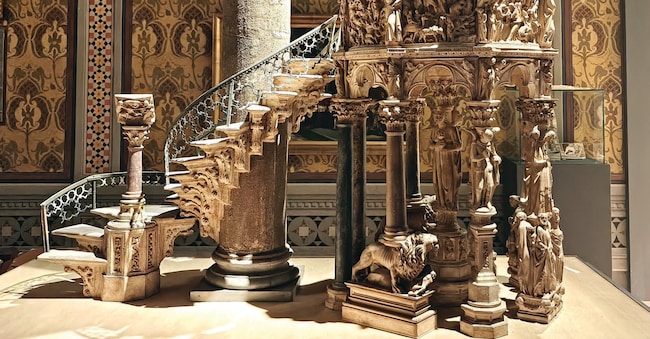
"Nemo propheta in patria'. Not even that Giovanni Pisano who gave his word to the marbles of the Piazza dei Miracoli. The exhibition 'Giovanni Pisano. Memoria di uno scultore', organised by the Opera della Primaziale Pisana, is not a monographic exhibition. It goes many steps further, in the sign of archival research and traces the fortune that followed decades of obscurity, the dispersion of works, the often barely legible overlap with the masterpieces of his father Nicola, and the critical rediscovery between the 19th and 20th centuries, and celebrates the 100th anniversary (1926-2026) of the relocation of Giovanni Pisano's pulpit in Pisa Cathedral.
Giovanni completed the pulpit by 1310 and was so self-aware that he engraved these words on the marble: 'Sculpting beautiful works in stone, wood, gold, ugly things he could not have sculpted even if he had wanted to'. These can still be read today on the masterpiece in the Cathedral, reassembled in 1926 at the behest of Cardinal Pietro Maffi. But, between 1311 and 1926, six centuries of shadows, dismemberments, oblivion, until the blossoming of interest in the 19th century. In October 1595, when Pisa Cathedral suffered a serious fire, Giovanni Pisano was evidently no longer in fashion. The ambo was dismembered into dozens of pieces that became holy water stoups, decorations for the counter façade of the Duomo, leafy corbels, steps and supports for new liturgical furnishings. With the pulpit, Giovanni Pisano's greatness fades away, gradually re-emerging thanks to the passion of Carlo Lasinio (1759-1838), head of the Pisa Cemetery and the creator of the collection of many of those fragments in the cemetery area. Leaning against the walls, fragments of columns and statues lie anonymous but strike travellers and artists who come to Pisa and appreciate their uniqueness. Thus, the artist, always referred to as Nicola's son, becomes Giovanni again, with his personality, his art. At the beginning of the 19th century, Jean-Auguste-Dominique Ingres drew elements of the pulpit, Paul Delaroche included the sculptor - and not his father - in the painting decorating the hemicycle of the aula magna of the École des Beaux-Arts in Paris (1836-1841) and also featured in the exhibition. Giovanni was rediscovered, found the light again and Salvino Salvini dedicated a monument to him in the Camposanto in 1875, later moved to Piazza San Sisto and blown up there by American soldiers in 1945. Only a stump remains, which curators Donata Levi and Emanuele Pellegrini have chosen as the opening of the exhibition itinerary. It is a headless torso, but it is evidence of the fame that returns in travellers' notebooks and artists' drawings. And of the desire to find the fragments of Giovanni Pisano's pergamum in order to recompose it. In 1870, John Ruskin bought three sculptures, attributed to Nicholas, on the Florentine antiques market and used them to furnish the dining room of his home in Brantwood, near Birmingham. What he called 'Dante marbles' were sold at his death to the Metropolitan Museum in New York in 1910 and 1921. Now, after more than a century, those three pieces that scientists assign to Giovanni's pergamum are returning to Pisa. The emotion is endless in front of the two small pillars with Angels playing the tuba. It is an angelic melody, that polished marble from the 14th century that comes down to us to remind us of the divine hand of John who sculpted them. Equally touching is the so-called Tetramorph, the pillar with the symbols of the evangelists (they are represented in threes, because John is in the lectern), placed under the lectern itself.
Leaving this room, the exhibition unfolds through the history of artists such as Lodovico Pogliaghi, who at the beginning of the 20th century studied Giovanni in order to renovate the cathedral, or Giuseppe Fontana, who, amidst notes, sketches and drawings, proposed an ebony and plaster pulpit, or Giovanni Franchi, who made a plaster version for the South Kensington Museum in London (today Victoria & Albert). Eventually, after a thousand discussions, in 1926 the reassembled pulpit returned to the Duomo, where we admire it today, but Giovanni's intense vibrancy does not stop between the naves. Marino Marini appreciates him; Henry Moore adores him unconditionally: 'If I were asked to choose ten great artists, the greatest of European art, I would put Giovanni Pisano among them'. Which is revealed in this courageous exhibition (how much easier it would have been to set up a monograph) and in the rooms of the Museo dell'Opera, where the polished white is ascended to heaven, in particular, in that small Madonna and Child inlaid in ivory.
Giovanni Pisano. Memory of a sculptor, edited by Donata Levi and Emanuele Pellegrini, Pisa, Palazzo dell'Opera del Duomo, Until 8 March 2026. Pacini catalogue, pp. 406, € 38


