
Rediscovering Jules Massenet’s ‘Roma’
Directed by Diego Ceretta, it will be performed in Monte Carlo at the Auditorium Ranieri III (26 September) and in Paris at the Théâtre des Champs-Élysées (28 September)

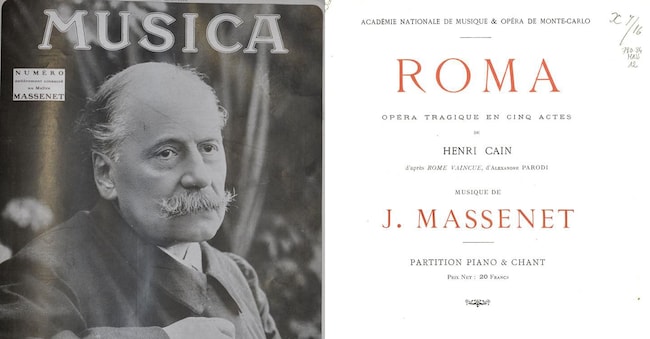
Jules Massenet’s final opera, ‘Roma’: it has been rediscovered by the commendable and ever-vibrant Palazzetto Bru Zane in Venice, which has enthusiastically enlisted both the Monte-Carlo Philharmonic and the Radio France Choir in this revival, thereby forging a cultural link between the southern Riviera and Paris.
For a week, in the Ranieri III Auditorium – overlooking the sea, right in front of the Casino – Diego Ceretta meticulously oversees the rehearsals of this score, which is concise yet grand in tone. ‘Intentional’ is the title of a retrospective that recounts the composer’s farewell to the stage – an icon of French Romanticism: ill and at the end of his journey, he too clings to the lifeboat of classicism. And he crafts a gem of a tragic opera, in which, across the traditional five acts – yet in just over two hours – forbidden loves and clashes of familial affections resonate. Whilst the homeland lay under siege and the Empire of 216 BC, besieged by Hannibal, mirrored the contemporary situation of France under threat from Germany.
Monte Carlo
‘Rome’ had premiered in Monte Carlo in 1912. He was seventy years old, and was to die that same year, Massenet undertook the arduous journey from Paris to reach the vibrant cradle of the Belle Époque, then a world away from today’s frenetic property speculation, not to mention the gathering of yachts seen these days, racing for height, as menacing as a naval fleet. Their packed show can be seen through the windows overlooking the harbour of the new Monegasque Auditorium. But all this is left behind as soon as one enters the intense working atmosphere of the recording rehearsals: following the two live performances (on Saturday afternoon here and on Monday evening in Paris, at the Théâtre des Champs-Élysées) ‘Roma’ will become a new CD volume in the Palazzetto Bru Zane’s series of rare recordings, a unique project dedicated to the study of France’s Romantic heritage and an absolute benchmark in the field.
What is particularly noteworthy here is the decision to entrust the conducting of Massenet’s late works to the young Diego Ceretta, not yet thirty, whose meticulous interpretation and technically assured conducting style see him at the helm of the professional Monte-Carlo Philharmonic and a fine cast, in which the voice of Rachel Willis-Sørensen stands out – a soprano with a full-bodied tone yet still incredibly bright and radiant. The role of Fausta—a Roman vestal virgin who (not particularly originally) breaks her vow of chastity for love—suits her perfectly. This time, however, the threat does not come from an enemy, as in the much earlier *Norma*. Yet the gods take offence and ominous signs rain down from the heavens: Hannibal’s advance is entirely the fault of the unfaithful woman. She is to be punished, buried alive. Neither the defence of her uncle Fabius Maximus – the eloquent Greek baritone Tassis Christoyannis – nor the weeping of her mother-grandmother (Caïn’s libretto remains ambiguous) – the mezzo-soprano Julie Robard-Gendre, with her fine lower register – will be of any use. To save her from death by suffocation—the fate befitting traitors, in the tradition of Radames in *Aida*—her mother hands her a dagger. But the young woman’s hands are bound. And were she unbound, she would certainly flee, given her resolute nature: shortly before, she had sung with great pride, ‘I burn with such a guilty and triumphant love’. So it is better to kill her and then kill herself. The end.
An old-fashioned orchestra, with its many Wagnerian echoes, comments on futile heroism: the elderly Massenet sensed the 19th century slipping away; he foresaw that the bucolic fanfares of the horns would soon be replaced by quite different sounds, for the signs of the First World War were knocking at the door. All that remained was to frame, within an Arcadian garden, the beauty of true feelings – those entrusted to the tenor in an aria of heart-rending beauty: here it is not Werther who yearns to remain in the world of dreams, but a Lentulus (a rather unpromising name, much like Bellini’s Pollione) who imagines meeting her. It is in this vision—in a reality that will never come to pass—that the most moving moment of *Roma* lies. Jean-François Borras distils it with beautiful phrasing, soaring to the high notes on the wings of the woodwinds, with a piccolo that carries him even higher into the heavens. The Maestro certainly knew how to orchestrate – adhering not only to the rules of the manuals, but even more so to those of the heart.

